Matters of Matter
The "Sub"
Way
Way
Atomic History Museum
Nucleus & Isotopes
Configuration Station
Final Jeopardy
100
Anything that has mass and takes up space is the definition of this.
What is Matter?
100
This subatomic particle has a positive charge of +1.
What is a proton?
100
This scientist's "Plum Pudding" model suggested that an atom was a positive "pudding" with negative electrons scattered like plums.
Who is J.J. Thomson?
100
These are atoms of the same element that have the same number of protons but a different number of neutrons.
What are isotopes?
100
In the Bohr Model, this is the maximum number of electrons that the first energy level (shell) can hold.
What is 2?
200
This is the phase change that occurs when a gas turns directly into a solid.
What is deposition?
200
These two subatomic particles are located inside the nucleus of an atom.
What are protons and neutrons?
200
This atomic model, created in 1913, suggests that electrons travel in circular energy levels like planets orbiting the sun.
What is the Bohr Model?
200
This is the total number of protons and neutrons in the nucleus, also known as "nucleons".
What is the Mass Number?
200
This is the specific name for the outermost shell of an atom where valence electrons are found.
What is the valence shell?
300
This is the phase change that occurs when a solid turns directly into a gas, like dry ice.
What is sublimation?
300
This subatomic particle has "negligible" mass and is found outside the nucleus.
What is an electron?
300
Ernest Rutherford’s Scattering Experiment led to the discovery that the atom is mostly made of this.
What is empty space?
300
Protons are all positively charged and should repel each other; this short-ranged force is what actually keeps the nucleus together.
What is the Strong Nuclear Force?
300
This simplified diagram uses the element's symbol and dots to represent its valence electrons.
What is a Lewis Dot Structure?
400
According to the slideshow, chemistry is the identification, investigation, and _______________ of matter.
What are interactions?
400
To calculate the number of neutrons in an atom, you must subtract the Atomic Number from this value.
What is the Mass Number?
400
Rutherford also discovered that the center of the atom (the nucleus) has this specific electrical charge.
What is a positive charge?
400
Atomic mass on the Periodic Table is not a whole number because it is this kind of "average" of all naturally occurring isotopes.
What is a weighted average?
400
Using your Periodic Table, identify the electron configuration for an atom of Magnesium (Mg).
What is 2-8-2?
500
Use the diagram provided to identify the two phase changes that occur between the Liquid and Gas states.
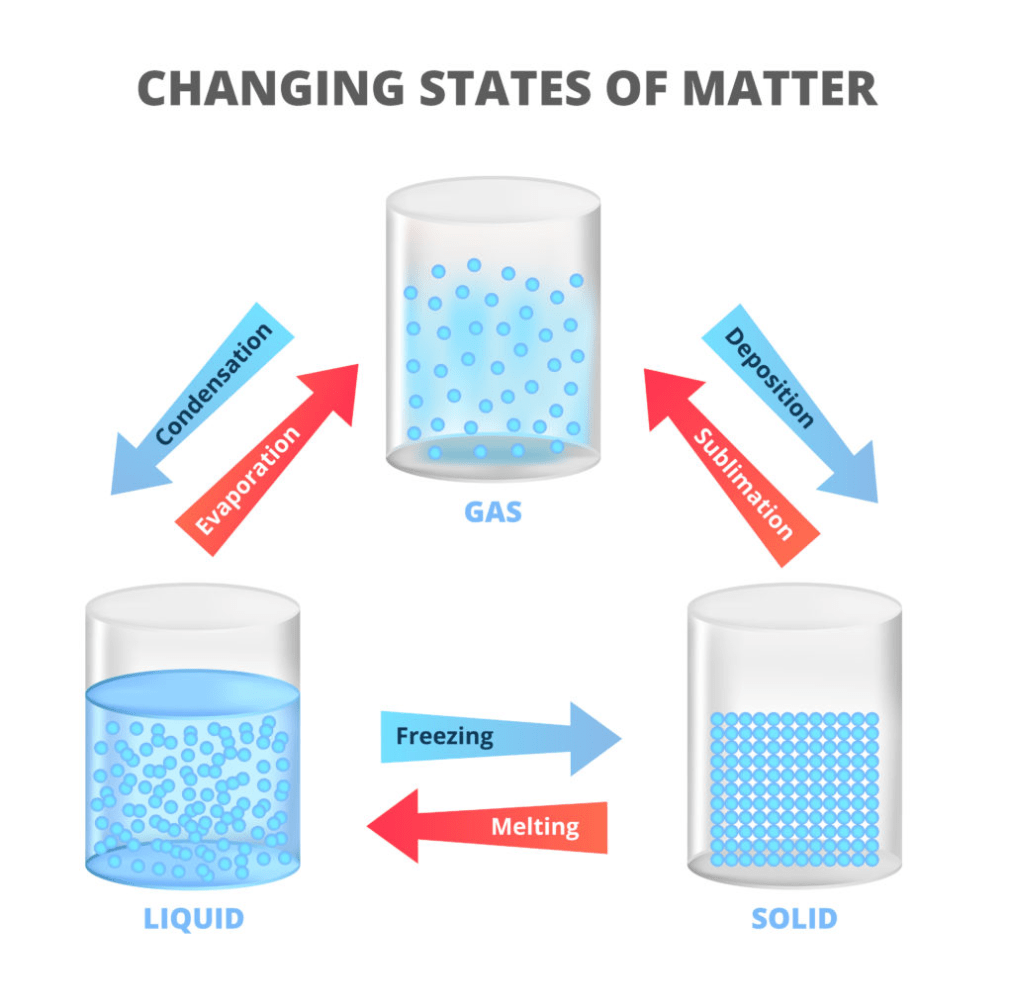
What are evaporation (liquid to gas) and condensation (gas to liquid)?
500
If an atom of Boron has a mass number of 11, identify the number of protons, neutrons, and electrons it contains.
What are 5 protons, 6 neutrons, and 5 electrons?
500
This is the primary difference between how electrons are placed in the Rutherford Model versus the Bohr Model
What is electrons roam randomly (Rutherford) vs. electrons are in orbiting/circular energy levels (Bohr)?
500
Using the formula from the slides, calculate the atomic mass of an element if 75% of its atoms have a mass of 35 amu and 25% have a mass of 37 amu.
What is 35.5 amu? ((35 * 0.75) + (37 * 0.25))
500
When drawing a Lewis Dot structure, you should not pair electrons until after you have completed this.
What is the first cycle (or "the first four dots")?
500
An unknown element has two naturally occurring isotopes. Isotope A has a mass of 10.01 amu and an abundance of 19.9%. Isotope B has a mass of 11.01 amu and an abundance of 80.1%.
Calculate the weighted atomic mass.
Identify the element using your NYS Reference Table.
Explain why the nucleus of this element does not fly apart despite containing multiple protons.
10.81 amu (Calculation: (10.01 x 0.199) + (11.01 x 0.801) ~ 1.99 + 8.82 = 10.81).
2. Boron (B).
3. The Strong Nuclear Force is a short-ranged attractive force that is much stronger than the electrical repulsion between the positive protons.