Articles of Confederation
BOR / Articles
Consitution
Vocab
Federalist v Antifederalist
100
What was the Articles of Confederation
The AOC was America's first attempt at government. It was set up in 1781 after the American Revolution. It gave a lot of power to individual states
100
What was the main idea of the 1st Amendment?
Freedom of speech, freedom of the press
100
What are the 3 SECTIONS of the Constitution
Preamble, Articles, Amendments
100
Explain the concept of federalism and how it relates to the division of powers between state and federal governments.
Federalism is a system of government in which power is shared between federal and state governments. They have unique responsibilities and powers and some overlapping powers
100
Which of these two groups wanted a stronger central government?
Federalist
200
Name one weakness with the Articles of Confederation
No central power, no ability to tax, raise a military, no national currency, couldn't regulate interstate commerce, no national court system, too hard to pass laws with state voting system
200
What is the Bill of Rights?
1st ten amendments added to the Constitution, protects individual liberties
200
Explain the Virginia plan and its stance on representation in Congress?
The Virginia plan wanted representation to be based on population being a larger state.
200
Explain the difference between ratification and amendments
Amendments are the changes to the constitution. Ratification is the process of approving these changes.
200
Which of these two groups wanted a stronger state government?
Antifederalist
300
Under the Articles of Confederation, who had the power to coin money and regulate its value?
The states all coined their own money and decided their own currency
300
What does Article 5 of the Constitution describe?
5 The process of how to amend the constitution
300
What does the 2nd article in the Constitution set up?
Executive branch - powers of the president
300
Give an examples of an issue that falls under concurrent powers?
Taxing, enforcing laws, creating laws
300
Which of these two groups wanted to add the bill of rights to the Constitution? Be able to explain why
Antifederalist, because they wanted to protect personal liberties and thought if it wasn't written in the constitution it couldn't be absolutely protected by the federal government
400
Which event in American History exposed the weaknesses in the Articles of Confederation? Explain what happened
Shays' Rebellion was a protest by debt-ridden farmers in Massachusetts in 1786-1787 against high taxes and oppressive economic conditions, highlighting the weaknesses of the Articles of Confederation.
400
What did articles 6 set up?
6 The ideas of Federalism (Shared powers between the central and state governments), Hierarchy of laws (which law do I obey when two laws conflict with one another)
400
What does the 1st and 3rd articles in the Constitution set up?
Legislative branch, and the judicial branch
400
Which powers are reserved for the states according to the Tenth Amendment of the U.S. Constitution?
Any that are not explicitly given to the federal government in the constitution
400
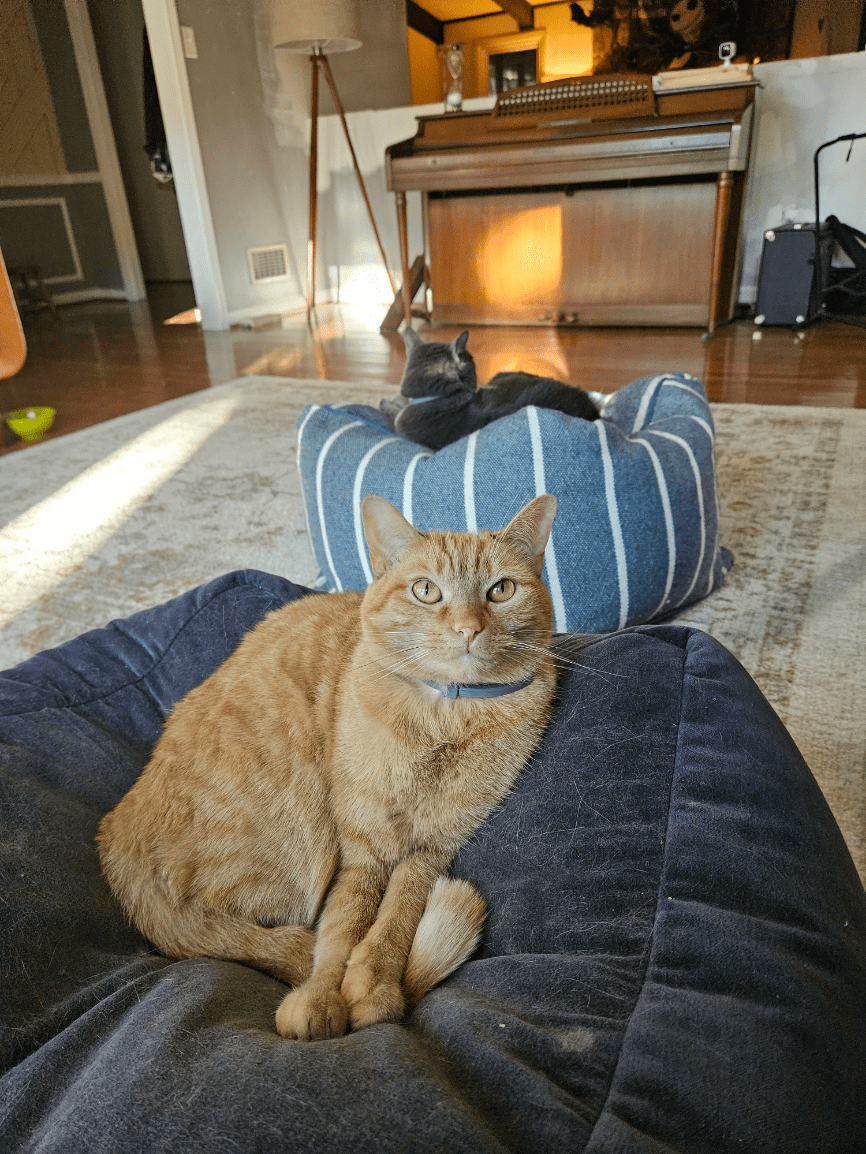 What are the names of Coach V's cats?
Roxie - orange and Abner - Grey
500
Name 3 weaknesses with the Articles of Confederation
No central power, no ability to tax, raise a military, no national currency, couldn't regulate interstate commerce, no national court system, too hard to pass laws with state voting system
500
What does articles 4 and 7 set up in the government?
4 - sets up relations between states, makes sure that states treat each other fairly
7 - the process of ratifying of the Constitution
500
Describe the New Jersey plan and its stance on representation in Congress
NJ plan wanted equal representation being a smaller state. They thought they could have a legislative branch with equal representation from each state
500
Explain the difference between separation of powers and checks and balances
Separation of powers refers to the divison of government into different branches, checks and balances refers to the power that each of these branches has to regulate the power of the other branches
500
Give one reason that Federalist wanted what they wanted and one reason antifederalist wanted what they wanted
Federalist - thought strong central government would unify the states, weak government might lead to chaos and division, better for wartimes to be under a central leadership, better when being represented to other countries
Antifederalist - feared strong central government would threaten individual liberties and states rights, could lead to dictator, and that local governments would know citizens best