Regular Verbs
Nouns and Adjectives
Numbers and Telling Time
Irregular Verbs
Questions and Negations
1
What are the -ER verb endings for the subject pronouns?
je nous
tu vous
il/elle ils/elles
e ons
es ez
e ent
1
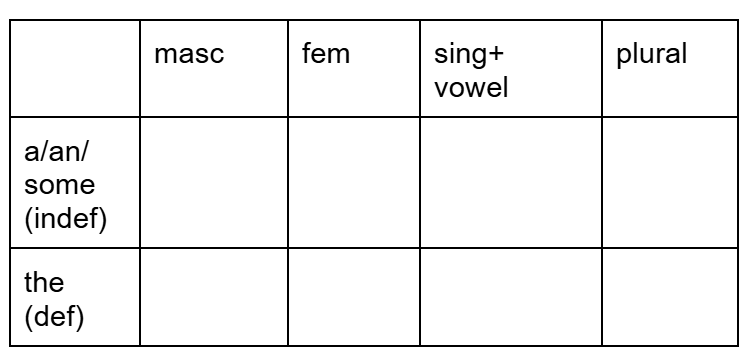
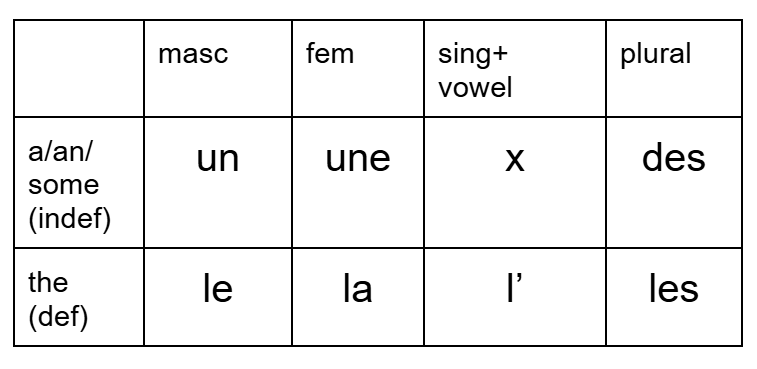
All nouns have an indefinite article (a/an/some) or a definite article (the). Write the corresponding articles.
1
Il est une heure moins le quart.=
Il est quatre heures.=
Il est sept heures et demie.=
12:45
4:00
7:30
1
to be=
to have=
to do/make=
to go=
to be=être
to have=avoir
to do/make=faire
to go=aller
1
1. à quelle heure=
2. combien de=
3. pourquoi=
4. où=
5. quand=
1. à quelle heure= at what time
2. combien de= how much/many
3. pourquoi= why
4. où= where
5. quand=when
2
What are the -RE endings for regular -RE verbs for all subject pronouns?
je tu il/elle nous vous ils/elles
s ons
s ez
__ ent
2
opposite of facile=
opposite of utile=
difficile
inutile
2
Write out the digits:
1. trente-sept + cinquante-six=
2. quatre-vingt-quatorze + onze=
3. quarante-deux + treize=
1. 93
2. 105
3. 55
2
to drink=
to drive=
to put/put on/place=
to laugh=
to drink= boire
to drive= conduire
to put/put on/place=mettre
to laugh=rire
2
Which interrogative expressions would result in the following answers.
1. J'étudie le français, parce que je veux voyager en France.
2. Elle mange à la cantine.
3. Nous arrivons à sept heures et demie.
1. Pourquoi
2. Où
3. À quelle heure/Quand
3
What are the -IR endings for regular -IR verbs for all subject pronouns?
je tu il/elle nous vous ils/elles
is, is, it, issons, issez, issent
3
Identify 3 of the following words:
1. busy 2. polite 3. German 4. Japanese
5. pleasant 6. friendly
1. busy: occupé 2. polite: poli
3. German: allemand 4. Japanese: japonais
5. pleasant: agréable 6. friendly: amical
3
What do midi and minuit refer to in the sentences below?
Il est midi.=
Il est minuit.=
noon
midnight
3
Expressions with avoir: Identify 3 of the following
1. avoir raison 2. avoir besoin de 3. avoir envie de
4. avoir faim 5. avoir soif 6. avoir chaud
7. avoir froid
1. avoir raison: to be right 6.avoir chaud:to be hot
2. avoir besoin de: to need 7.avoir froid:to becold
3. avoir envie de: to feel like
4. avoir faim: to be hungry
5. avoir soif: to be thirsty
3
Turn the following questions using "est-ce que" into questions using inversion.
Est-ce que tu joues au foot?
Est-ce qu'il habite à Atlanta?
Joues-tu au foot?
Habite-t-il à Atlanta?
4
There are two exceptions for -ER verbs in this nous form. What are those exceptions?
-ger verbs, the nous ending is -eons
ex. Nous mangeons
-cer verbs, there is a ç in the nous form
ex. Nous commençons
4
Write the feminine form (with correct article for the nouns below)
un ami= un chanteur=
un étudiant= un acteur=
un ami= une amie un chanteur= une chanteuse
un étudiant= une étudiante un acteur=une actrice
4
Write out:
It is 8:29.
Il est huit heures vingt-neuf.
4
Conjugate the verb prendre and include its meaning.
prendre=to take or to have + food or beverage.
je prends nous prenons
tu prends vous prenez
il prend ils prennent
4
Make the following sentences negative:
Je joue au basket.
Elles vont parler au prof.
Je ne joue pas au basket.
Elles ne vont pas parler au prof.
5
Write 4 regular -ER verbs that you know.
Examples:
jouer, parler, habiter, manger, écouter...
5
What is the female equivalent to the following:
un frère=
un père=
un oncle=
un neveu=
un frère= une soeur
un père= une mère
un oncle= une tante
un neveu= une nièce
5
1. 115=
2. 80=
3. 16=
1. cent quinze
2. quatre-vingts
3. seize
5
Translate:
Nous allons à la cantine.
Tu vas au supermarché.
Elles vont au stade.
We are going/we go to the cafeteria.
You are going/you go to the supermarket.
They are going/go to the stadium.
5
Translate using est-ce que
Where do they (m) live?
Où est-ce qu'ils habitent?
6
Write 4 regular -IR verbs that you know.
Examples: finir, obéir, choisir, grandir, rougir, maigrir, grossir, réussir
6
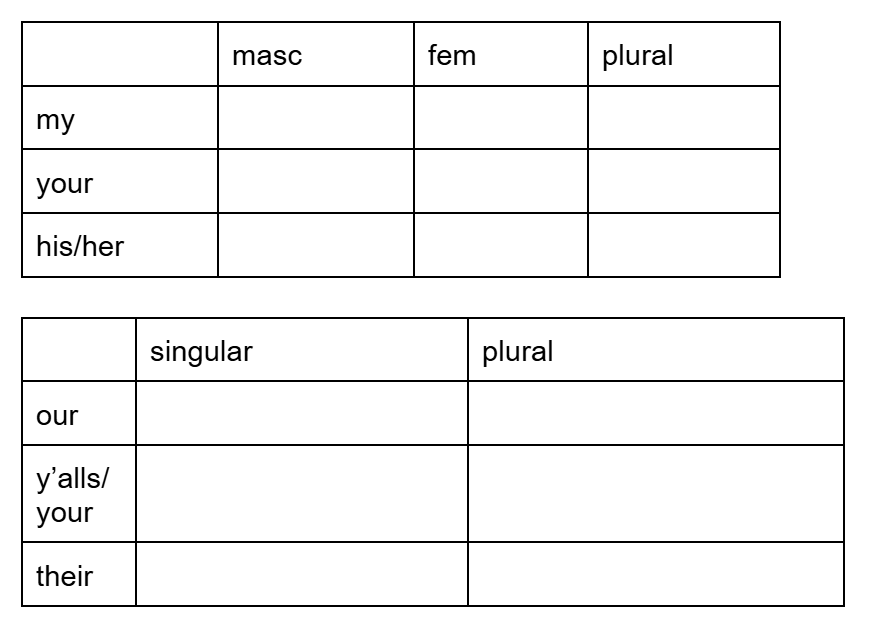
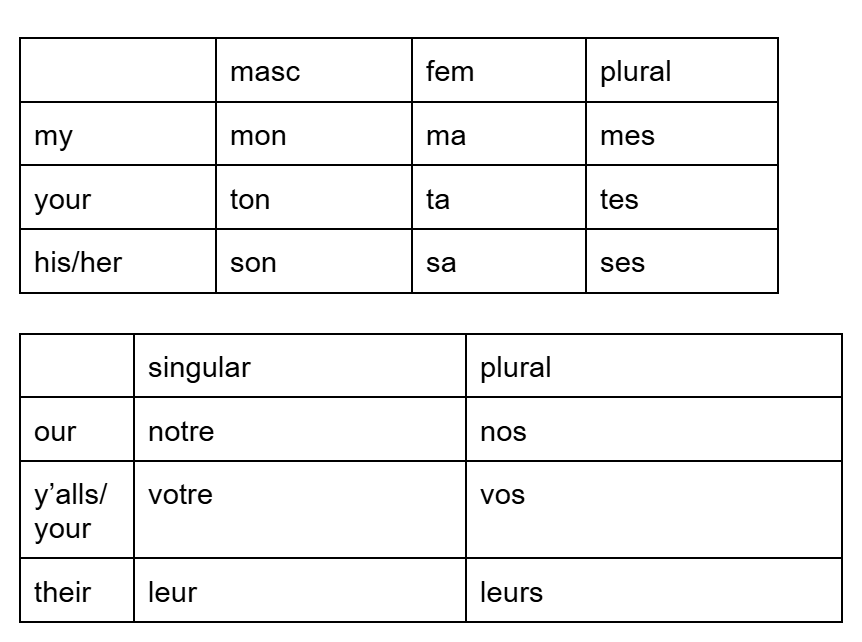
Possessive adjectives
6
Reply in a complete sentence in French and spell out any numbers:
Quelle est la date aujourd'hui?
Aujourd'hui c'est le dix-neuf octobre deux mille vingt-six.
6
What two other verbs are conjugated like prendre and what do they mean?
1. apprendre=to learn
2. comprendre=to understand
6
Translate using inversion.
Why are you traveling?
Pourquoi voyages-tu?
7
write 4 regular -re verbs that you know
Examples: attendre, entendre, vendre, perdre, répondre, rendre, rendre visite à, descendre
7
Write the feminine form of these irregular adjectives and write the definition in English.
1. ennuyeux
2. fou
3. gentil
4. inquiet
1. ennuyeux/ennuyeuse: boring
2. fou/folle: crazy
3. gentil/gentille: nice
4. inquiet/inquiète: worried
7
Reply in a complete sentence logically en français and spell out any numbers.
À quelle heure est-ce que tu déjeunes?
Je déjeune à onze heures quarante.
Je déjeune à douze heures moins vingt.
7
what do the following idiomatic expressions with the verb faire mean?
1. faire attention=
2. faire ses devoirs=
3. faire une promenade=
4. faire du vélo=
1. faire attention= to pay attention
2. faire ses devoirs= to do one's homework
3. faire une promenade= to take a walk
4. faire du vélo= to go bike riding
7
Use either est-ce que or inversion to translate.
When do y'all study?
Quand est-ce que vous étudiez?
Quand étudiez-vous?
8
Each of the following sentences has an -ER, -IR, or -RE verb. Translate them.
1. Y'all are finishing.
2. We do eat.
3. She loses.
Vous finissez.
Nous mangeons.
Elle perd.
8
Write the feminine form of these irregular adjectives and write the definition in English.
1. jaloux
2. paresseux
3. travailleur
1. jaloux/jalouse: jealous
2. paresseux/paresseuse: lazy
3. travailleur/travailleuse: hardworking
8
:45=
:30=
:15=
:45= moins le quart
:30= et demie
:15= et quart
8
what do the following irregular -IR verbs mean?
sortir=
dormir=
partir=
courir=
sortir= to go out
dormir= to sleep
partir= to leave
courir= to run
8
Use either est-ce que or inversion to translate.
How many students (m) are there?
Combien d'étudiants est-ce qu'il y a?
Combien d'étudiants y-a-t-il?