Are You Having Fun(ction)?
h(x)=x-1; g(x)=5x-2
Am I a function?
What's my function?
Domain and Range
100
This word is used to describe the set of all inputs for a function.
What is the domain?
100
Find h(3)
What is 2?
100
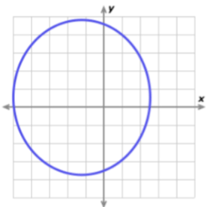
What is No, not a function? It does not pass the vertical line test.
100
Am I a linear function?

No, I am not made of a LINE
100
Find the DOMAIN:
{(-2, 4), (3, 2), (2, 10)}
What is {-2, 3, 2}?
200
This word is used to describe the set of all outputs of a function.
What is the range?
200
Find g(4)
What is 18?
200
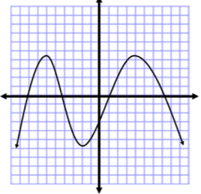
What is Yes, a function?
200
Am I a linear function?
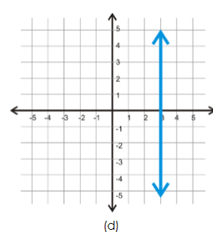
yes, it is a linear function --- it is made of a (straight) line.
200
Find the RANGE:
{(-2, 4), (3, 2), (2, 10)}
What is {2, 4, 10}?
300
This word describes a relation that pairs each x value with only one y value.
What is a function?
300
What is x if h(x) = 5
What is 6?
300
Is this a function and why?
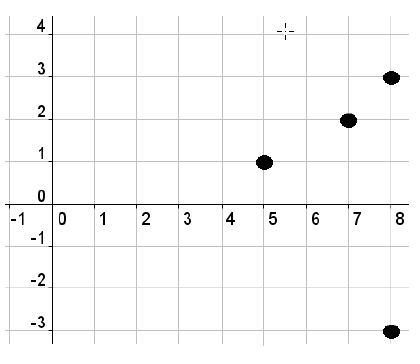
What is no, because x's repeat at 8?
300
Am I a linear function?

No. I am not made of a straight line.
300
Is the following a function?
x 1. 3 5 7
y 2. 3 4 5
Yes, each input has exactly one output.
400
This word describes a relationship between two sets of numbers.
What is a relation?
400
What is x if g(x) = 18
What is 4 ?
400
Does the following table represent a function?
x y
1 2
2 5
6 2
2 9
5 1
What is No, because the input (x) of 2 has two different outputs (y)?
400
Does the following table represent a linear function?
x y
1 2
2 5
6 2
2 9
5 1
No, there is not a constant rate of change
(also it is NOT a function, so it can be a LINEAR FUNCTION)
400
Is the following a linear function?
x 1. 3 5 7
y 2. 3 4 5
Yes, it has a constant rate of change.
500
We use "x" to describe the input, what do we use to describe the output?
What is Y?
500
What is h(-3)
What is -4?
500
 Is this a function?
No, it fails the vertical line test
500
Would this graph be consider discrete or continuous?
Discrete --- it is made up of a series of points --- not the numbers in between.
500
Is the following a linear function?
x 3 6 9 12
y 5 7 10 12
No, there is not a constant rate of change