Nursing Vocabulary
Physical Assessment
Vital Signs
Physical Assessment 2
NCLEX
100
The term that describes what the nurse sees, hears,measures, and feels. Considered objective data.
What are signs?
100
This type of disease results in a structural change in an organ that interferes with its functioning.
What is an organic disease?
100
Patient Gertrude has been having multiple falls. The Doctor orders the nurse to check BPs while lying, sitting and standing 1 to 3 mins apart. The nurse is measuring for ______________ _________________.
What is orthostatic hypotension?
100
The third assessment technique in a standard physical exam of a patient's chest?
What is auscultation?
100
Name 2 factors that influence pulse rate.
What are : acute pain, anxiety, exercise, fever/heat, hemorrhage, medications, metabolism, postural change, pulmonary conditions, unrelieved severe pain/chronic pain.
200
The medical term that describes this man's eyes.

What is scleral icterus?
200
A partial or complete disappearance of clinical and subjective characteristics of a disease.
What is remission?
200
Nurse A's next action after counting her patient's resps at 12 bpm.
What is the normal range for adults which is 12-20bpm.
200
What is percussion?
The fingertips are used to tap the body surface to produce sound and vibration.
200
What is Cheyne Stokes respirations?
300
These are terms that the patient perceives when describing their illness.
Example, "I feel like a knife is stabbing me in my stomach."
What are symptoms?
300
Diabetes is an acute disease. True or False
What is False. Diabetes is a chronic disease.
300
The term used to describe a regular heart rhythm with a rate less than 60 bpm.
What is bradycardia?
300
A patient has a new diuretic prescription for fluid retention. He mistakenly took double the dose for 2 days. He weighed 81kg 2 days ago and now weighs 77 kg. How many liters of fluid has the patient lost.
What is 4 L? 4 kg =8.8 LBS
1 L = 1 KG
1 KG=2.2 LBS

400
There are 4 categories of risk factors that increase chances for an individual to develop a disease.
Name one.
What is/are :
Genetics
Physiologic
Age
Lifestyle
400
What are moist lung sounds during inspiration not cleared by cough?
400
The term used to describe consistent BPS greater than 140/90.
What is hypertension?
400
With a deteriorating patient, the nurse should check this pulse.
What is the carotid pulse?
400
During this type of data collection, the nurse asks the patient about normal functioning of each system and any changes the patient has noted.
What is the review of systems?
500
The term used to describe the difference between an apical and radial pulse.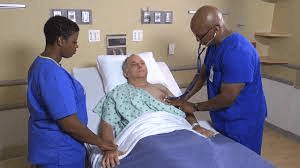
What is pulse deficit?
500
Loud, low coarse sounds like a snore during inspiration or expiration which may clear with cough.
What are Rhonchi (sonorous wheeze)?
500
Name a guideline for daily weights.
What are patients should
Wear the same amount of clothing every day
Weighed at the same time every day
Weighed on same scale
Weighed after voiding and before breakfast
500
Factors that can affect patient temperature.
What are:
Age, Exercise, Hormonal influence, diurnal variations, stress, environment, ingestion of food and hot/cold liquids, and smoking.
500
A 90 year old patient is having difficulty answering the nurse's questions while completing the patient history. What should the nurse keep in mind about caring for older adults?
a. All older adults age at the same rate.
b. The nurse should write down all of the questions and have the patient's family complete the information.
c. The nurse should sit down at eye level with the patient and allow a longer period to answer each question.
d. The nurse should talk more loudly and raise the pitch of her voice.
What is C?