Planets, Stars, & Galaxies
The Solar System
The Universe
Characteristics of Earth
Wildcards
Moon, Eclipses, & Tides
100
The sun provides the _____ and _____ that make life possible on Earth.
The sun provides the HEAT and LIGHT that make life possible on Earth.
100
What galaxy do we live in?
The Milky Way!
100
What is the universe?
The Universe is everything that exists in space. It is made up of billions of galaxies.
100
How long does the Earth take to complete one spin?
ONE DAY or about 24 hours!
100
True or false? Stars are enormous spheres of gas that produce a great deal of energy Emitted in the form of light and heat.
TRUE!
100
What are the two types of eclipses we experience?
Lunar Eclipses and Solar Eclipses
200
What are satellites?
Objects that orbit around a planet. For example, the Moon is the Earth’s natural satellite.
200
What are the three shapes of galaxies?
Elliptical, spiral, and irregular.
200
How many years ago did the Universe begin?
Approx. 15 billion years ago! 15,000,000,000.
200
True or False? Earth is NOT the only planet known to support life.
False! It IS the only planet known to support life.
200
Who is the best science teacher in the world? The best assistant?
Javi and Karsyn! :)
Maria Jesus and Justin! :)
200
About how many hours are between high tide and low tide?
Approx. 6 hours!
300
What is a dwarf planet?
Celestial bodies that orbit stars and are smaller than planets.
300
True or False? Galaxies are groups of thousands of stars, planets, gas clouds, and rock fragments.
FALSE. Galaxies are groups of MILLIONS of stars, planets, gas clouds, and rock fragments.
300
What is the furthest planet from the Earth?
Neptune!
300
In Winter, the Northern Hemisphere is tilted ____ from the Sun and in Summer, it is tilted ______ the Sun.
In Winter, the Northern Hemisphere is tiltedAWAY from the Sun and in Summer, it is tilted TOWARDS the Sun.
300
What is luminosity?
The amount of light a star emits and their distance from Earth.
300
What is the difference between rotation and revolution? How many days do they take?
Rotation: the moon rotates on its axis
Revolution: the moon orbits the Earth
They both take about 28 days!
400
Stars can vary in three ways… What are they?
Color, size, and brightness.
400
What is the difference between an asteroid and a comet?
Asteroid: LARGE ROCKS that orbit the sun.
Comets: BALLS OF DUST AND ICE that orbit the sun.
400
What is the big bang theory?
The phenomena that about 14 billion years ago, the entire universe was packed into a tiny, super-hot, and heavy point that suddenly started expanding and stretching out in all directions—and it is still stretching today!
400
The atmosphere is made up of two main gases… What are they?
Nitrogen approx. 78% and Oxygen approx. 21% of Earth’s Atmospheric Gases.
400
The Solar System is located in one of the arms of the Milky Way called…?
The Orion Arm!
400
Tides are the regular rise and fall of the sea level. What causes them? What are the two types of tides?
The moon‘s gravitational pull on Earth… high tide (water rises to its highest level) and low tide (water falls to its lowest level).
500
What colors are the hottest and coldest stars? Must name all 4!
Coldest: orange or red
Hottest: white or blue
500
Can you name all 9 planets?
Saturn, Earth, Venus, Mercury, Neptune, Mars, Jupiter, Uranus, and Pluto
500
Each galaxy contains millions and millions of _____, _______, and other _______ ______ that are far apart.
Each galaxy contains millions and millions of STARS, PLANETS, and other CELESTIAL BODIES that are far apart.
500
Name and explain the three main characteristics that make life on Earth possible?
1. Its distance from the sun= temperature is not too hot nor too cold and water can remain liquid.
2. Liquid Water= essential for life and covers more than 70% of Earth‘s surface.
3. Atmosphere= contains the oxygen we breathe and keeps the Earth’s temperature regulated.
500
Stars are enormous spheres of _____. They produce a great deal of _____ that is emitted in the form of ______ and _____.
Stars are enormous spheres of GAS. They produce a great deal of ENERGY that is emitted in the form of LIGHT and HEAT.
500
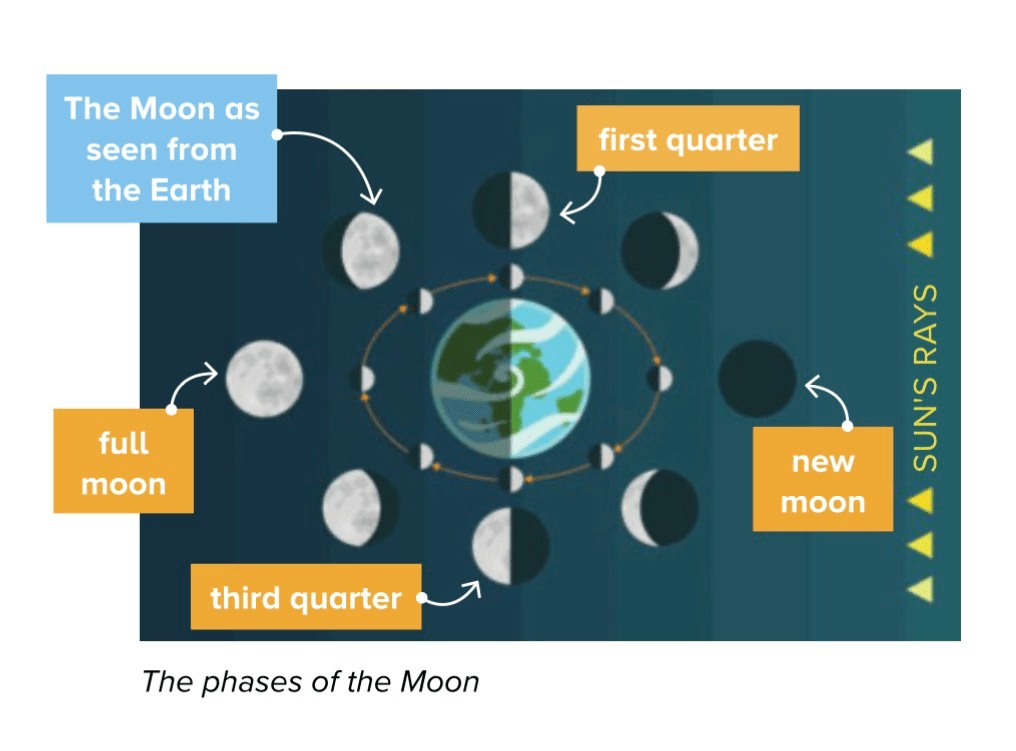
The moon has 4 phases… can you draw and name them all?
First Quarter, New Moon, Third Quarter, Full Moon