A
B
C
D
E
10
5. What is the evidence that the average kinetic energy of the particles of this substance is decreasing during the first two minutes?
The temperature is decreasing.
10
16a. Which segment of the graph represents a phase change only?
BC
10
15. Identify the process that takes place during line segment DE on the heating curve.
Vaporization
Boiling10
13. What is the freezing point of the compound?
50 degrees Celsius.
10
1. State what happens to the average kinetic energy of the gas molecules if the cabin temperature decreases.
The avg KE energy decreases.
The particle speed decreases.
20
7. What is the boiling point of this substance?
110 degrees celsius
20
16b. What is the melting point of lauric acid?
Any temperature within the range 42-45 degrees Celsius.
20
6. Which segment of the graph represents the gas phase only?
AB
0-2 min
20
10. What kelvin temperature is equal to 15 degrees Celsius?
288.15 K
20
16c. At which point to the particles have the highest average kinetic energy?
Point A
30
14. Describe in terms of particle behavior or energy what is happening during segment CD.
The liquid particle speed is increasing.
Liquid particles are moving faster.
Average Kinetic energy is increasing while potential energy is constant.
30
2. State what happens to the potential energy of a sample of NO (l) at 121 K as it changes to NO (g) at constant temperature and standard pressure.
PE increases
Increases
30
12. State what is happening to the average KE of the particles in the sample between minute 2 and minute 6.
The average KE remains constant.
30
16d. Name the phase change that takes place during this 10-min cooling time.
Solidification
Freezing
30
8. Draw at least nine particles showing the correct particle arrangement of this sample during the first minute of cooling.
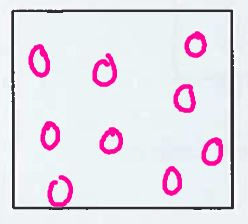 Drawing consistent with representing a gas.
40
3. Identify the substance in this table that is a liquid at STP.
Br2
Bromine
40
17. State evidence that indicates photosynthesis is an endothermic reaction.
Energy is absorbed with the reactants in the equation.
40
4. Explain how the avg KE of sample B could be the equal to the avg KE of sample C.
If they are at the same temperature.
40
11. A different experiment was conducted with another sample of the same compound starting in the solid phase. The sample was heated at a constant rate from 15 to 75 degrees Celsius. On the graph, draw the resulting heating curve.
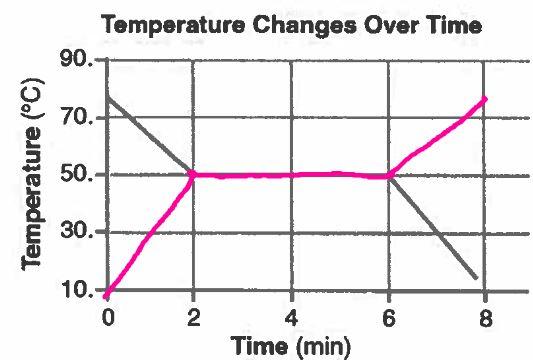
Graph should show the solid temperature rising from 15 to 30 degrees for 2 min, melting at 50 degrees Celsius for the same length of time it took to freeze (4 min), then liquid temperature increases from 50 to 75 degrees for 2 min.
40
18. In terms of energy, explain why the forward reaction is exothermic
Energy is released with the products in the equation.
50
9. State evidence from the investigation that indicates the process of dissolving the NH4Cl in water is endothermic.
The temperature of the water decreased.
This implies energy was absorbed from the surroundings into the dissolving compound.
50
19. Describe the direction of heat flow between the solution made by the student and the air in the laboratory.
Heat flows from the solution to the air in the laboratory.
50
20. State the direction of heat flow between the air in the oven and the muffin batter when the muffin batter is first placed into the oven at 200 degrees Celsius.
Heat flows from the air in the oven to the muffin batter.
50
BONUS:
A. If 25.0 grams of ice was placed onto a window sill, how much energy would be required to melt half of the sample?
B. Explain why the melting process may happen slower if the sample of ice were placed into a windowless room?
Q=(12.5)(334)=4,175
There is no sunlight to help speed up the melting process.50
BONUS:
A match is removed from a box and stricken to light. What form of energy activates the combustion reaction (burning) of the match?
Thermal energy
Heat