cells and microscopes
cell structure
cytoskeleton/cell membrane
transport
signaling and receptors
100
What is the difference between SEM and TEM?
SEM: image looks 3D, focus a beam of electrons onto the surface
TEM: can see internal structures, focus a beam of electrons through a specimen


100
What type of cell is this?

animal cell
100
What three things make up the cytoskeleton? list them in order from smallest to largest.
microfilaments
intermediate filaments
microtubules
100
What is the definition of passive transport?
Diffusion with no energy investment.
100
What are four types of chemical signaling that were discussed in class?
Autocrine, signaling across gap junctions, paracrine, and endocrine
200
What are the 3 parts of the unified cell theory?
1. one or more cells comprise of all living things
2. the cell is the basic unit of life
3. new cells arise from existing cells
200
What are the function of the smooth ER?
-synthesize lipids
-store calcium ions
-detoxify drugs and poisons
-metabolizes carbs
200
What are each of the cytoskeletal components made up of?
microfilament= actin
intermediate filament= Keratin
microtubules= tubulin
200
Explain the difference between isotonic, hypertonic, and hypotonic solution.
Isotonic Solution: Solution where the effective solute concentration is the same as that of another solution
Hypertonic: Solution with greater concentration of solutes than another solution
Hypotonic: Solution with lower concentration of solutes than another solution
200
What are the three types of cell surface (membrane) receptors?
G-protein coupled receptors
Enzyme linked receptors / receptor tyrosine kinases
Ion channel receptors
300
What 4 things do all cells have??
1. ribosomes
2. chromosomes
3. cytosol
4. plasma membrane
300
List and describe the different types of vacuoles
food: formed by phagocytosis
contractile: found in man freshwater protists, pump excess water out of cells
central: found in many mature plant cells, holds organic compounds and water
300
What are the 4 kinds of cell junctions? briefly describe each of them.
plasmodesmata: in plant cells, channels that perforate plant cell walls, allow passage of water and small solutes (sometimes RNA and proteins)
tight junctions: membranes of neighboring cells are pressed together
desmosomes: anchoring junctions, fasten cells together into strong sheet
gap junctions: communicating junctions, provide cytoplasmic channels between adjacent cells
300
What are the two different types of transport proteins that aid in facilitated diffusion, and give a brief description of their functions.
Channel: hydrophilic channels certain molecules or ions can be used as a transport
aquaporins and Ion channels
Carrier: bind to molecules and change shape to shuttle them across membrane
300
What are the three stages of cell signaling, and briefly describe each step.
Reception: Target cell detects a signaling molecule that binds to a receptor protein on the cell surface
Transduction: The binding of a signal molecule alters the receptor and initiates a signal transduction pathway
Response: Transduced signal triggers a specific action in the target cell
400
what is the difference between resolution and magnification when talking about microscopes?
resolution: being able to distinguish different parts/structures
magnification: making an image larger
400
list 3 ways prokaryotes and eukaryotes differ
1. prokaryotes
-no nucleus, DNA in unbound region, cytoplasm bounded by plasma membrane, no membrane bound organelles, smaller, includes: bacteria/archaea
2. eukaryotes
-DNa is bounded by nuclear envelope, membrane bound organelles, cytosol, cytoplasm, larger, includes: protists/fungi/animals/plants
400
What is the extracellular matrix composed of?
Glycoproteins
Collagen, proteoglycans, and fibronectin
400
Describe active transport vs cotransport.
Active transport moves substances across their concentration gradient and maintains this even when it differs from its environment. It needs energy and specialized proteins.
Cotransport is a type of active transport of a solute indirectly drives transport of other substances
400
What is the difference between protein phosphorylation vs dephosphorylation?
Phosphorylation: Protein kinases transfer phosphates from ATP to protein
Dephosphorylation: Protein phosphatases rapidly remove the phosphates from proteins
500
explain why cells want a larger SA:V ratio
It makes it easier to exchange materials in the environment when the ratio is larger. As size increase volume grows more than SA.
500
describe/draw the endosymbiont theory
-Early ancestor of euks engulfed an oxygen-using non-photosynthetic prok cell-->Formed a relationship becoming an endosymbiont -->Endosymbionts evolved into the mitochondria
-One of these two cells took up a photosynthetic endosymbiont-->Evolved into the chloroplast
Enveloped by a double membrane
Contain free ribosomes and circular DNA molecules
Grow and reproduce somewhat independently

500
Draw the cell wall with the three components.
Middle Lamella, Primary Cell Wall, and Secondary Cell Wall
500
Go to the board and draw the sodium potassium pump.
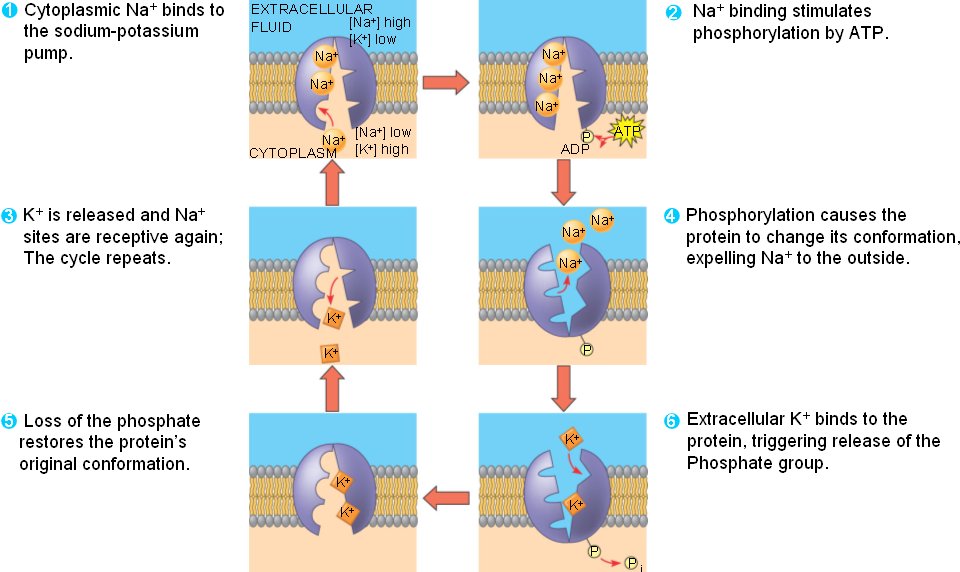
500
Name the two common second messengers, and draw out the G-protein coupled receptor pathway that involves one of these common second messengers.
