Personality Parade
Persona Ponderings
Coping Chronicles
Cognitive Chronicles
Recollection Roundup
Memory Lane
Disorder Digest
Abnormal Analysis
Disorder Depot
100
Which assessment technique requires people to respond to unstructured or ambiguous stimuli?
Projective test
100
Boys experience the ________ complex, and girls _______ experience the complex during the _______ stage.
Oedipal; Electra; phallic
100
When we refuse to acknowledge or accept anxiety-arousing information, we are using...
Denial
100
What psychological concept refers to the phenomenon where retrieval of information is most effective when the conditions of encoding and retrieval are the same or highly similar?
Encoding Specificity is when memory recall is optimized when the conditions present during encoding match those during retrieval.
For example, if you studied for a test in a quiet room with soft music playing, you may perform better on the test if you're in a similar environment.
100
What psychological concept refers to the phenomenon where memory retrieval is most efficient when an individual's internal state at the time of encoding matches their state at the time of retrieval?
State-Dependent Learning
Information learned or encoded in a particular state, such as being happy, sad, intoxicated, or sober, is better recalled when the individual is in the same state during retrieval.
State-dependent learning highlights the role of internal cues or context in memory retrieval processes, emphasizing the interconnectedness between mood states and memory performance.
100
What is anterograde amnesia
Type of memory impairment characterized by the inability to form new memories after the onset of amnesia.
Individuals with anterograde amnesia may have intact memories of events that occurred before the onset of amnesia, but they struggle to encode and retain new information or experiences.
100
xA seemingly sly criminal plots to murder a rival gang leader and "get away" with the crime by pleading insanity. Apart from the low probability of success when pleading insanity, why did this sly criminal’s plan fail?
A. He did not have a prior record of psychological disorders.
B. The court could determine that he did not meet the criteria for insanity.
A. He did not have a prior record of psychological disorders.
100
What is the criteria for a psychological disorder?
1. Statistical Rarity
2. Disrupts daily life
100
What book do psychologists typically use to diagnose patients?"
Diagnostic and Statistical Manual of Mental Disorders (DSM) 5
200
What term do psychologists use for a personality test that requires people to answer questions about themselves in a yes/no, true/false, or similar format?
Self-report inventory
200
What term did Abraham Maslow use to describe the drive to make full use of talents, capacities, and potentialities?
Self-actualization
200
This defense mechanism involves redirecting one's feelings or emotions from their original source to a less threatening or safer target.
Displacement
200
What is the "magic number" that represents the typical capacity of working memory?
7
200
What cognitive strategy involves improving memory and increase working memory capacity?
Chunking
Particularly effective for remembering long lists, sequences, or complex information by breaking it down into smaller, more easily remembered units.
200
What is the name for 'classic amnesia,' and what type of amnesia does it refer to?
Retrograde amnesia is a type of amnesia characterized by the loss of memories for events or information that occurred before the onset of amnesia.
Individuals with retrograde amnesia may have difficulty recalling past experiences, knowledge, or personal information.
200
Andrea Yates was accused of killing her five children. Her defense attorney contended that she suffered from which psychological disorder?
Postpartum depression
200
Despite having a strong desire to attend social gatherings and events, Sarah finds herself avoiding them at all costs. She experiences intense fear and anxiety when thinking about leaving her home and being in situations where escape might be difficult or embarrassing. What psychological disorder might Sarah be experiencing?
Agoraphobia
200
What is a common treatment for most psychological disorders?
Cognitive Behavioral Therapy (CBT)
300
Which acronym can help you remember the "big five" traits?
OCEAN
300
According to Freud, the latency stage is characterized by a temporary suppression of sexual desires. During this stage, what becomes the primary focus of a child's energy?
development of social and intellectual skills
300
When you use an alternative, acceptable reason to replace the actual, unacceptable reason for a behavior, you are using...
Rationalization
300
What are the three components of the Information Processing System in psychology?
Encoding: Encoding involves the initial processing of sensory information into a form that can be stored in memory.
Storage: Storage refers to the retention of encoded information over time. Once information has been encoded, it is stored in memory for later retrieval.
Retrieval: Retrieval is the process of accessing and bringing stored information back into conscious awareness when needed.
300
What advice might a researcher offer regarding studying for an upcoming exam in relation to cue-dependent memory?
Match study conditions to exam conditions: Study in environments similar to the exam setting to capitalize on state-dependent learning.
Create self-referent cues: Reflect on how the information makes you feel or what memories it evokes, and incorporate those emotional and physiological cues into your study materials. When studying, try to evoke the same emotional state or mindset that you anticipate experiencing during the exam, as this can facilitate memory retrieval based on state-dependent learning principles.
300
Explain when the serial effect would be advantageous in situations such as voting or memorable performances.
What are the two types of effects associated with it?
Primacy & Recency effects, are advantageous in situations where the order of presentation influences memory retention, such as voting or memorable performances.
In voting scenarios, candidates listed first or last on the ballot often benefit from the primacy and recency effects, respectively. Similarly, in memorable performances, the order of acts can impact audience recall.
By strategically arranging the order of presentation, organizers can capitalize on these effects to enhance audience memory and engagement.
300
Your father was admitted to a mental hospital where a team of professionals meets with you and your family. According to the team leader, your father suffers from one of the most commonly diagnosed disorders and is also comorbid. Which explanation of your father’s condition are you most likely to hear?
Your father has at least two disorders
300
Sarah and Jake both exhibit symptoms of ADHD, but their experiences differ.
Sarah is often described as talkative and daydreamy in class, while Jake is frequently disruptive and impulsive.
What might account for these differences, particularly considering gender?
ADHD symptoms in females are often underdiagnosed or overlooked due to differences in how they present. Females with ADHD may exhibit internalizing symptoms, such as inattention and daydreaming, which can be mistaken for other conditions like anxiety or depression.
Males with ADHD may display more externalizing symptoms, such as hyperactivity and impulsivity, which are more readily recognized.
These gender differences in symptom presentation can influence diagnosis and treatment approaches for individuals with ADHD.
300
Samantha feels intense anxiety whenever she has to speak in front of a group of people. Even the thought of giving a presentation makes her feel physically sick.
What psychological disorder might Samantha be experiencing?
Social Phobia
400
Personality descriptions that have "something for everyone" fit the...
Barnum effect
400
Dr. Dandy, a clinical psychologist, is conducting a study to investigate whether a person's personality can be used to predict their ability to resist relapse during alcoholism treatment. To achieve this, he has consulted with an expert on personality measurement. What aspect of personality is Dr. Dandy likely to focus on when attempting to predict the ability to resist relapse in alcoholism treatment?
Self-efficacy
400
Which defense mechanism is illustrated by a person with antisocial and aggressive tendencies who channeled his energies into becoming an orthopedic surgeon?
Sublimation
400
What is the consolidation hypothesis in the context of memory?
The consolidation hypothesis is a theory in cognitive psychology that explains how memories are initially fragile and susceptible to disruption but become more stable and resistant to interference over time. According to this hypothesis, newly formed memories undergo a process of consolidation, during which they are strengthened and integrated into existing neural networks within the brain.
400
The spacing effect and the consolidation hypothesis are related in what way?
The spacing effect and the consolidation hypothesis both pertain to memory processes.
The spacing effect suggests that information is better retained when it is studied and rehearsed over spaced intervals of time rather than in one continuous session.
The consolidation hypothesis proposes that memory traces are gradually strengthened and stabilized over time through a process of neural consolidation, typically occurring during periods of sleep.
Both concepts underscore the significance of time and repetition in memory formation, with the spacing effect focusing on the timing of study sessions and the consolidation hypothesis emphasizing the role of sleep in solidifying memories.
400
Why is the cognitive interview better for recall than a traditional police interview?
The cognitive interview employs techniques such as open-ended questioning, mental reinstatement of context, and encouraging witnesses to report everything they remember, even if seemingly trivial.
These techniques help to maximize the retrieval of accurate information from memory by facilitating a more comprehensive and detailed recall of events.
400
Which anxiety disorder is characterized by intense physiological reactions in the absence of any specific stimulus?
Panic disorder
400
What are three inattentive symptoms of ADHD?
1. Struggles with task attention
2. Difficulty Organizing
3. Avoid tasks involving mental effort
4. Easily distracted
400
Provide an example of Dissociative Fugue and explain its occurrence
John suddenly leaving his home and traveling to another city without any memory of his past identity or purpose for doing so.
Dissociative Fugue occurs when an individual experiences a sudden and unexpected departure from their usual environment, accompanied by amnesia for their past identity and life circumstances.
This can happen due to severe stress, trauma, or psychological conflict, which overwhelms the individual's ability to cope, leading to a dissociative state.
During the fugue state, the individual may assume a new identity and engage in unfamiliar behaviors, often without awareness of their previous life.
500
What did Raymond Cattell call the underlying traits that direct surface traits?
Source Traits
500
Mark is a high school student preparing for his final exams. He believes that his success depends on his own efforts and actions. He also believes that he has the ability to study effectively and perform well in his exams.What is Mark's type of locus of control and level self efficacy?
Mark has an internal locus of control and high self-efficacy.
500
John secretly harbors intense anger and resentment towards his demanding boss but goes out of his way to excessively praise and flatter their boss, showering them with compliments and gifts.
What defense mechanism is John using?
Reaction Formation
500
What is the difference between retroactive and proactive interference in memory?
Retroactive Interference:When newly learned information disrupts the recall of previously learned information. For example, if you learn a new password for a website and then later have trouble remembering the old password, retroactive interference may be at play.
Proactive Interference: When previously learned information interferes with the encoding and retrieval of new information. For instance, if you've previously learned how to ride a bike using a particular technique and then try to learn a new, different technique, the old technique may interfere with your ability to master the new one.
500
What are the two types of rehearsal, and which one is better for long-term memory retention, and why?
Maintenance rehearsal involves simple repetition of information to keep it in short-term memory, while elaborative rehearsal involves deeper processing by making meaningful connections between new information and existing knowledge.
Elaborative rehearsal is better for long-term memory retention because it encourages semantic encoding, which facilitates deeper understanding and integration of information into existing memory networks.
Elaborative rehearsal enhances memory durability by creating multiple retrieval paths and associations, making the information more readily accessible for future recall.
500
Provide an example of an episodic and a semantic memory.
Can either of these be a flashbulb memory?
Why or why not?
Episodic memory could be recalling your high school graduation ceremony, including details such as who attended, what you wore, and how you felt during the event.
Semantic memory could be knowing that Paris is the capital of France, without any personal context or recollection attached to the information.
Episodic memories are typically personal experiences tied to specific events and contexts, whereas semantic memories are factual knowledge independent of personal experience.
Flashbulb memories are typically vivid, detailed recollections of significant and emotionally charged events, such as the assassination of a prominent figure or a major historical event.
While both episodic and semantic memories can contribute to flashbulb memories, the episodic component is more dominant. Flashbulb memories often involve a strong emotional response and are characterized by their perceived clarity and accuracy.
500
Brad and Sheila have been dating for several months. Sheila, a graduate student in psychology, is studying to be a clinical psychologist. Over the months, she’s become concerned that Brad may suffer from______ . Because Brad seeks additional information before making even minor decisions.
Generalized anxiety disorder
500
Why is Dissociative Identity Disorder (DID) sometimes thought to be fake or not believable?
Dissociative Identity Disorder (DID) is sometimes thought to be fake or not believable due to misconceptions and stigmatization surrounding the disorder. Media portrayals and sensationalized accounts have contributed to skepticism about the validity of DID.
DID is often underreported or underdiagnosed due to factors such as lack of awareness among clinicians, stigma associated with mental illness, and challenges in accurately diagnosing the disorder.
500
Who are the group of people who experience little to no Major Depressive Disorder (MDD)?
Why is this the case?
The Amish community is often cited as a group of people who experience relatively low rates of MDD.
The Amish prioritize strong family bonds, communal support, and a simple way of life that emphasizes traditional values and close-knit relationships.
Additionally, their lifestyle typically involves regular physical activity, meaningful work, and a lack of exposure to modern stressors such as technology and urbanization.
These factors, along with a collective approach to problem-solving and coping, contribute to the lower prevalence of MDD within the Amish community.
600
In psychology, what term is used to describe the concept that all mental and emotional reactions are predetermined by earlier experiences and unconscious forces, as proposed by Sigmund Freud?
Psychic determinism
600
Consider a situation where an individual attributes their inability to maintain a stable relationship solely to their past traumatic experiences and external circumstances. What type of locus of control do they likely possess?
external locus of control
600
Sally is an accomplished and composed, however in a high-stress situation Sally suddenly begins to throw a temper tantrum, and demand excessive attention from those around them.
What defense mechanism is Sally using?
Regression
600
Draw the typical memory model, including its components and stages
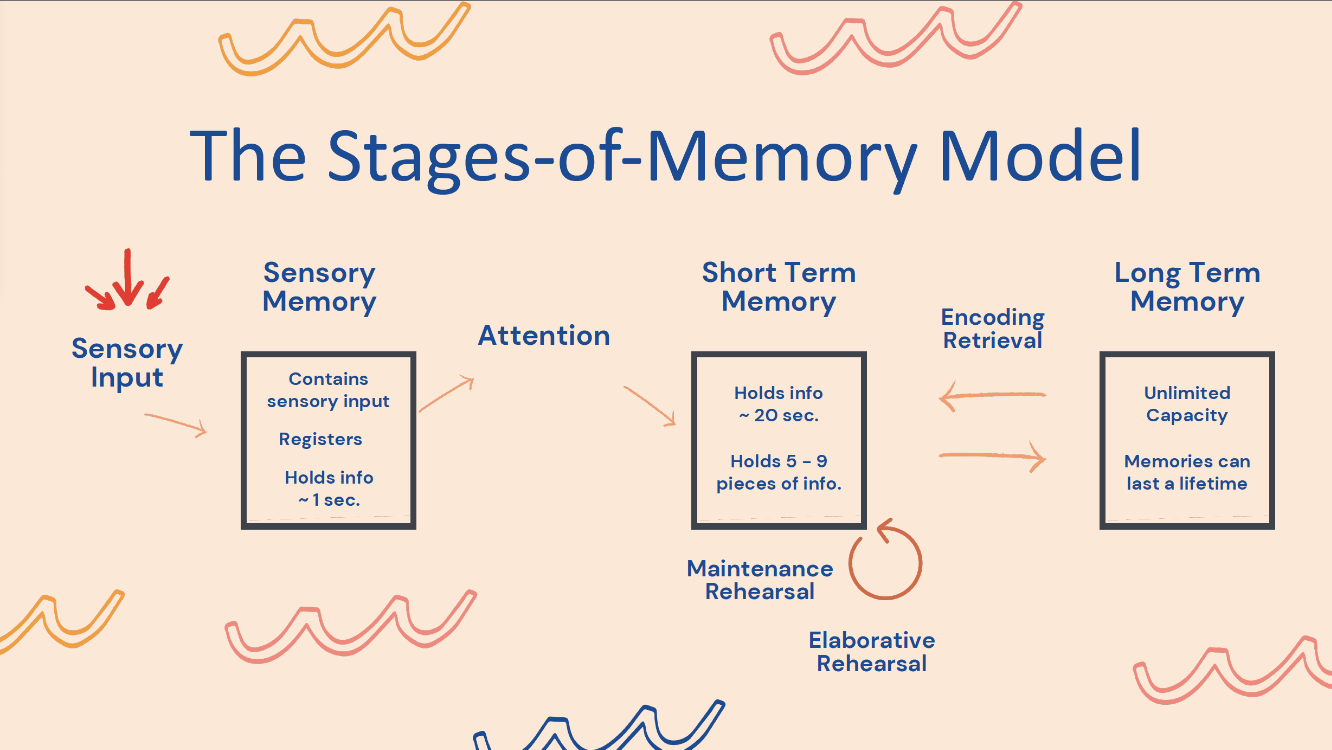
600
Provide an example of something that starts off as explicit memory and then moves on to implicit memory.
Explain what this transition means.
Learning to ride a bicycle.
Initially, when someone is learning to ride a bike, they rely on explicit memory to remember the instructions, techniques, and rules involved, such as how to balance, pedal, and steer.
With practice and repetition, these skills become automatized, and the process of riding a bike becomes more automatic and effortless.
At this stage, the memory of how to ride a bike transitions from explicit to implicit memory. Implicit memory is non-conscious and involves the recall of information without conscious effort or awareness.
600
Explain how semantic and episodic memories differ in their entry into Long-Term Memory
They differ in their entry into LTM in terms of their encoding processes and the types of information they store.
Episodic memories involve the encoding of personal experiences
Semantic memories involve the encoding of general knowledge, facts, and concepts that are independent of personal experience or context.
Episodic memories, involving personal experiences and events, often have a strong emotional or contextual component that inherently facilitates their encoding and storage without explicit rehearsal. The vividness and richness of episodic memories, along with their autobiographical significance, contribute to their durability in LTM without the need for extensive rehearsal.
Semantic memories, typically require some form of rehearsal or elaboration to ensure their retention in LTM. Because semantic memories lack the personal context, they may be more susceptible to forgetting without deliberate rehearsal or association with existing knowledge.
Therefore, while both types of memories contribute to LTM, episodic memories often enter LTM more readily and robustly, whereas semantic memories may require additional cognitive effort to establish and maintain
600
Amy has been collecting baseball cards for years. At the drop of a hat, she will launch into a lengthy discussion of her collection, the price of cards, and her plans for purchasing more cards. Her friends say that she must be suffering from obsessive-compulsive disorder. You disagree. What do you say to her friends when they ask you why you disagree?
Unlike an obsessive-compulsive, Amy derives pleasure from this activity.
600
In Prolonged Exposure Therapy, individuals are gradually exposed to traumatic memories and situations to reduce their symptoms.
This therapy is typically beneficial for which group of people?
Who are individuals with PTSD who have experienced specific traumatic events, such as combat veterans, survivors of sexual assault, or individuals who have been involved in accidents or natural disasters?
600
List and describe three positive and three negative symptoms of schizophrenia.
Positive Symptoms:
- Hallucinations: Sensory experiences that occur in the absence of external stimuli.
- Delusions: False beliefs that are firmly held despite evidence to the contrary.
- Thought Disorder: Fragmented or illogical thoughts, making it difficult for individuals to communicate coherently.
- Disorganized behavior: Unusual behaviors that disrupt normal activities.
- Disorganized Speech: Speech that is incoherent or incomprehensible.
Negative Symptoms:
- Avolition: Lack of motivation or goal-directed behavior, leading to difficulty initiating and sustaining activities.
- Alogia: Poverty of speech, characterized by reduced speech output or content.
- Flat affect: Reduction in the display of emotional expression, leading to a lack of facial expressions, vocal intonation, and gestures.
- Anhedonia: Inability to experience pleasure or enjoyment from activities that were previously rewarding.
- Social withdrawal: Avoidance of social interactions and a preference for solitude, often due to discomfort or apathy toward social situations.
- Cognitive deficits: Impairments in cognitive functions such as attention, memory, and executive functioning, which can impact daily functioning and social relationships.