Basic Anatomy
EDX
EDX
General/Medical Rehab
100
Which ligament is the weakest of the ankle ligaments ?
Anterior talofibular ligament ( ATFL)
Explanation-
Most sprains affect the anterior talofibular ligament. The ligament comes under strain and is vulnerable to injury, particularly when the foot is inverted.
100
Which of the following explains post-exercise facilitation that is seen in Lambert-Eaton myasthenic syndrome?
Calcium influx into the nerve terminal
100
During electrodiagnostic studies, the A-wave can be studied. How would we best describe the A-wave? ( what does it tell us)
A-waves show there has been previous reinnervation involving the nerve to the muscle being studied
Explanation- A-waves (also called the axon reflex - not a true reflex) are a very predictable, stable waveform that shows up somewhere between the F-wave and the direct motor response when recording F-waves from a muscle. It is the exact same waveform with every stimulation (same latency and amplitude). If present, A-waves indicate that there has been previous reinnervation involving the nerve to the muscle being studied.
100
In burn patients, heterotopic ossification (HO) is most common at which of the following locations?
In most patients, HO is most common at the hip. In burn patients, HO is most common at the elbow.
200
The gastrocnemius muscle is supplied by which nerve?
Tibial Nerve
Explanation-
The tibial nerve is a branch of the sciatic nerve. The tibial nerve innervates the gastrocnemius, popliteus, soleus, and plantaris muscles.
200
Compared to a limb at 32°C, the compound muscle action potential (CMAP) recorded from a limb at 29°C will be? ( Specifically define the affects to the amplitude and duration)
Larger in amplitude and longer in duration
Explanation- In a cold limb the amplitudes of CMAP and SNAPs are larger due to prolonged opening of sodium channels which causes increased depolarization phase thus increasing the amplitude. Phase cancellation is less which results in increased duration. Prolonged depolarization results in prolonged latency, and slow NCV. During the studies, the limb temperature should be maintained at 30 degrees in the lower limb and 32 degrees in the upper limb.
200
To determine whether an ulnar nerve lesion is at the wrist or the elbow, it is important to test : A) Conduction velocity across the elbow. B) Needle testing of the first dorsal interosseous muscle. C) The dorsal ulnar cutaneous nerve. D) The ulnar motor response to the first dorsal interosseous muscle
C) The dorsal ulnar cutaneous nerve.
The dorsal ulnar cutaneous nerve is a sensory branch of the ulnar nerve that supplies the dorsum of the hand. It can easily be obtained (and compared with the non-affected hand). The dorsal ulnar cutaneous nerve branches above the wrist. Therefore, in lesions at the wrist, the dorsal ulnar cutaneous nerve will be spared. Decreased amplitude of the dorsal ulnar cutaneous nerve indicates that the ulnar nerve lesion is above the wrist.
200
All of the following are muscles of active inspiration except which of the following? A) internal intercostals B)Trapezius C) Levator Scapula D) scalens
A) internal intercostals
Muscles of active inspiration include diaphragm, external intercostals, sternocleidomastoids, levator scapulae, scalenes, pectorals, and trapezius. Muscles of expiration include internal intercostals and abdominal muscles.
300
Which is the best test to help determine if a patient has an ACL tear ?
Lachman's test ( most sensitive test for ACL tears or laxity)
300
what kind of needle electrode is depicted here?
A) Monopolar B) Standard Concentric C) Single fiber and D) Bipolar Concentric
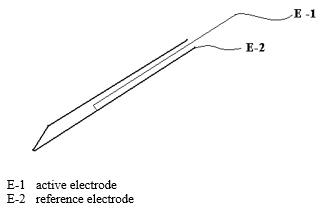
C) Single fiber
Explanation- The single fiber electrode has an active electrode as a side port pickup and the cannula serves as the reference; a separate ground electrode is also required. A standard concentric needle also uses the cannula as a reference and requires a separate ground electrode, but the recording electrode is not a side-port pick-up. A monopolar needle requires a separate reference and a separate ground electrode. A bipolar concentric needle contains both the reference and the active electrodes within the cannula which serves as the ground electrode.
300
You are reviewing EMG/NCS results of a patient. The results demonstrate decreased proximal and distal amplitude with normal latency. EMG reveals decreased recruitment. Which of the following is the most likely etiology of these findings? A) Axonal loss B) conduction block C) Demyelination D) normal variant
Axonal loss
explanation- Decreased amplitude throughout an entire nerve’s length suggests axonal loss. EMG will show decreased recruitment in these cases. Conduction block is seen with proximally reduced amplitude, but stimulating distally beyond the spot of conduction block can demonstrate a normal “repaired” amplitude.
300
A 67 year-old female with a T score of -2.7 on a most recent DXA scan asks you for advice regarding bone health. Which of the following is the most reasonable action to take to improve her bone health? swimming, limiting walking, canoeing or resistance exercises
Resistance exercises
explanation- This patient with T score -2.7 fits DXA criteria for osteoporosis. In order to improve her bone density, weight-bearing exercise is recommended, such as resistance training, ambulation, stair-climbing, golf, tennis, etc. Swimming and canoeing are excellent physical activities, but will not offer maximal impact in terms of improving her bone health. Putting limits on this patient’s walking will only encourage disability.
400
Which muscle is an ankle dorsiflexor and inverter? A) Tibialis anterior B) Peroneus tertius C) Peroneus brevis D) Plantaris
It is the Tibialis anterior
400
Measurement of F-wave minimal latencies are a useful part of the electrodiagnostic workup for?
Demyelinating neuropathy.
Explanation- F-wave minimal latency is notably prolonged (or absent) in demyelinating neuropathies such as acute and chronic inflammatory demyelinating polyradiculoneuropathy (AIDP, CIDP), and is among the electrodiagnostic criteria for demyelination. The F-wave is elicited by antidromic backfiring of motor neurons, making it useful only in detecting lower motor neuron pathology (and not upper motor neuron, as in myelopathy). F-waves are abnormal in radiculopathy when there is significant single root-level or multilevel root compromise, however, the majority of muscles are innervated by more than one root level, and most radiculopathies do not completely obliterate all nerve fibers within the involved root, somewhat reducing the clinical utility of F-waves in detecting radiculopathy.
400
What is the only muscle that is innervated exclusively by the C5 nerve root? A) Supraspinatus B) Levator scapulae C) Trapezius D) Rhomboid (major and minor)
D.Rhomboid (major and minor)
The dorsal scapular nerve (which innervates the rhomboid muscle) is the first branch off the upper trunk and is usually composed of C5 fibers only.
400
What is the target heart rate for a patient with stable arrhythmias during cardiac rehabilitation?A) Maximum heart rate B) Heart rate below the rate where arrhythmias are noted C) Heart rate 10 to 20 beats above the rate where arrhythmias are noted D) Patient is not a candidate for cardiac rehabilitation
B) Heart rate below the rate where arrhythmias are noted
The goal of therapy for a patient with frequent stable arrhythmias is to condition the body to increase efficiency while maintaining the pulse under the heart rate where arrhythmias frequently occur. Closer cardiac monitoring and gradual cool-down phase are also required to reduce episodes of arrhythmia.
500
If someone has weak knee extension and hip flexion what nerve is most likely injured?
The femoral nerve
Explanation- The femoral nerve is formed from the L2–4 nerve roots. The main motor component innervates the iliopsoas (hip flexor) and the quadriceps (knee extensor).
500
After what amount of time can axonotmesis usually be distinguished from neurapraxia?
A) 24 hours B) 3 days C) 10 days and D) 21 days
D) 10 days
explanation- Wallerian degeneration typically takes 3-10 days to occur with motor fiber degeneration occurring in days 3-5 and sensory fiber degeneration occurring in days 6-10. The typical pattern of axonal loss can be seen after Wallerian degeneration is completed- i.e. at 10 days, at which point neurapraxia should be distinguishable from axonotmesis. While compound muscle action potential can still be elicited distal to the lesion in a neurapraxic injury, it will not be present if axonotmesis has occurred due to Wallerian degeneration.
500
During an EMG/NCS study, routine sensory nerve action potentials (SNAPs) and compound muscle action potentials (CMAPs) are normal. Needle EMG reveals abnormal spontaneous activity in the infraspinatus, and normal EMG of the cervical paraspinals, deltoid, supraspinatus, triceps, pronator teres, abductor pollicis brevis, and first dorsal interosseous. Which of the following is the most likely diagnosis? A) C5 radiculopathy B) Suprascapular neuropathy distal to the spinoglenoid notch C) Upper trunk brachial plexopathy D)Suprascapular neuropathy proximal to the spinoglenoid notch
D) Suprascapular neuropathy distal to the spinoglenoid notch
Explanation- The suprascapular nerve innervates the supraspinatus, then passes through the spinoglenoid notch to innervate the infraspinatus. Thus, if injury occurs distal to the spinoglenoid notch, only the infraspinatus will show abnormalities, as the supraspinatus is already innervated at that point. If the injury to the suprascapular nerve occurs proximal to the spinoglenoid notch, then both supraspinatus and infraspinatus should show abnormalities. Upper trunk plexopathy would also show abnormalities in the deltoid (normal in our patient’s study). C5 radiculopathy would also show abnormalities in the deltoid and cervical paraspinals (normal in our patient’s study).
500
The mechanism of action of ondansetron (Zofran), a common antiemetic given to cancer patients is: A) Serotonin antagonist B) Antihistamine C) Anticholinergic D) None of the above
A) Seratonin antagonist
Ondansetron is a selective serotonin 5-HT3 receptor antagonist. It is thought that chemotherapeutic agents produce nausea and vomiting by releasing serotonin from the enterochromaffi n cells of the small intestines. The released serotonin then activates 5-HT3 receptors located on vagal efferents to initiate the vomiting refl ex. Ondansetron works by blocking the reception of serotonin at these 5-HT3 receptors.