Maps
Land Resources
Landscape
Waters and Currents
Culture
100

1.Austria
2.Belgium
3.Switzerland
4.France
5.United Kingdom
1.Austria -A
2.Belgium -B
3.Switzerland -C
4.France -D
5.United Kingdom - E
100
What are the most common renewable energy resources used in the Nordic nations? Choose all that apply.
1. biofuel
2. hydroelectric
3. geothermal
4. wind
hydroelectric
geothermal
100
What were the effects of glacial movement on the Nordic nations? Choose all that apply.
1. fertile river valleys
2. rocky soil
3. thousands of lakes
4. North Atlantic Current
5. jagged coastline
rocky soil
thousands of lakes
jagged coastline
100
What effect does the North Atlantic Current have on Norway?
1. It drives fish out of the area.
2. It causes increased precipitation.
3. It creates valuable oil deposits.
4. It makes the area warmer.
It makes the area warmer.
100
Where do most Europeans live?
1. cities
2. suburbs
3. villages
4. plains
cities
200
 Which country has the highest population density?
1. Sweden
2. Austria
3. Spain
4. United Kingdom
United Kingdom
200
What renewable resource is produced in Western Central Europe?
1. geothermal
2. biofuel
3. solar
4. hydropower
hydropower
200
The Pyrenees Mountains separate the IberianPelopónnisosItalianBalkan Peninsula from the rest of Europe.
1. Iberian
2. Peloponnisos
3. Balkian
Iberian
200
What is Europe's most important commercial river?
1. Rhine
2. Elba
3. Seine
4. Danube
Rhine
200
Most European nations have _____.
1. several dominant cultures
2. no culture at all
3. no dominant culture
4. a dominant culture
a dominant culture
300
Fine-grained fertile soil
1. fjord 5. loess
2. polder 6. Iberian
3. deciduous 7. navigable
4. dike
loess
300
Southern Europe's landscape can be described as mostly _____.
1. tropical
2. mountainous
3. flatland
4. farmland
mountainous
300
Which of these countries has a coastline?
1. Andorra
2. Denmark
3. Switzerland
4. Spain
5. France
6. Austria
7. Norway
Denmark
Spain
France Norwya
300
is the most widely observed religion in Europe.
1. Judaism
2. Buddhism
3. Christianity
4. Islam
Christianity
400
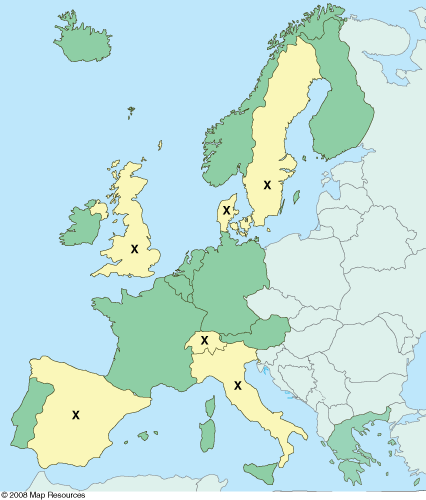 Sweden
Denmark
United Kingdom
Switzerland
Italy
Spain
Sweden
Denmark
United Kingdom
Switzerland
Italy
Spain
400
How did the movement of glaciers affect the countries of Northern Europe?
1. It created fertile river valleys.
2. It resulted in rocky soil.
3. It formed thousands of lakes.
4. It cut out a jagged coastline.
5. It caused the North Atlantic Current.
2. It resulted in rocky soil.
3. It formed thousands of lakes.
4. It cut out a jagged coastline.
400
Why is the Rhine River important to Western Central Europe?
1. It is the leading commercial river in Europe.
2. It is the only European river that flows from west to east.
3. It is Europe's largest river.
4. It contains large coal deposits.
1. It is the leading commercial river in Europe.
400
These countries have large populations of Protestants.
1. Spain
2. Norway
3. The Netherlands
4. Ireland
5. England
2. Norway
3. The Netherlands
5. England
500
trees that lose their leaves in the fall
1. fjord 5. loess
2. polder 6. Iberian
3. deciduous 7. navigable
4. dike
deciduous
500
able to be used for travel by water
1. fjord 5. loess
2. polder 6. Iberian
3. deciduous 7. navigable
4. dike
navigable
500
In which part of Europe are the Germanic languages mainly spoken?
1. Northwestern Europe
2. Northern Europe
3. Western Europe
4. Central Europe
5. Southern Europe
1. Northwestern Europe
2. Northern Europe
4. Central Europe
600
a deep, high-walled coastal valley created by glacier movement and filled by the waters of melting glaciers
1. fjord 5. loess
2. polder 6. Iberian
3. deciduous 7. navigable
4. dike
fjord
600
a severe windstorm characterized by spiraling winds
1. mistral 5. drought
2. cyclone 6. harbor
3. sirocco
4. glacier
cyclone
600
Which languages are Romance languages? Choose all that apply.
Italian
Spanish
English
Danish
Portuguese
French
Norwegian
English
Danish
Norwegian
700
dam
1. fjord 5. loess
2. polder 6. Iberian
3. deciduous 7. navigable
4. dike
dike
700
a long period of dry weather resulting in water shortages
1. mistral 5. drought
2. cyclone 6. harbor
3. sirocco
4. glacier
drought
700
By the end of the nineteenth century, most of Europe's colonies were in _____.
1. North America
2. South America
3. the South Pacific
4. Asia
5. Africa
3. the South Pacific
4. Asia
5. Africa