Geologic History
Plate Tectonics
Geologic History
Plate Tectonics
Final Jeopardy
100
This is the law of superposition
What is "In any undisturbed layers of rock, the oldest layers are on the bottom and the youngest are on top."
100
How are the continents like puzzle pieces? Can you give an example?
Some of the coastlines look like they could fit together. (example: Africa and South America)
100
Define what a fossil is.
What is the mineralized remains or an impression of an organism found in rock.

100
What layer are the continents located on?
What is the lithosphere.
100
Category:
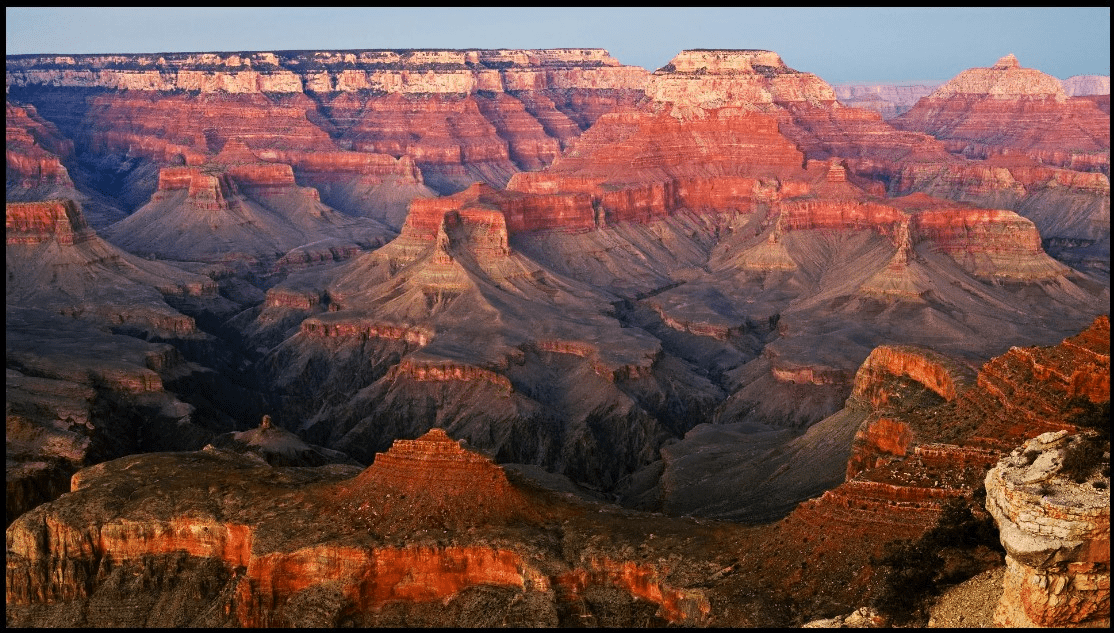
Grand Canyon
200
Age of Earth determined by geologists.
What is approximately 4.6 billion years?
200
Name the four major layers of Earth.
What are crust, mantle, outer core and inner core?

200
The only kind of rock fossils are found in.
What is Sandstone?
200
Define what an index fossil is.
An index fossil is a fossil found in many areas around the world, is plentiful and easily recognizable in a specific type of rock, and over a short geologic period of time.
200
How old were the rocks found at the bottom of the Grand Canyon?
Almost 2 billion years old. (1.85 - 1.9 billion years)
300
Compare relative age to absolute age.
Relative age is how old an object is compared to the items around it where absolute age is the object's actual age (usually in years).
300
This geologic feature is formed at a subduction zone.
What is a volcano?

300
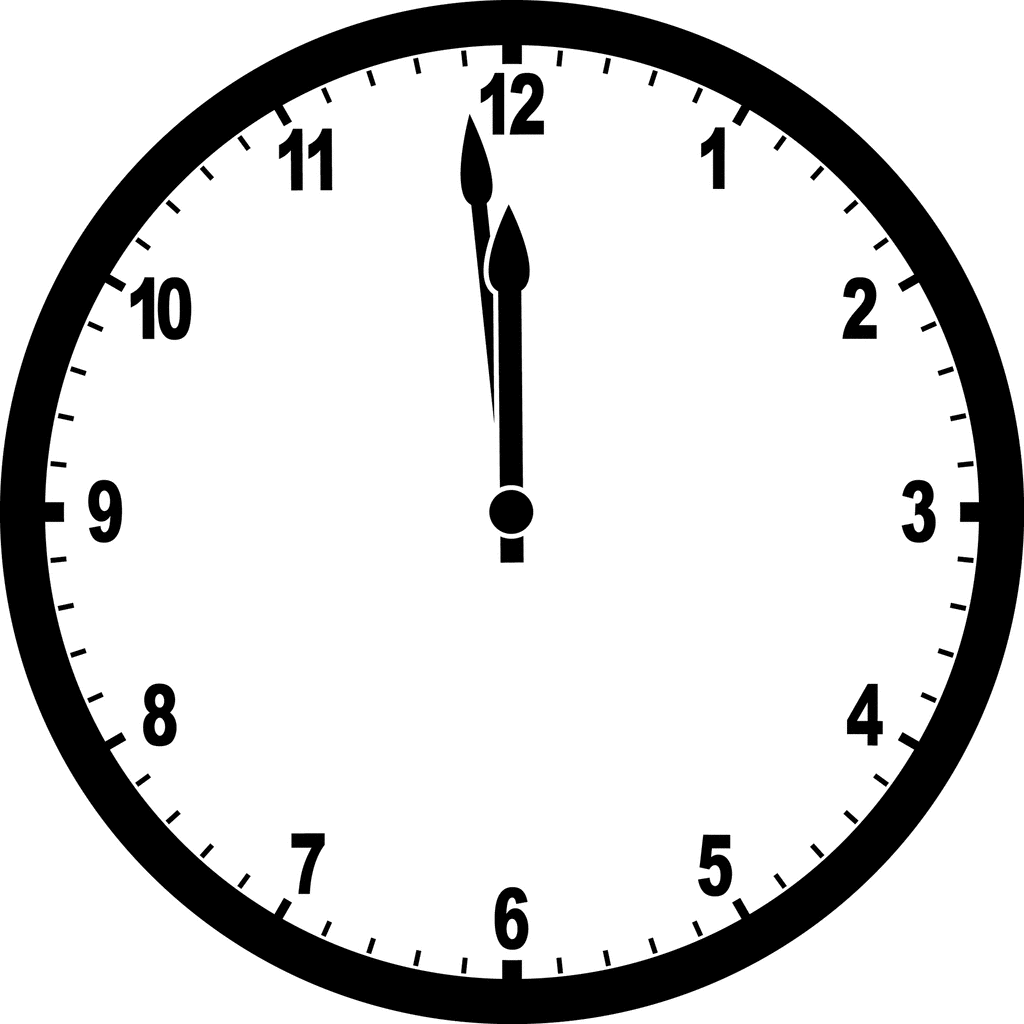
If our Earth's history was one 12 hour time period, when did people show up to the party?
A few seconds before midnight.
300
Explain Continental Drift and who proposed the theory.
Continental Drift was a theory proposed by the German scientist, Alfred Wegener. He said that at one point all the continents were at one point a large supercontinent, dubbed Pangaea, that broke apart over time.
400
If rock layers are called Strata, what is the study of these layers called?
What is Stratigraphy?
400
Which of the following provides evidence for past tectonic plate motions?
Matching rock type and rock formations can show the way the continents were once attached.
Glacial evidence has been found in areas where glaciers could not exist if the continents were in their current location.
Ancient life forms preserved as fossils can tell us what organisms existed and where they were. Matching the fossils can show that land masses were once connected.
All of the above.
All of the above.
400
What can geologists learn from studying the law of superposition?
Geologists can learn when events occurred and the order they occurred.
400
By studying the distribution of different types of fossils, geologists have determined that some plates have traveled great distances. Evidence to support this comes from the fact that...
fossils of organisms that lived in warm climates have been found in arctic environments.
500
What is the Geologic Time Scale?
The system of chronologic measurement that relates rock layers to time. (The timeline of Earth's history)
500
Name 2 events that occur at convergent boundaries:
Name 2 events that occur at divergent boundaries:
What are mountains and volcanoes?
What are rift valleys and seafloor spreading?
500
Which layer is the oldest? Which event happened second?
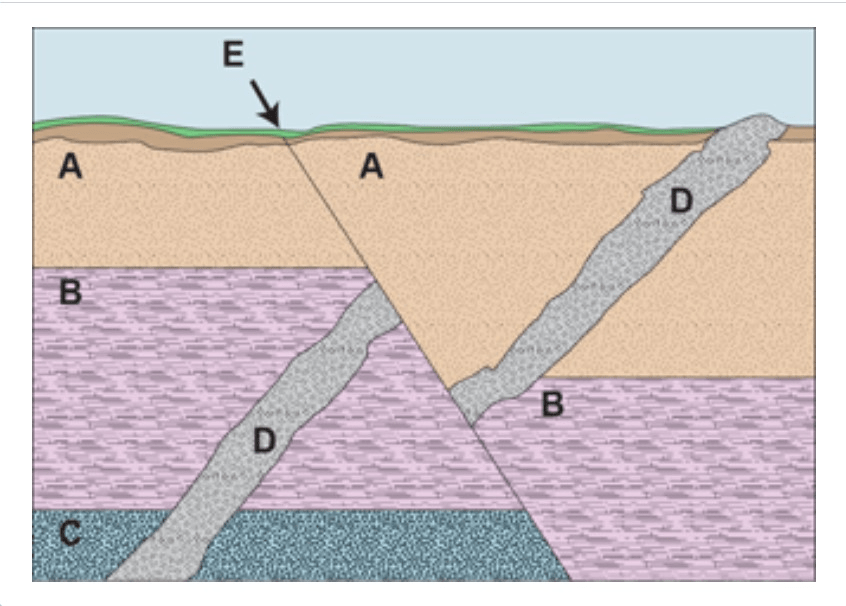
Layer C is the oldest and Event E happened second.
500
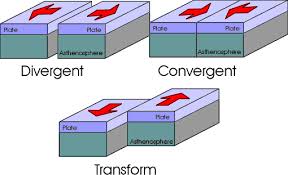
Name and define the different types of plate boundaries.
What are convergent (plates move together), divergent (plates move apart) and transform (plates slide past each other.