Geologic Time Scale
Timeline Tools
Principles
Mass Extinctions and Evolution
100
Scientists use this organized timeline to show the major events in Earth's history.
What is the geologic time scale?
100
This is the process of filling gaps in the rock record by matching layers or fossils with other regions
What is correlation?
100
This principle states that the same geologic processes happening today have also occurred in the past.
What is uniformitarianism?
100
The complete disappearance of a species from Earth is called this.
What is extinction?
200
This division of geologic time is smaller than an era but larger than an epoch.
What is a period?
200
This method of dating involves organizing layers by oldest to youngest, rather than finding actual numerical ages.
What is relative age dating?
200
This principle assumes that the oldest layers will be at the bottom, and get younger as they go up
What is superposition?
200
What evidence would indicate that a species went extinct
the disappearance of fossils above a certain layer
300
Why are the divisions of the geologic time scale not all the same length?
Because scientists divide Earth's history based on major changes in Earth's geology and life, so different intervals lasted different amounts of time
300
These unique layers are helpful because they are easy to recognize, and usually signify a major event or mass extinction.
What is a key bed?
300
Scientists can use this principle to infer that two layers are the same even miles apart, because layers form over large areas
What is lateral continuity?
300
A rapid, widespread loss of many species over a relatively short period of geologic time is called this.
What is a mass extinction?
400
Put these divisions in order from largest to smallest: period, eon, epoch, era.
What is eon → era → period → epoch?
400
These two characteristics make a fossil a good index fossil
1. Existed for a short time
2. Were abundant in many locations on Earth
400
Which is older: H or G, and what principle did you use?
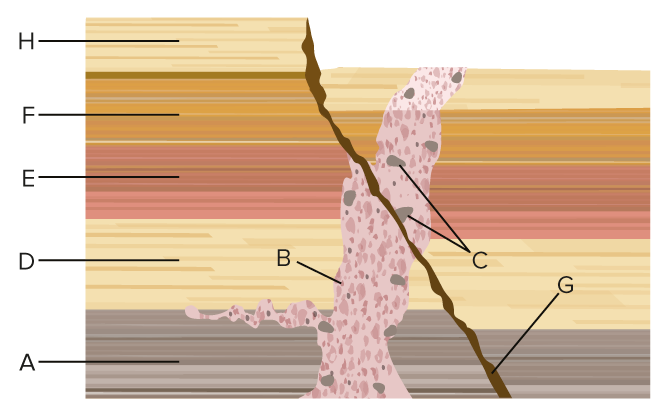
Based on the principle of cross-cutting relationships, if a feature cuts through a layer, the layer is older. That means the layer H is older than the fault G
400
Scientists have identified this many major mass extinction events in Earth's history.
What are five major mass extinctions?
500
Challenge: Name any of the current Eon, Era, Period, or Epoch that we are in
Eon: Phanerozoic (abundant animal and plant life)
Era: Cenozoic (age of mammals)
Period: Quaternary (start of early hominids)
Epoch: Holocene (age of humans)
500
Challenge: The presence of this element in the rock indicated a meteorite impact that caused the extinction of the dinosaurs
What is Iridium?
500
These are breaks or gaps in the rock record that are usually caused by erosion
What are uncomformities?
500
CHALLENGE: This mass extinction (boundary) occurred about 66 million years ago and resulted in the extinction of non-avian dinosaurs.
What is the Cretaceous-Paleogene (K-Pg) extinction?