Vocabs
True/False
Points, Lines, Planes
Postulate
100
A flat surface with no thickness.
Plane
100
You can name a ray with points A and B, where A is the endpoint, as either Ray AB or Ray BA.
FALSE, the first letter always has to be the starting point.
100
The intersection two lines
What is a point.
100
The Segment Addition Postulate and the Angle Addition Postulate both share the same idea of
part + part = ___________
whole
200
Points that lie on the same line are called _________?
collinear
200
A segment has one endpoint.
False, there are 2 endpoints.
200
The intersection of two planes
A line
200
Name this Postulate:
AB + BC = AC
Segment Addition Postulate
300
Three or more points that lie in the same plane.
Coplanar
300
Complementary angles must be adjacent.
False, complementary angles just mean their angle measures add to 90 degrees.
300
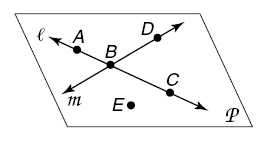 Name 3 Collinear points.
A,B, & C
300
A point that divides a segment into two congruent parts.
Midpoint
400
What does a bisector do?
Bisector splits something (line, angle, etc) into 2 congruent parts
400
If point B is between points A and C, then AB = BC.
False, B does not have to be the midpoint. It can be located anywhere.
400
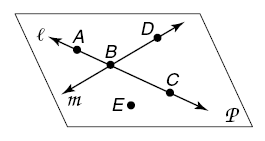 Name 3 noncollinear points.
E, A, & B or
E, B, & C, or
E, B, & D
etc.
400
A ray that divides an angle into two congruent angles.
Angle Bisector
500
What are linear pairs?
(There are 2 key components we need to mention)
Adjacent angles that add up to 180 degrees (supplementary)
500
Two distinct lines can intersect in more than one point.
False, the only way for two lines to intersect in more than one point is if they are the exact same line.
500
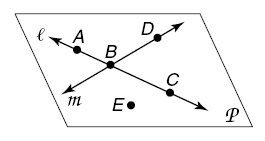 Name the plane.
Plane P or
Plane ABD or
Plane BEC or
etc.
500
Why do we use absolute value when doing the Ruler Postulate?
Ruler Postulate is used to find distance.
Distance cannot be negative.