Geometric Reasoning and Logic
Transformations and Symmetry
Coordinate Geometry
Geometric Measurement
100
When two parallel lines are cut by a transversal, these types of angles are on opposite sides of the transversal and inside the parallel lines.
What are alternate interior angles?
100
These three specific transformations (translations, reflections, and rotations) are known as "rigid motions" because they preserve this.
What is distance or congruence?
100
To prove a quadrilateral on a coordinate plane is a rectangle, you can show that its diagonals are congruent or that its adjacent sides have slopes that are this.
What are opposite reciprocals?
100
To find the area of a trapezoid, you multiply the height by the average of these two parallel parts.
What are the bases?
200
This theorem states that the sum of the measures of the interior angles of any triangle is always
180^o
What is the Triangle Sum Theorem?
200
A regular hexagon has this many distinct lines of reflective symmetry.
What is 6?
200
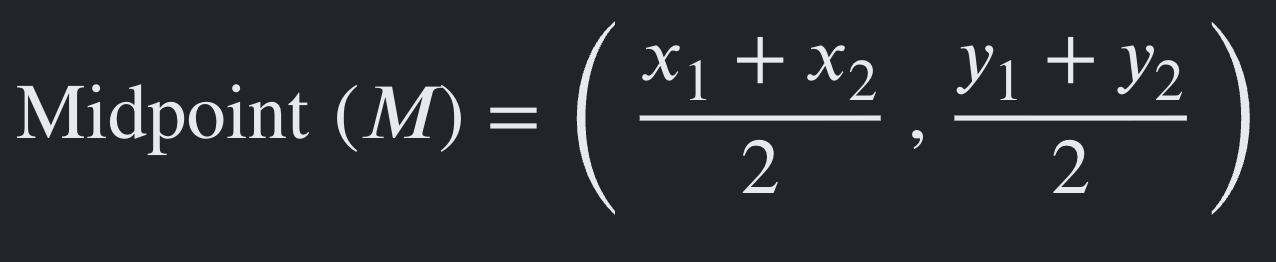
On a coordinate plane, this formula is used to find the middle of 2 points. Give the formula.
What is the midpoint formula?
200
This 3D figure’s volume is calculated by the formula
V=1/3BH
, where B is the area of the base and h is the height; it applies to both pyramids and these circular-based shapes.
What are cones?
300
If two polygons are similar, their corresponding angles are congruent, but their corresponding sides must have this relationship.
What is proportional?
300
To prove two figures are similar but not congruent, the sequence of transformations must include at least one of these.
What is a dilation?
300
In the standard form equation of a circle, the variables h and k represent this part of the circle.
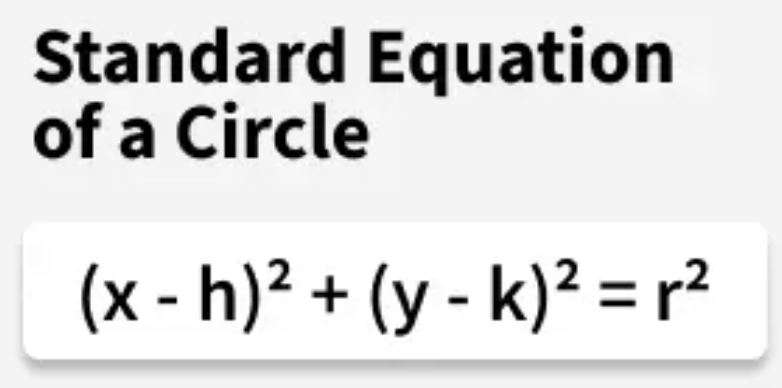
What is the center?
300
If the side lengths of a square are doubled, the area of the square increases by this factor.
What is 4?
400
In a parallelogram, these types of angles (which share a common side) are always supplementary.
What are consecutive interior angles?
400
If you rotate a square 90 degrees around its center, it will occupy the exact same space, a property known as this type of symmetry.
What is rotational symmetry?
400
To find the perimeter of a triangle on a coordinate plane, you must use this formula (derived from the Pythagorean Theorem) for each of its three sides. Give the formula.
What is the distance formula?
400
For a cylinder, the "lateral area" refers to the surface area of everything except for these two circular parts.
What are the bases?