Finding Arc Measures
Pythagorean Theorem
Tangent Ratio
Sine and Cosine Ratio
Proving a Quadrilateral is a Parallelogram
100
If line FH is the diameter of the circle, what is the m∠GEH?
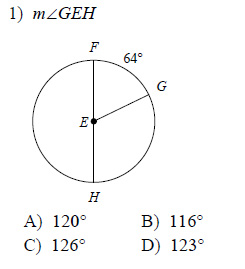
A: 116°
180° - m∠FEG = m∠GEH.
180° - 64° = 116°.
100
Find the value x.

A: 10
a2 + b2 = c2
62 + 82 = 100
√100 = 10
100
Find the value of x. Round to the nearest tenth.
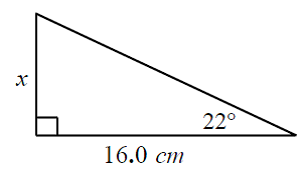
A: 6.5
tan = opp/adj
tan(22) = x/16.0
16 tan(22) = x
x ≈ 6.5
100
Find the sine and cosine of ∠A.
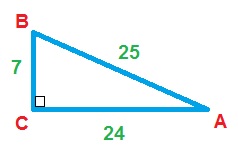
A: 0.28, 0.96
sin = opp/hyp
cos = adj/hyp
sin(A) = 7/25 = 0.28
cos(A) = 24/25 = 0.96
100
Quadrilateral ABCD is a paralellogram. ∠C is 43°. What is m∠A? m∠B? m∠D?
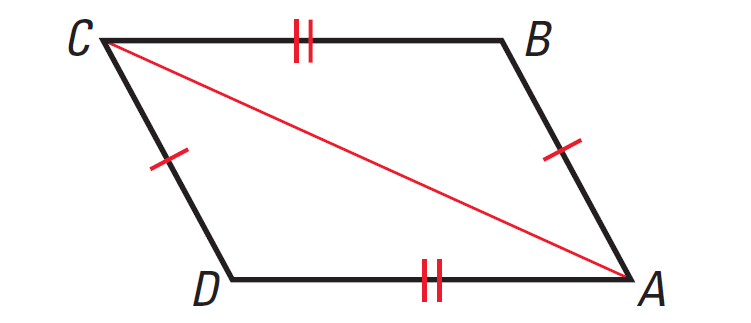
A: 43°, 137°, 137°
Because ∠A is the opposite angle of ∠C, it would have to be 43°. Based on same side interior theorem, that would make ∠'s B and D 137°. You get this by subtracting 43° from 180°.
200
What is the m∠AOC? What kind of arc is it? (major, minor, or half circle)
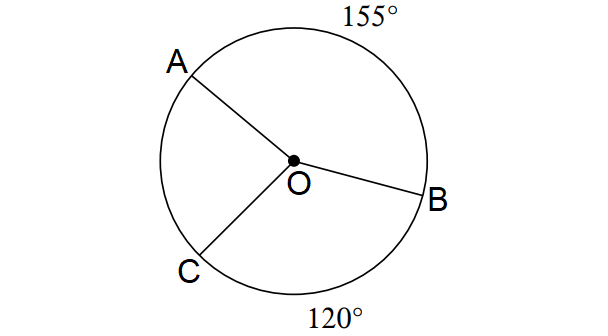
A: 85°, minor arc
360° - (m∠BOA + m∠COB) = m∠AOC
360° - (155° + 120°) = 85°
Because the arc is less than 180° it is a minor arc.
200
What is he value of x?
A: 27
a2 + b2 = c2
x2 + 362 =452
x + 1296 = 2025
2025 - 1296 = 729
√729 = 27
200
What is tan(53°)? Round to the nearest hundredth. What is the value of x?
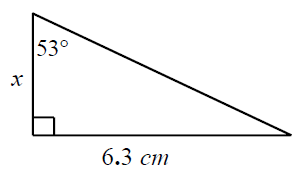
A: 1.33, 4.75
tan = opp/adj
tan(53°) = 6.3/x
tan(53°) ≈ 1.33
x = 4.75
200
What is the length of x? what is the cosine of 60°? Round to the nearest hundredth.
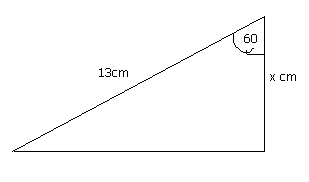
A: 12.38, 0.95
cos 60° = adj/hyp
cos 60° = x/13 (x 13)
13 x cos 60° = x
12.38 ≈ x
cos 60° ≈ 0.95
200
What is X? Is quadrilateral ABCD a parallelogram?
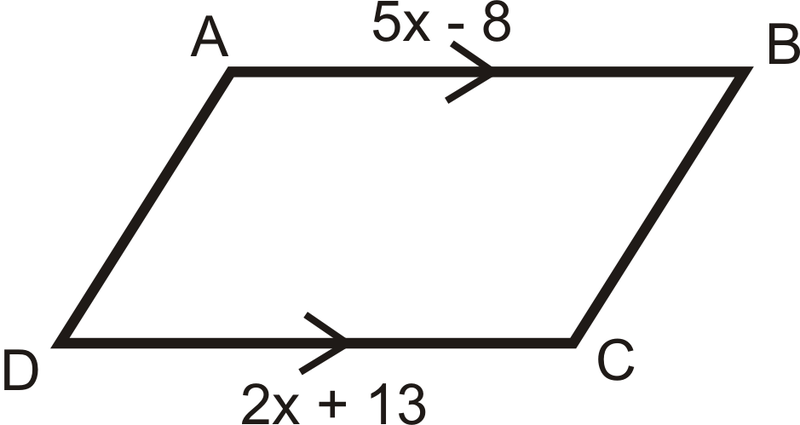
A: 7, yes
Segment AB = segment DC
5x - 8 = 2x + 13
3x = 21
x = 7
5(7) - 8 = 27
2(7) + 13 = 27
Opposite sides are parallel and equal
300
Line SP is the diameter of the circle (circle O). ∠TOS is a vertical angle to ∠QOP. what is the m∠ROQ?
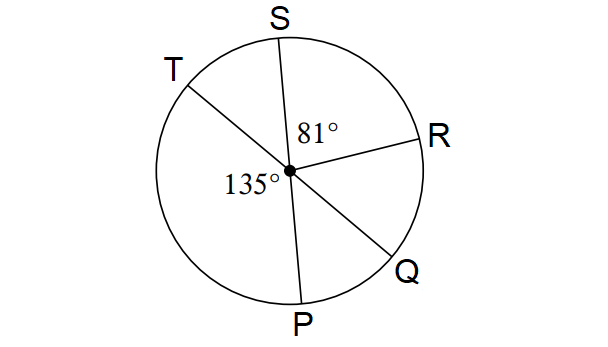
A: 54°
180° - m∠POT = m∠TOS. m∠TOS = m∠QOP. 180° - (m∠QOP + m∠SOR) = m∠ROQ.
180° - 135° = 45°. 180° - (45° + 81°) = 54°.
300
What is the distance from the wall to the bottom of the ladder?
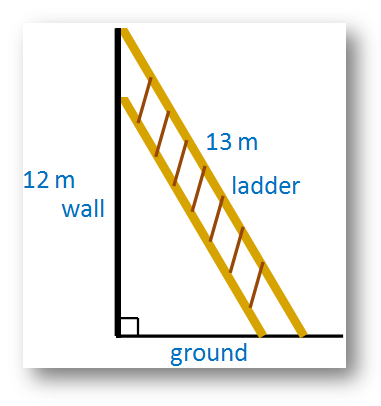
A: 5m
a2 + b2 = c2
? + 122 = 132
? + 144 = 169
169 - 144 = 25
√25 = 5
300
What is the value of x? What is the tangent? round to the nearest hundredth.

A: 28.80, 0.55
tan = opp/adj
tan(x) = 11/20
x = 28.8
11/20 = 0.55
300
What is the length of side K? What is the cosine of 53°? round to the nearest hundredth.
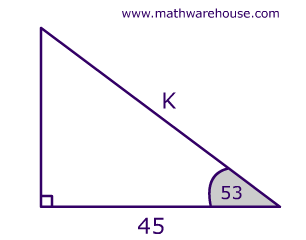
A: 41.32, 0.92
cos 53° = adj/hyp
cos 53° = 45/K (x 45)
45 x cos 53° = K
41.32 ≈ K
cos 53° ≈ 0.92
300
In quadrilateral WXYZ, WC = 2x + 5 and CY = 3x + 2. What must x equal for quadrilateral WXYZ to be a parallelogram? What is the length of WY?
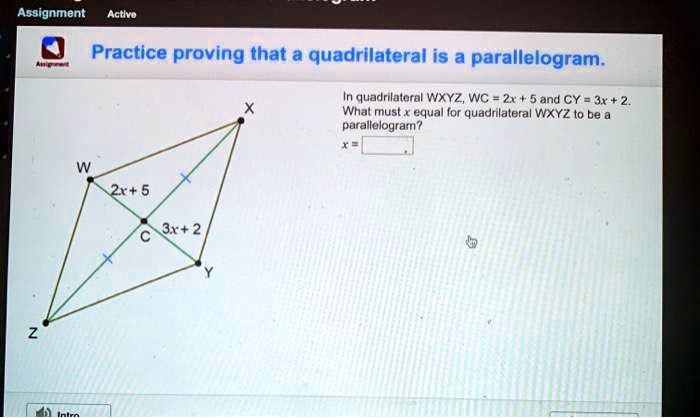
A: 3, 22°
In order to be a parallelogram, WC and CY would have to be congruent.
(2x + 5) = (3x + 2)
3 = x
2(3) + 5 + 3(3) + 2
6 + 9 + 7 = 22°
400
What is the value of X? What is the m∠RVU? What is the m∠UVT?

A: X = 8, m∠RVU = 101°, m∠UVT = 112°
360° - (60° + 87° + (x + 93°) + 14x)
360° - (240° + 15x)
120°/15x = 8°
8° + 93° = 101°
14(8) = 112°
400
Find the value of X.
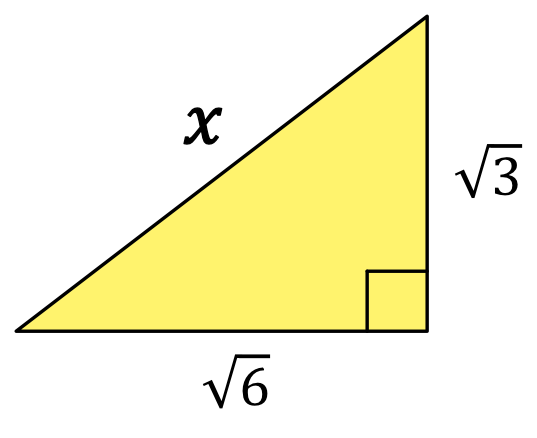
A: 3
a2 + b2 = c2
√32 + √62 = x2
3 + 6 = 9
√9 = 3
400
What is the value of x (CB)? what is the tangent? round to the nearest tenth.
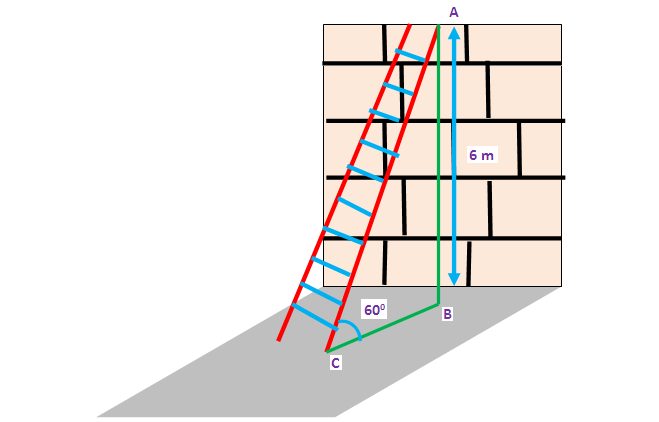
A: 3.5, 1.7
tan = opp/adj
tan(60°) = 6/x
x ≈ 3.5
6/x ≈ 1.7
400
Side AC will also be known as side B. What is the length of side B? what is the cosine of ∠A? Round to the nearest hundredth.
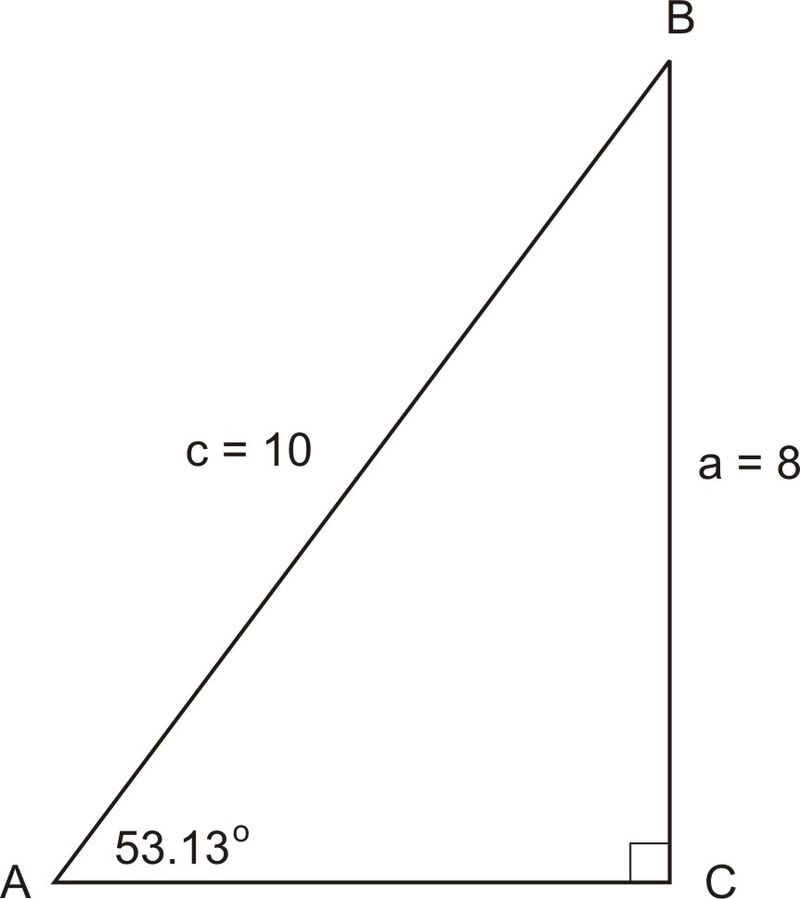
A: 9.62, 0.96
cos 53.13° = adj/hyp
cos 53.13° = x/10 (x 10)
10 x cos 53.13 = x
9.62 ≈ x
cos 53.13 =≈0.96
400
What must x and y be for quadrilateral ABCD to be a parallelogram? What is the m∠ABC? What is the m∠BAD?

A: 21, 39, 63°, 117°
Opposite angles are congruent
3x = (4x - 21°)
21° + 3x = 4x
21° = x
3y = (y + 78)
2y = 78
y = 39
3(21) = 63°
3(39) = 117°
500
What are the two possible arc measures for arc AE? Are they major or minor arcs? Now let's say this survey was taken by about 180 people (2% per person). How many people voted for country and other?

A: 103°, minor arc, 257°, major arc, 72
If you were to look at arc AE as arc AGE, then you would have to add all of the arcs between A, G, and E. 17° + 26° + 28° + 32° = 103°. 103° is under 180°, meaning it is a minor arc.
On the other hand you could say arc AE is actually arc ACE. You would then have to add up all the arcs between A, C, and E. 66° + 55° + 89° + 47° = 257°. 257° is greater than 180°, therefore it is a major arc.
If 2% is equal to one person and you were trying to find how many people voted for country/other, you would have to add up the percentages and divide by two. 55° + 89° = 144°. 144°/2 = 72.
500
Find the value of a. Round to the nearest tenth.

A: 6.7
a2 + b2 = c2
a + 6.42 = 9.32
a + 40.96 = 86.49
86.49 - 40.96 = 45.53
√45.53 ≈ 6.7
500
What is the m∠K? What is the tangent? Round to the nearest tenth.
A: 34.7°, 0.7
tan = opp/adj
tan(∠K) = 9/13
∠K = 34.7°
9/13 ≈ 0.7
500
Find the measure of side length D. Find the sine/cosine of 39 degrees. Round to the nearest hundredth.
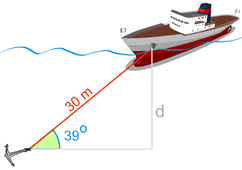
A: 28.91, 0.96, 0.27
sin 39° = opp/hyp
sin 39° = d/30 (x 30)
30 x sin 39° = x
28.91 ≈ x
sin 39° ≈ 0.96
cos 39° ≈ 0.27
500
∠D = (6x + 28) and ∠F = (16x - 12). CD = 6(y) - 4 while FE = 22. What is the measure of x and y? What is m∠C?
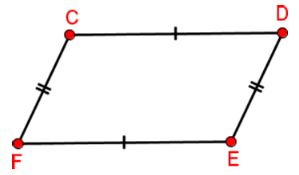
A: 4, 3, 128°
∠D and ∠F are opposite angles meaning they are congruent.
6x + 28 = 16x - 12
40 = 10x
4 = x
6y - 4 = 22
6y = 18
y = 3
Based on same side interior angle theorem, in order to find m∠C you must first find m∠F and then subtract that number from 180°.
m∠F = 16(4) - 12
m∠F = 64 - 12
m∠F = 52°
180° - 52° = 128°
m∠C = 128°