Postulates
Theorems/Definitions
Parallel/Perpendicular Lines
Similar Triangles
Angle Relationships
100
What does the Angle-Side-Angle Postulate look like in two congruent triangles?
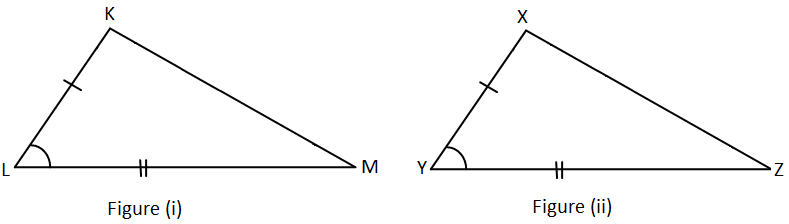
100
What does a bisector do to an angle or segment?
Cuts the angle or segment in half.
100
What is the slope of a line perpendicular to y=-3/4x+3?
The slope is 4/3
100

Write a similarity statement for the two triangles.
△PQR~△STR
100

What's the relationship between ∠8 and ∠12?
Consecutive Interior Angles
200
What is the Corresponding Angles Postulate?
A postulate that states if two parallel lines are cut by a transversal, then each pair of corresponding angles is congruent.
200
What are the measures of the angles in an equilateral triangle?
The measures are 60
200
Write an equation for a line parallel to y=x-3 that passes through the point (1,3).
y=x+2
200
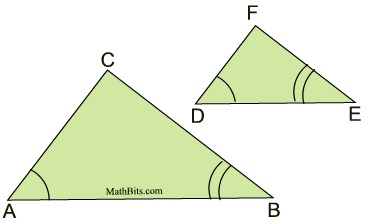
What theorem can you use to prove that these two triangles are similar?
AA thoerem
200
Find the measure of ∠4 if ∠11=100.
m∠4=80
300
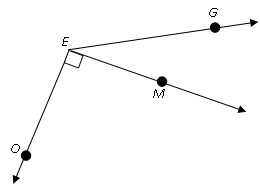
Give an example of the Angle Addition Postulate.
∠OEM+∠MEG=∠OEG
300
Name the property that justifies the statement: If AC=CE, AC=AB+BC, and CE=CD+DE then AB+BC=CD+DE.
Substitution Property of Equality
300
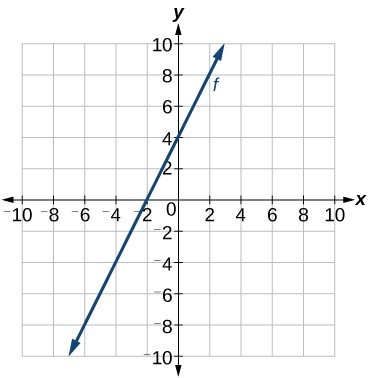
Write the equation of a line perpendicular to the line above that also passes through the point (1,0).
y=-1/2x+1/2
300

Find the measure of KM.
KM=27
300
Find the measure of ∠2 if ∠11=125.5.
m∠2=54.5
400


Write a two column proof.
Segment AB is parallel to
segment CD; segment AD Given
is parallel to segment CB
Segment BD≅Segment BD Reflexive Property of Equality
∠ABD≅∠CDB Alternate Interior Angles Theorem
∠ADB≅∠CBD Alternate Interior Angles Theorem
ΔABD≅ΔCDB ASA
400


Write a two column proof using Vertical Angles Theorem.
∠A≅∠C, ∠D≅∠B, segment
AD≅ segment CB , segment Given
AE≅ segment CE , segment
AC bisects segment BD
Segment BE≅ segment DE Def. bisector
∠AED≅∠CEB Vertical Angles Theorem
400
Write an equation for a line parallel to the line above that goes through the point (3,0).
y=2x-3
400
If a street sign is 9 feet tall and casts a shadow 12 feet long, then how long of a shadow will be cast by a nearby apple tree that is 12 feet tall?
16 feet
400

Given that m∠5+m∠3=180, determine which lines are parallel and state how you know.
Line L is parallel to line m due to the Converse of Consecutive Interior Angles Theorem