Transversals
Angle Bisectors
200
Find x and both ∡
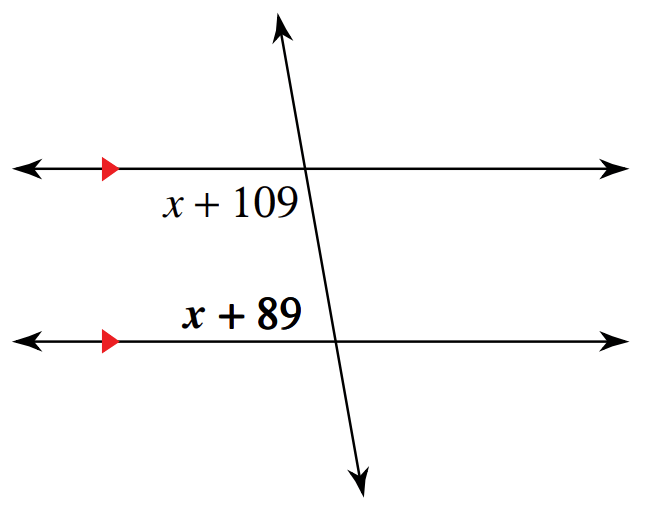
x = -9
∡(x + 109) = 100°
∡(x + 89) = 80°
200
m∠1 = 1 + 4x and m∠2 = 3x + 5. Find m∠YWX.
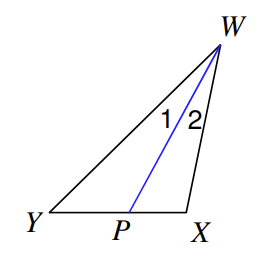
m∠YWX = 34°
350
∡ABC = 50° and ∡KIJ = 80°. Find ∡BEI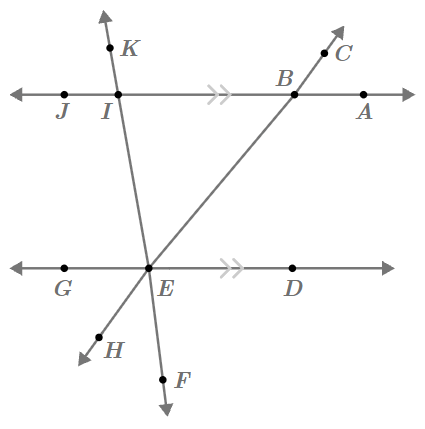
∡BEI = 50°
350
Given: A, B, E collinear
BD bisects ∠ABC, BF bisects ∠CBE
m∠ABD = (2x + 4)°, m∠CBE = (6x + 2)°
Find x
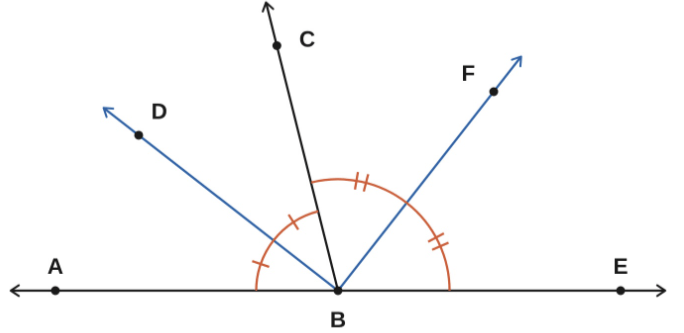
- (a) ∠ABC and ∠CBE form a linear pair, and ∠ABC = 2·m∠ABD. So 2(2x + 4) + (6x + 2) = 180.
- That simplifies to 10x + 10 = 180, so x = 17.
- (b) m∠ABD = 38°, which gives:
- m∠ABC = 76°
- m∠CBE = 6(17) + 2 = 104° ✓ (76 + 104 = 180)
- m∠CBF = 104 ÷ 2 = 52°
- m∠DBF = m∠DBC + m∠CBF = 38 + 52 = 90°
- (c) ∠DBF is a right angle. For any linear pair, m∠ABC + m∠CBE = 180, so half of each adds to ½(180) = 90. The bisectors of a linear pair are always perpendicular.
400
Given: l ∥ m
m∠1 = (3x + 15)°, m∠5 = (5x − 25)°,
m∠2 = (4y − 3)°
Find x and y
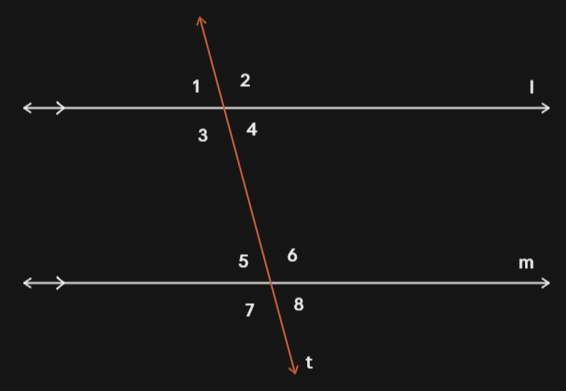
- ∠1 and ∠5 are corresponding angles, so they're equal: 3x + 15 = 5x − 25, so 40 = 2x and x = 20.
- That makes m∠1 = m∠5 = 75°.
- ∠1 and ∠2 form a linear pair, so they're supplementary: 4y − 3 = 180 − 75 = 105, so y = 27, and m∠2 = 105°.
400
Figure 1 (BD bisects ∠ABC; m∠ABD = (5x − 7)°, m∠DBC = (3x + 15)°)
1. Error analysis. Jordan writes (5x − 7) + (3x + 15) = 180 and gets x = 21.5. Explain Jordan's mistake. What does the sum of those two expressions actually represent?
2. Evaluate the claim. Maya says, "∠ABD is bigger than ∠DBC whenever x > 11." Is her algebra correct? Does her claim make sense for this figure? Explain.
1. Jordan treated the two angles as a linear pair, but nothing in the figure makes ∠ABC a straight angle. Their sum is m∠ABC itself. Because BD is a bisector, the two halves are equal: 5x − 7 = 3x + 15, so x = 11 and m∠ABC = 96°. Jordan's x = 21.5 would give halves of 100.5° and 79.5°, which aren't equal.
2. Her algebra is correct: (5x − 7) − (3x + 15) = 2x − 22, which is positive when x > 11. But the claim doesn't apply to this figure. Because BD is a bisector, the halves must be equal, so x can only be 11. Any other x describes a ray that isn't a bisector.
500
Given: l ∥ m, k ⊥ m
m∠1 = (2x + 8)°, m∠9 = (3x − 3°),
m∠2 = (4y + 2)°
Find m∠1, m∠2, m∠5, and m∠9
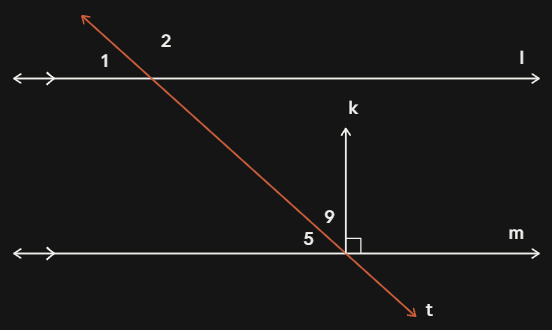
- CHECK WITH YOUR HOMIE!
500
Figure 2 (BD bisects ∠ABC; m∠ABD = (4x + 6)°, m∠ABC = (11x − 18)°)
4. Error analysis. Priya writes 2(11x − 18) = 4x + 6. Find her mistake. Then explain how she could tell her answer is unreasonable just by checking her angle measures, without redoing the problem.
5. Is it a bisector? Suppose we are not told that BD bisects ∠ABC, but we know x = 12. Is BD a bisector? Justify your answer with angle measures.
4. She doubled the whole angle instead of the half. Solving her equation gives 22x − 36 = 4x + 6, so x = 7/3. That makes m∠ABD ≈ 15.3° and m∠ABC ≈ −2.3°. An angle can't be negative, and the whole can't be smaller than its part. The correct equation is 11x − 18 = 2(4x + 6), which gives x = 10.
5. No. m∠ABD = 54° and m∠ABC = 114°, so m∠DBC = 114 − 54 = 60°. Because 54 ≠ 60, BD doesn't split the angle evenly. A ray is a bisector only if both halves are equal, or equivalently, if the whole is exactly twice one half.