Observations & Conclusions
Scientific Method
SI (Metric) System
Measurement
Metrix Prefixes
100
Which of these is a quantitative observation?
1. The sky is blue.
2. There are 10 pencils.
1. There are ten pencils.
100
What is the scientific name for an educated guess?
Hypothesis
100
What are the metric base units of length and mass?
meter and gram
100
50 g of water is placed into a beaker. The mass of the beaker is now 135 g. What is the mass of the empty beaker?
85 grams
100
How many milliliters are in one liter?
1,000
200
Identify the conclusion:
1. The coin is copper colored.
2. It looks like it is going to rain.
2. It looks like it is going to rain.
200
In the scientific method, how is a hypothesis tested?
By experiments.
200
What quantity measures the amount of space an object occupies?
Volume
200
What two things must be included in all measurements?
a number and a unit
200
How many centigrams are in one gram?
100
300
The observation "The box has red words written on the side" is qualitative because...
It does NOT include numbers and units.
300
What are the three types of variables in an experiment?
Manipulated, responding and control.
300
What are the metric base units for volume and time?
liters and seconds
300
Name the measurement using correct significant digits, make the following measurement in centimeters (cm).

4.4 or 4.5 cm (about)
300
What is the following numbers in scientific notation: 34000
3.4x10⁴
400
What is the difference between a quantitative and qualitative observation?
Quantitative observations include numbers and units, qualitative observations do not.
400
The final step of the scientific method involves making a __________ based on the results of the __________.
conclusion; experiment
400
Describe the process used to find the volume of a rectangular solid.
Multiply length times width times height.
400
A brick measures 5 cm by 2 cm by 3 cm. What is the volume of the brick in cm3? In mL?
30 cm3 and 30 mL
400
Convert 0.00025 Megaseconds to milliseconds.
2.5 x 10⁵ ms
500
What is the difference between an observation and a conclusion?
An observation uses the senses or devices in the lab to obtain information, and a conclusion is a statement based on observations and prior knowledge.
500
What are the four steps of the scientific method?
1. Making observations that lead to a question.
2. Forming a hypothesis to answer the question.
3. Testing the hypothesis by experiments.
4. Making a conclusion based on the results of the experiment.
500
Describe the process used to find the volume of an irregular solid such as a rock.
Water displacement: First, you put a measured amount of water into a graduated cylinder. Then you add the irregular solid and record the new volume. Then subtract the two volumes.
500
If this cube is dropped into a graduated cylinder with 46 mL of water, what will the new volume of water be?
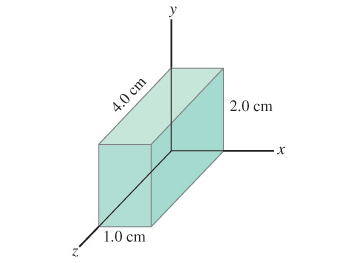
54 mL
500
What is the first thing you do in any conversion question?
Set up the problem in the question mark format.