Dividing Fractions
Integers
Ordered Pairs
Exponents
Fractions, Decimals, Percents
100
We use this process when dividing fractions.
What is Keep, Change, Flip (KCF)?
100
Positive numbers get larger as they move in this direction from 0.
What is right?
100
We always start at this place when graphing ordered pairs.
What is the origin?
100
Exponents represented this type of repeated operation.
What is multiplication?
100
All percents have a denominator of this number.
What is 100?
200
When dividing fractions, we always use this operation when solving.
What is multiplication?
200
Opposites are considered to have this in common.
What is the same distance from 0?
200
X-values move in these two directions.
What is left and right?
200
The big number represents this part of the exponent.
What is the base?
200
Fractions, decimals, and percents all represent this.
What is the same value?
300
The following expression would have this number as an answer.
5 div 1/4
What is 20?
300
The opposite of 6 would be this number.
What is -6?
300
Y-values move in these two directions.
What is up and down?
300
11 x 11 x 11 x 11 can be written as this exponent.
What is 114?
300
46% can be written as this fraction.
What is
46/100?
400
When dividing fractions, we always keep this part of the division problem the same.
What is the dividend?
400
The bigger the digit of a negative number, the ___________ the value.
What is smaller?
400
This quadrant has a negative x-value and a negative y-value.
What is quadrant III?
400
155 can be written as this multiplication expression.
What is 15 x 15 x 15 x 15 x 15?
400
The following fraction can be written as this decimal.
15/1000
What is 0.015?
500
The following expression would have this mixed number as an answer.
3/5 div 2/7
What is
2 1/10?
500
The opposite of -(-12) would be this number.
What is -12?
500
The following coordinate would have this for an ordered pair.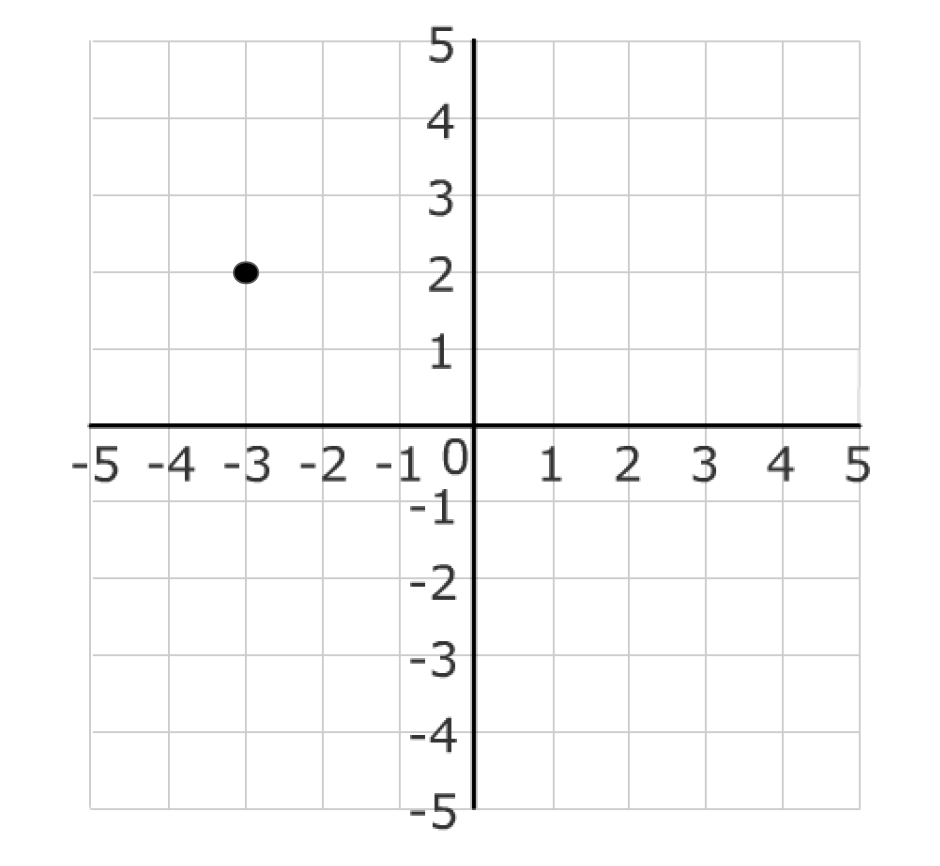
What is (-3, 2)?
500
The answer to the following expression would be this number.
22 + 32
What is 13?
500
0.1 can be written as this percent.
What is 10%?