Laws of Exponents
Exponential Growth
Exponential Decay
Factors and Rates
Interpreting Equations
100
Evaluate as a whole number.
5^4
625
100
Identify the growth factor from the table.
6
100
How do you know this equation models exponential decay, not growth?
y=40(1/2)^x
Because the decay factor (1/2) is less than one
100
The equation y=A(B^x) models exponential growth if ______.
B > 1 (growth factor is greater than one)
100
Identify the initial value.
y=100(1.07^x)
100
200
Evaluate as a whole number.
2^8/2^5
8
200
Give an equation modeling this growth.
y=6^x text( or ) y=1(6^x)
200
Find the decay factor from this graph.
1/3text( or )0.333...
200
Identify the rate of growth or decay from the equation below.
y=325(0.7)^x
30% decay
200
Identify the growth factor.
v=4,500(1.5^n)
1.5
400
Evaluate as a whole number.
(23^6times8^2)/(23^5times23)
64
400
Give an equation modeling this growth. Use F for fruit flies and g for generations.
F=2(60^g)
400
Give an equation for this graph.
y=300(1/3)^x
400
If the growth rate is 25%, the growth factor is ___.
1.25
400
Identify the growth rate.
p=2^t
100%
800
Evaluate as a whole number.
(159^0times6^(1/2)times0^2)/(3^20times17)
0
800
A population of mice grows exponentially. After 1 month, there are 36 mice. After 2 months, there are 108 mice. How many mice were in the population initially (at 0 months)?
12
800
Write an equation for this relationship.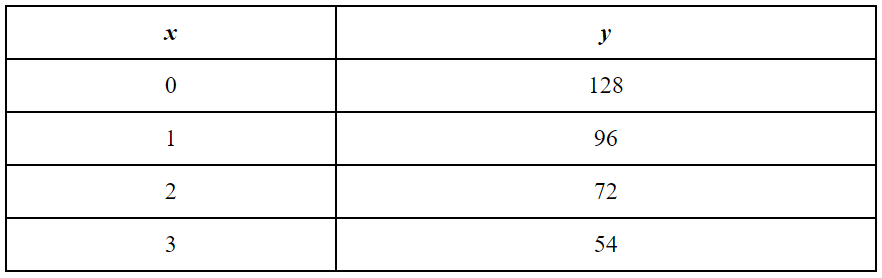
y=128(0.75^x)text( or )y=128(3/4)^x
800
If the growth factor is 3.4, the growth rate is ___.
240%
800
Identify the rate of decay.
m=60(0.85^h)
15%
1600
Evaluate as a whole number.
((3^2)^2)^2
6561
1600
John deposits $1,000 into a savings account with 10% annual growth. How many years will it take for the value in his account to double?
7-8 years
1600
An exponential decay graph has y-intercept 2400 and passes through (4, 150). When x = 3, what is y?
300
1600
If the decay rate is 6.5%, the decay factor is ___.
0.935
1600
Find the value of r, for p = 3
r=2500(3^p)
67500