Stars
H - R Diagram
Miscellaneous
Galaxies
Universe
100
The Color of a Star depends on its:
a. Size
b. Temperature
c. Shape
d. Magnitude
Answer: b. Temperature
100
The H-R Diagram shows the relationship of a star's surface temperature and its:
a. Color
b. Apparent Magnitude
c. Size
d. Absolute Magnitude
Answer: d. Absolute Magnitude
100
Distance of stars is measured using what?
What is light years.
100
Scientists classify galaxies by:
a. Size
b. Shape
c. Age
d. Color
Answer: b. Shape
100
Scientists and astronomers have much evidence that the universe is doing what? (Think about a balloon.)
Answer: Expanding

200
The color red represents the color of the __________ stars in the universe
Answer: Coolest
200
What type of star has used up all of its Hydrogen and is the leftover core of an older star? (Last phase of the star life cycle)
a. Red Giant
b. Supernova
c. White Dwarf
d. Main Sequence
e. Black hole
f. Neutron star
Answer: c. White Dwarf
200
What kind of star is the sun? (Refer to temperature, brightness. Think "type.")
Answer: Average temperature and brightness; main sequence. Type G main-sequence
200
what binds a galaxy together?
a. stars
b. gravity
c. a neutron star
d. a globular cluster
e. a black hole
Answer: b. gravity
200
Stars are composed mainly of what two elements?
+ 100 if you know the typical percentage of each.)
Hydrogen and helium
75% - H, 25% - He
300
Which of the following statements is true of stars:
a. New stars form from the material of old stars.
b. A star does not change its size or temperature during its life.
c. The shortest stage in a star's life cycle is the main sequence.
d. When a star dies, none of its material returns to space but is changed into pure energy.
Answer: a. New stars form from the materials of old stars
300
Which of the following shows the sequence of a star's life cycle from its earliest stage to its latest stage?
a. white dwarf, main sequence, red giant
b. main sequence, red giant, white dwarf
c. red giant, white dwarf, main sequence
d. main sequence, white dwarf, red giant
e. red giant, main sequence, white dwarf
Answer: b. Main Sequence, Red Giant, White Dwarf
(This is what we expect would happen to our sun.)
300
How bright a star would be if it were located at a standard distance. Synonymous with luminosity.
Absolute magnitude.
the apparent magnitude (The luminosity an object would have if it were located at a standard distance of exactly 10 parsecs (approximately 32.6 light-years) from Earth. It measures a star's intrinsic luminosity or true brightness, removing the effect of its actual distance from the observer.
300
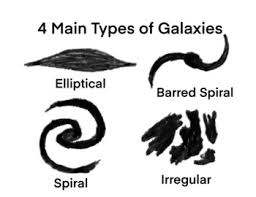
Scientists think the Milky Way probably is:
a. An Irregular Galaxy
b. An Elliptical Galaxy
c. A Ghirardelli Chocolate Galaxy - type 6-7
d. A Barred-spiral Galaxy
e. A Spiral Galaxy
Answer: e. A Spiral Galaxy
300
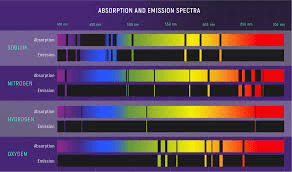
What is a star spectra used for?
To find out of which elements stars are composed.
They use absorption or emission spectra:
400
When looking through a glass prism, you see a rainbow of colors called the __________________ .
Answer: Color Spectrum (red, orange, yellow, green, blue, violet)
400
Used to measure the size of stars?
Answer: Solar Radii
It is a unit of distance used in astronomy to express the size of stars and celestial objects relative to the Sun. It is defined as the distance from the Sun's center to its photosphere, officially set by the IAU as 695,700 kilometers (approx. 432,300 miles) - which is the radius of our sun.
400
Stars that have a solar radii between 10-100
Answer: Giant star (Red Giant - example) - but NOT Supergiant.
400
A collection of hundreds of galaxies is called a(n)?
A Galaxy Cluster
400
What states that as the mass increases, gravitational attraction increases. As distance increases gravitational attraction decreases.
Newton's Law of Universal Gravity
500
The brightness of a star as seen from planet earth is known as: __________________ magnitude.
Answer: Apparent Magnitude
500
Where is our sun on the HR-diagram?
Answer: On the main sequence.
500
Star A has an apparent magnitude of -4 and an absolute magnitude of 2. Star B has an apparent magnitude of 3 and an absolute magnitude of -8 Which star is brighter?
Answer: Star B is brighter because it has a more negative absolute magnitude. Star B has an absolute magnitude 10,000 times brighter.
The difference: 2 - (-8) = 10.
5 magnitude difference = 100x.
So 10 = 1002 = 10,000
500
Astronomical units are used to measure the distance to which specific star?
The Sun
500
How is absolute magnitude calculated?
From the measured apparent magnitude and the distance from Earth.