Misc.
Condense + Extra
Expand + Graph
Log Equations
Exp Equations
100
log289(17)
1/2
100
3 log6(m) - 1/2 log6(n)
log6(m3/sqrt(n))
100
ln(10xsqrt(y^5))
ln 10 + ln x + 5/2ln y
100
log36(20-4p) = 1/2
p = 7/2 or 3.5
100
25(v-2) = 625
v = 4
200
log 9 27
3/2
200
log(3) + log(20) - log(4)
log(15)
200
log((100x^5)/(yz))
2 + 5 log x - log y - log z
200
log6(9) + log6(4x2) = 4
x = 6, x = -6
200
216(-2x-2) = 36(-2x)
x = -3
300
In 2000, the world population was about 6.09 billion. During the next 13 years, the world population increased by about 1.18% each year. Estimate the year when the world population was 7 billion.
2012
300
log3(x) + log3(x-4)
log3(x2 - 4x)
300
log_3((27x^4)/root(3)(81))
5/3 + 4log_3(x)
300
log14(x)+ log14(x+2) = log14(40-x)
x = -8, x = 5
300
8e^(1-x/2)+4=20
x=2-2ln2
400
Find the inverse:
f(x)=4log_2(x-5)+8
f^(-1)(x)=2^((x-8)/4)+5
400
2/3 log7(x) + 1/3 log7(y)
log_7 root(3)(x^2y)
400
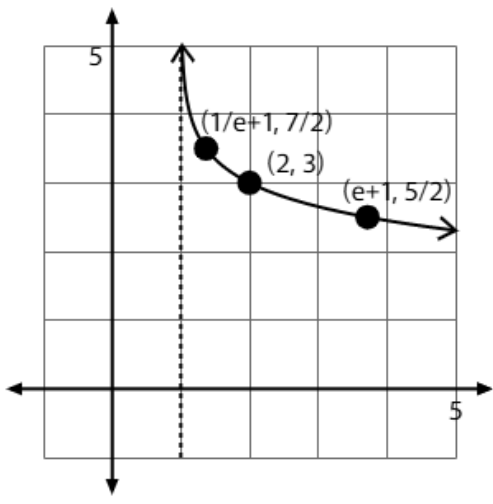
Graph
f(x)= -1/2ln(x-1)+3
400
ln(3x^2+4x+1)-ln(3x+1)=1
x =e - 1
400
(2^(3x-1) 4^(x+5))/8^(5-2x)=16
x = 10/11
500
Find the inverse.
g(x)=(1/4)e^(3x-9)+1
g^(-1)(x)=(ln(4x-4)+9)/3
500
State the End Behavior:
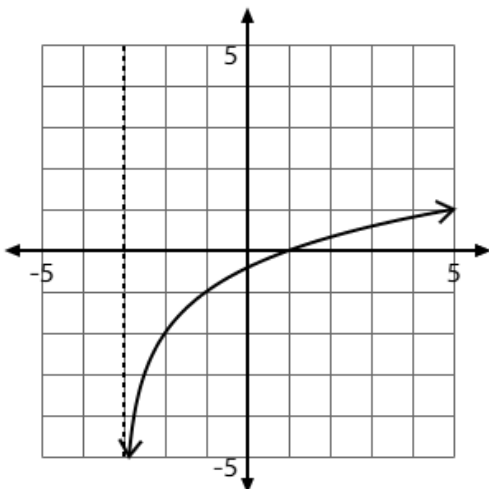
x->oo, f(x)->oo, x->-3^+, f(x)->-oo
500
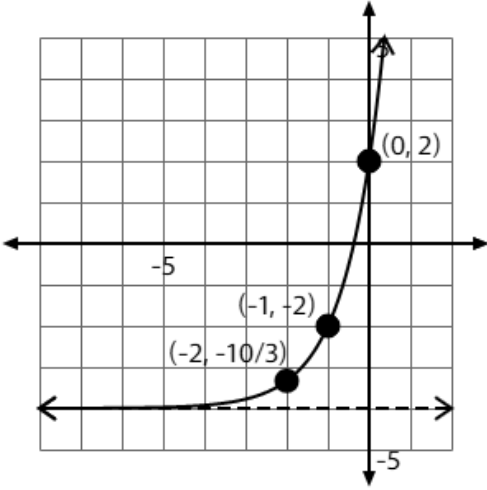
Sketch
f(x)=2(3^(x+1))-4
500
log3(4x+5) - log3(x+1) = 1
No Solution
500
3(5^(2x+1))^2-4=8
x=(log_5(4)-2)/4