Degree and Leading Coefficient
Multiplicity
Factorization
Long Division
100
What is the degree of the function below?
f(x)=(x-1)(x+3)(x+5)^3
5
100
What is the multiplicity of the zero at x = -5 ?
f(x)=(x-1)(x+3)(x+5)^3
3
100
Is x-1 a factor? Justify your answer.
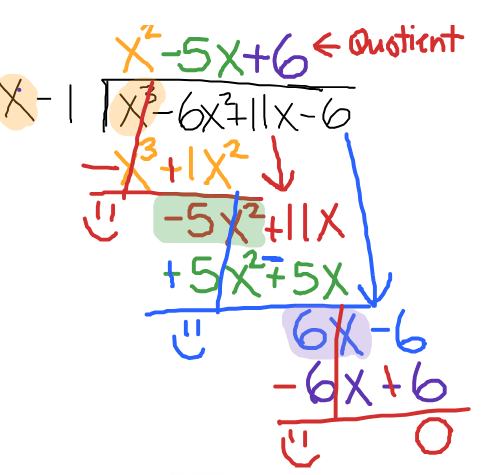
Yes, x-1 is a factor because when you divide the remainder is 0.
100
Use polynomial long division to solve.
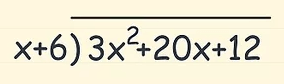
3x+2
200
Find the degree and leading coefficient.
f(x)=4(x-2)(x+3)^2(x+5)^3
Degree: 6
Leading Coefficient: 4
200
What is the multiplicity of the zero at x = -2 ?
f(x)=(x-2)^2(x+2)^3(x+5)^3
3
*if x = -2, the factor is x+2
200
Use the long division below to write a factorization of
x^3-6x^2+11x-6
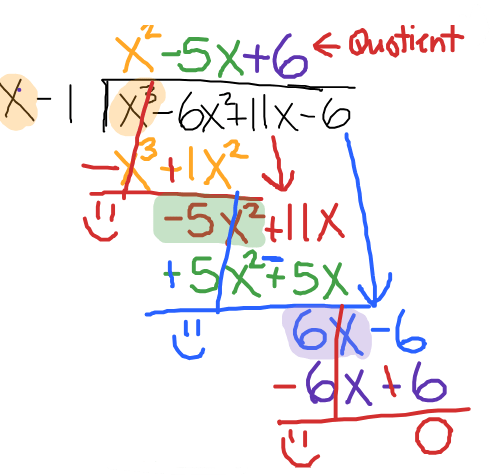
x^3-6x^2+11x-6 = (x-1)(x^2-5x+6)
200
Use polynomial long division to solve.

x^2+5x+2
300
What is the end behavior of the function?
f(x)=(x-1)(x+3)(x+5)^3
left down, right up
or
As x approaches -infinity, f(x) approaches -infinity,
As x approaches infinity, f(x) approaches infinity
(Positive odd)
300
What is the multiplicity if the zero at x = -1?
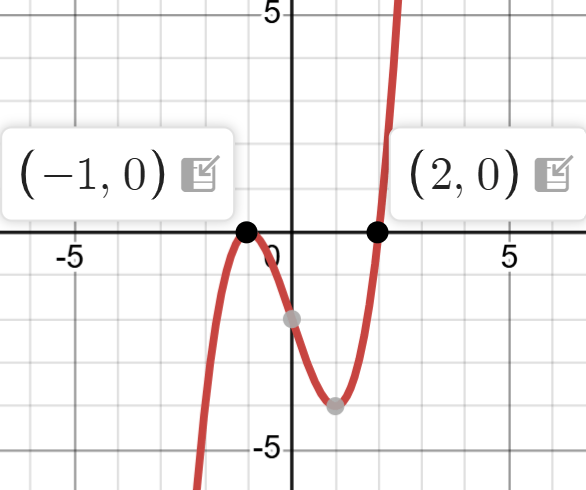
2
*parabola shape with vertex at (-1,0)
300
Use the factorization to help solve the equation
x^3-6x^2+11x-6 = 0
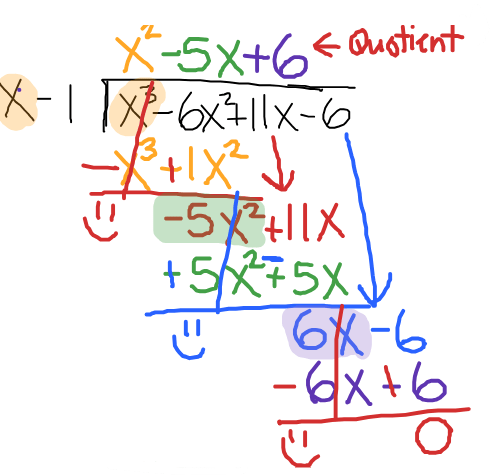
x=1, x= 2, x=3
*set each factor equal to 0 and solve.
300
Use polynomial long division to solve.

8x^2-2x-3
400
What is the end behavior of the function?
f(x)=-2(x-1)(x+3)(x+5)^3
left up, right down
or
As x approaches -infinity, f(x) approaches infinity,
As x approaches infinity, f(x) approaches -infinity
(negative odd)
400
What is the multiplicity if the zero at x = 2?
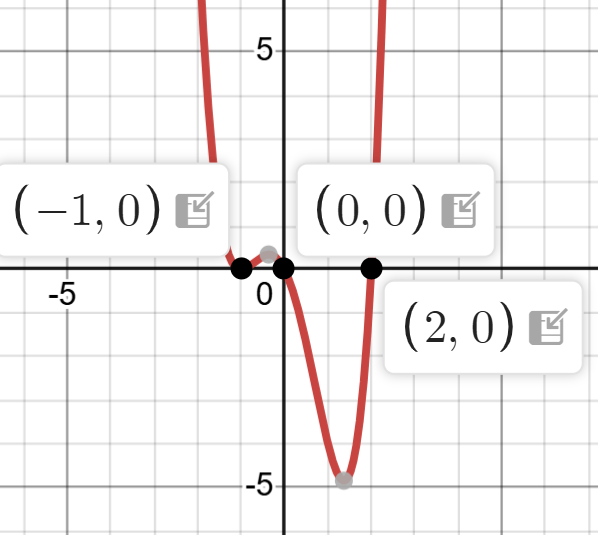
1
*goes straight through the point (2,0)
400
Use the long division below to determine f(-2)
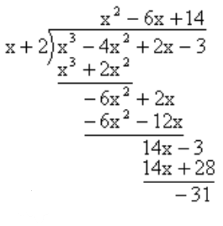
f(-2)=-31
*the factor for x=-2 is x+2, when you divide by x+2 the remainder is -31