Introduction
Methods
Results
Discussion
Conclusion
100
(True or False?) Academic articles will always provide a header for this section of a paper
What is false?
100
The Methods section primarily tells us who, what, when, where, or how the researchers conducted their study.
What is how?
100
(True or False) To quickly understand what the findings mean I should reference this section
What is false?
100
In this section, researchers explain what their findings mean and why they matter. What is this process called?
What is interpretation?
100
(True or False) Subramanyam recommends that this is one of the sections you should read first when persuing an article.
What is true?
200
A researcher wants to quickly determine whether an article is relevant before reading the entire paper. According to Subramanyam, this is the early section they should examine first.
What is the abstract?
200
1.76% of the students in Harris' study identified as _________.
What is Asian American?
200
Harris organized her findings into these three domains
What are cognitive, affective, and behavioral?
200
According to Subramanyam no ______ should be presented in the discussion section.
What is new data?
200
Subramanyam recommends that you read the conclusion _______ to determine whether what we had inferred initially is ________.
What is "twice" and "correct"?
300
According to Subramanyam, a strong introduction typically identifies _____ in previous research that motivate(s) the new study.
What is a gap/gaps?
300
Harris gathered _______ to learn more about their experiences inside and outside of the classroom.
What is student narratives?
300
Harris reported that students changed their attitudes towards particular groups as a result of the class. An attitude is a evaluative _______.
What is an evaluative judgement?
300
In the Discussion, researchers often explain whether their findings are consistent with or different from this.
What is previous research?
300
Put these four pieces of a research article in logical order: findings, research problem, future directions, interpretation, research procedures.
What is research problem → research procedures → findings → interpretation→ future directions?
400
If Harris had simply said, “Students need to learn about race,” without explaining what previous research had established or what remained unknown, she would be missing ______ for the study.
What is a rationale?
400
This qualitative method involves asking multiple people to discuss their perceptions, opinions, and experiences about a particular topic.
What is a focus group?
400
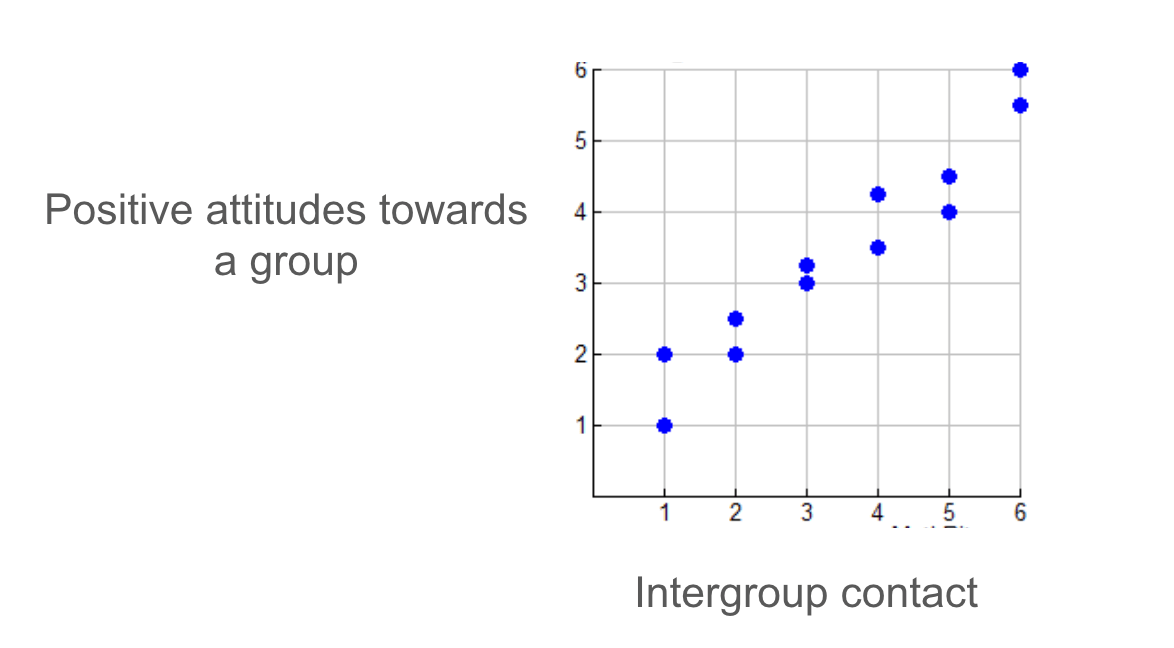 Describe the relationship between these two variables.
As intergroup contact increases, positive attitudes towards a group also increases (or vice versa). There is a positive relationship/association/correlation between these two variables.
400
Harris argues that students' experiences in the interracial communication course may help them develop greater awareness and understanding of this.
Answer: What are interracial interactions/relationships?
400
Harris's students reported positive changes after taking the course. Why can't we automatically conclude that the same changes would occur in every interracial communication course?
The study's particular students, course, and context may differ from other courses and populations.
500
Write one additional research question that could be answered using data from Harris's study. Provide a one sentence explanation explaining why you'd like to answer that question.
I'll evaluate these
500
Harris wanted to understand students’ perceptions and experiences in an interracial communication course. Why was a qualitative approach, using student narratives and focus groups, appropriate for answering this type of research question?
Because qualitative methods allow researchers to explore participants’ perceptions, experiences, and meanings in depth rather than reducing their responses to numerical measures.
500
A study finds that students who take an interracial communication course report a statistically significant increase in racial awareness, but the average increase is only 0.02 points on a 100-point scale. Why might this finding be statistically significant but not practically meaningful?
Because the difference is unlikely to be large enough to make a meaningful difference in students’ actual experiences or behavior, even though the statistical test indicates that the difference is unlikely to be due to chance.
500
Harris finds that students reported changes in the ways they navigated or thought about interracial interactions after taking the interracial communication course. What is one alternative explanation for those changes besides the course itself?
Students who enrolled may have already been interested in improving their understanding of interracial communication, or may have had other experiences during the that influenced them.
(e.g., they could have been influenced by political events, other classes, books they were reading that discussed interracial interactions between characters, etc.)
500
Based on Harris's study, identify one conclusion that the evidence supports and one conclusion that would go beyond what the evidence can tell us.
A supported conclusion might be that students reported changes in their perceptions and attitudes toward race after participating in the course. An unsupported/overly strong conclusion would be that the course definitively eliminated racial prejudice or caused lasting behavioral change.