Gas Behavior
Gas Laws
Calculations
Theory & Concepts
Phase Change Diagram
100
This state of matter spreads out to fill all available space.
gas
100
when comparing pressure and volume, ________ must be kept constant.
temperature
100
A container has krypton at 0.57 atm, argon at 0.31 atm, and xenon at 0.05 atm. What is the total pressure.
0.93 atm
100
This equation relates pressure, volume, moles, and temperature.
The Ideal Gas Law
PV = nRT
100
Heating matter changes this type of energy.
kinetic
200
When the average kinetic energy of a gas increases,___________ increases.
temperature
200
Why will a balloon expand in a warm room.
Charles’s Law, temp up, volume up
particles move faster, more collisions
200
At STP, one mole of gas occupies this volume
22.4 L
200
A __________ particle moves faster than a ___________ particle
small, large
200
The phase change from gas to liquid is called this.
condensation
300
As a bubble travels up in the atmosphere, the volume of the gas inside _______________.
increases
300
Pressure and volume are ____________ related.
inversely
300
How many mols of an unknown gas are present in a container with a volume 30.4L at STP
1.36 mols
300
State one thing that the Kinetic Molecular Theory says about a gas.
Particles are in constant, random motion.
Their collisions are elastic.
Temperature and Average Kinetic Energy are directly related.
Particles do not attract or repel or have volume.
300
Name two phase changes that share a line on the phase change diagram.
melting/freezing
vaporization/condensation
400
Putting a can in the refrigerator causes the pressure inside to do this.
Decrease
400
Dalton's Law says the ______ pressure equals the sum of individual gas pressures.
total
400
A volume of chlorine gas, Cl2, is collected at 34 C and an atmospheric pressure of 875 torr and is 660. mL. Calculate the mass of chlorine gas obtained.
2.127 g
400
According to Henry’s Law, increasing pressure increases ____________ of a gas in a liquid.
the solubility
400
Can oxygen become a solid? Why or Why not?
Yes, if it gets cold enough
500
What is the spreading of a gas from high concentration to low concentration called and what is it called if it goes through a small space
diffusion, effusion
500
What 2 properties of gasses does this graph relate and is it a direct or inverse relationship?
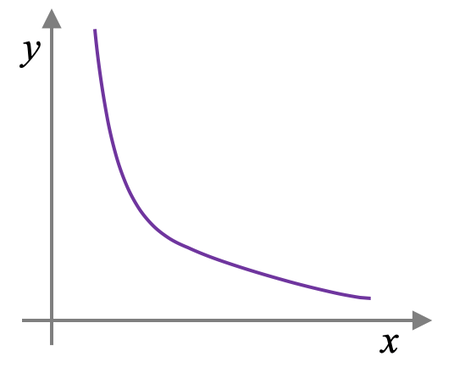
pressure and volume
inverse
500
At 305 K and 1.53 atm, a .515 g sample of a gas occupies a volume of 1980 mL. What is the molar mass of this sample?
4.29 g/mol
500
Tank A and Tank B are at the same temperature and pressure. A has a volume of 2L and B has a volume of 4L. Which has less particles? A, B, or are they the same?
A
500
During melting, temperature does this. And WHY?
Stays the same because the energy goes into breaking Intermolecular bonds.
600
What is density?
Mass per unit volume
(g)/(L) for gasses