Clinical Application
Pathophysiology
Labs/Management
Etiology/Genetics
From the Case
100
List 4 clinical presentations seen in individuals with HS
What are Anemia, Fatigue, Lethargy, Pallor, Jaundice, Black pigment Gallstones, and Splenomegaly?
100
Hereditary Spherocytosis is caused by a defect in:
What are spectrin and ankyrin proteins?
100
Name the definitive treatment for HS
What is a splenectomy?
100
What is the Inheritance Pattern of HS?
What is Autosomal dominant (~75% of cases)?
[What is Autosomal Recessive (~25% of cases)?]
100
Describe the findings of Lucas' peripheral blood smear
Erythrocytes have lost their biconcave shape, the presence of sphere-shaped erythrocytes, absent central pallor, potential anisocytosis, and decreased surface area of red blood cells
200
Erythropoietin is primarily secreted by the:
What are the kidneys?
200
___________________ is the gastrointestinal pathology most associated with HS.
What is Cholelithiasis?
200
Describe the levels of MCHC and RDW in individuals with HS compared to normal.
What are increased and increased?
200
_________________ commonly causes aplastic crisis in patients with sickle cell, thalassemias, and hereditary spherocytosis
What is Parvovirus B19?
200
______________ are pathologic RBCs that have an ____________ mean corpuscular hemoglobin concentration (MCHC)?
What are spherocytes and increased?
300
Elevated indirect bilirubin results in what clinical presentation of HS?
What is Jaundice?
300
Compare and Contrast Extrinsic vs Intrinsic Hemolysis. Which of these categories do HS fall under?
What is Intrinsic Hemolysis?
Extrinsic Hemolysis is when cause of hemolysis is external to the RBC. This can include antibodies, mechanical trauma (narrow vessels), and RBC infection.
Intrinsic Hemolysis is when cause of hemolysis is structural or functional RBC abnormalities. This is usually the failure of RBC membrane, Hemoglobin, or enzymes.
300
What type of anemia is seen in HS? What is the MCV range seen in this type of Anemia?
What is Normocytic Anemia? What is MCV 80-100 femtoliters?
300
The etiology of HS is a _______________ RBC membrane protein defect
What is Congenital?
300
Explain the osmotic fragility test and results seen in individuals with HS
Spherocytes are susceptible to osmotic lysis since they have a poor ability to swell like normal RBCs (due to loss of extra membrane); will lyse in hypotonic solution
400
Does anemia persist following splenectomy in a patient with HS? Why or Why not
No
400
Describe the pathophysiology of HS (big picture)
Genetic mutation → defects in RBC membrane proteins → continuous loss of lipid bilayer components → decreased surface area of RBCs in relation to volume → sphere-shaped RBCs with decreased membrane stability → inability to change form while going through narrowed vessels → entrapment of RBCs leading to various clinical presentations
400
Name two advantages of eosin-5-maleimide (EMA) binding test and the test findings in individuals with HS
1)What are high specificity/sensitivity, rapid turnaround time, and only a minimal amount of blood is needed?
2) What is reduced fluorescence?
400
What are the frequently affected proteins in Hereditary Spherocytosis (Name at least three)?
What is Spectrin, Ankyrin, Band 3, and Protein 4.2 ?
400
Explain how Lucas' recent viral infection led to the unmasking of his chronic spherocytosis
Infections that impair RBC production in the bone marrow and thus diminish the capacity to compensate for chronic hemolysis may lead to a period of aplasia. A common cause of aplastic crisis is parvovirus B19 infection.
500
Compare and Contrast the clinical presentation in mild, moderate, and severe HS. Which type is most common? At what age do these symptoms usually present?

500
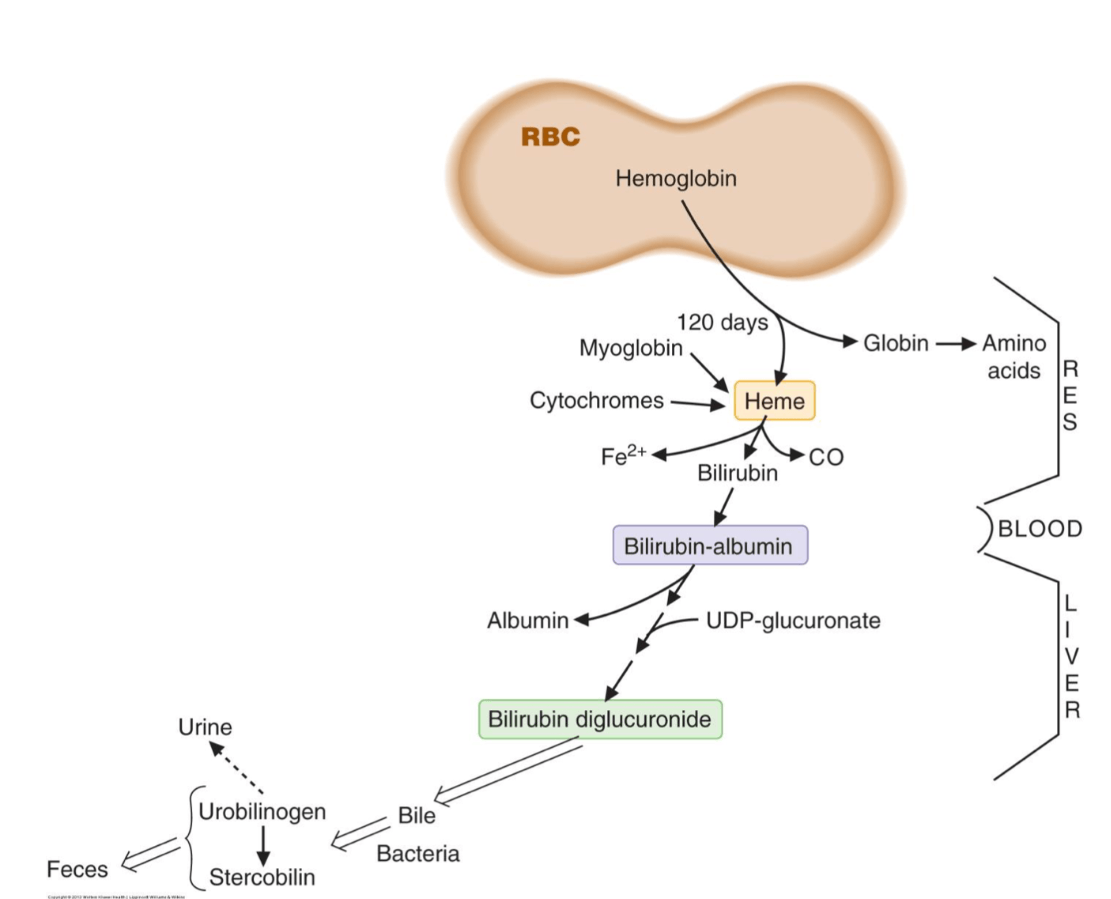
Name the products of heme catabolism (Atleast three). Outline the process of Heme catabolism
What are Fe2+, Stercobilin, carbon monoxide, and urobilinogen?
500
Explain Reticulocyte Production Index and its significance. What is the formula to calculate it?

500
HS may cause _____________ , manifesting as high-output heart failure and total body edema in the fetus.
What is hydrops fetalis?
500
Compare the outcome of infection with Parvovirus B19 in an healthy individual compared to an individual with HS?
Parvovirus B19 is a DNA virus that replicates in RBC progenitor cells. It decreases erythropoiesis. In a healthy individual, RBC production would return to normal in 10-14 days. In a patient with HS, you have increased RBC turnover and lack of erythropoiesis leading to severe anemia. This leads to a presentation of lethargy, pallor, and weakness.