What where How and when
From Hunting gathering to growing food
Understanding Diversity
100
Which languages were used for writing manuscripts?
Sanskrit, Prakrit, and Tamil languages were used for writing manuscripts.
100
Why the people start to protect the plants?
The people started protecting the plants because they could grow and the seeds could ripen.
100
What do you mean by ‘Kesar Saga’.
This is the local version of the Tibetan national epic sung by both Muslims and Buddhists of Ladakh.
200
identify the statement as True or false.
1. AD = BCE
2. BC = CE
1. False
2. False
200
We cannot know the exact dates when some customs and traditions started out and became common. But some people have studied the lives of present-day farmers and herders and they have made some guesses. For example, they believe that many farmers and herders lived in small groups. What are those groups called?
Tribes
200
Which are the religions practiced in Kerala?
Judism, Islam, Christianity, Hinduism and Buddhism are practised in Kerala.
300
How did our country get its names?
- Two of the words we generally use for our country are India and Bharat. The word India comes from the Indus called Sindhu in Sanskrit.
- The Iranians and the Greeks who came through the northwest about 2500 years ago, were familiar with the Indus, called it the Hindos or the Indos. The land to the east of the river (i.e., the Indus) was called India.
- The name Bharat was used by a group of people who lived in the northwest, and who are mentioned in the Rigveda, the earliest composition in Sanskrit (dated to about 3500 years ago). Later, it was used for the country.
300
People first started farming in the Neolithic Period. So watering the plants, weeding the soil, and driving away animals and birds from the fields became their routine. How was the life of those farmers different from the life of hunters and gatherers before them?
People who grew crops stayed in one place for a long time.
300

Which line in the poem sung after the Jallianwalla massacre, which according to you, reflects India’s essential unity.
The blood of Hindus and Muslims flows together today
400
What were the problems faced by people while travelling from one part to another part of subcontinent?
While people travelled from one part to another part of subcontinent, they had to face the hills and high mountains including the Himalayas, deserts, rivers and seas that made journey dangerous at times but never impossible.
400
Tell the important historical events against the following dates:
(a) About 12,000 years ago
(b) About 8,000 years ago
(a) About 12,000 years ago Beginning of domestication of plants and animals
(b) About 8,000 years ago Beginning of settlement at Mehrgarh
400
What are the reasons for existing diversity in India?
For a long time, people travelled from one place to another place for various reasons such as-trade, employment, droughts, wars, natural calamities etc. Due to the migration of people from one place to other places, their languages, food, music, customs, traditions become a mix of the new and old culture and from them came something new and different.
500
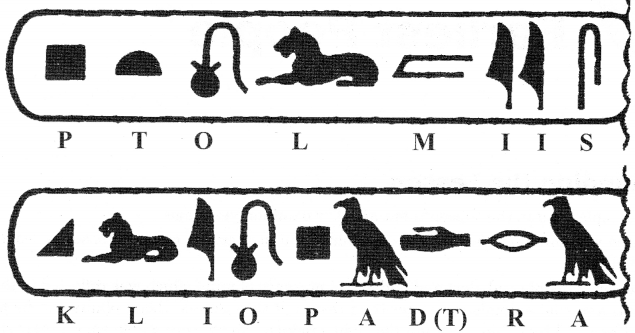
(a) What does the bird stand for?
(b) What does the lion stand for?
(c) Where was the inscribed stone found and what is the process of reading the letters, as describe above, called?
(a) A bird is stood for the letter A.
(b) Lion is stood for the letter L.
(c) The stone was found in Rosetta, a town on the north coast of Egypt. The process is called decipherment
500
Look at the picture given below. Please state its use in earlier times and in present.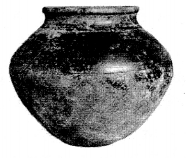
In the picture, a baked jar has been shown. This was prepared skillfully by mud and baked. It was earlier used to store the grains and seeds. People also used it for cooking the food.
In present time, these vessels are also used in the villages. Although the use of mud—made pots is very limited but still used in the villages. Women of the villages use this type of pot for:
(a) Boiling the milk, cooking of rice and pulses.
(b) Storing the agricultural produces.
(c) Putting money and ornaments.
(d) Storing drinking water etc.
Thus, we can see that this jar is almost having same nature of use in both the period. Only difference is that in the modern time, new objects are being used even in the villages.
500
how history and geography are often tied in the cultural life of a region. Describe in the view of Kerala and Ladakh.
While Kerala and Ladakh are quite different in terms of their geographical features, the history of both regions has seen similar cultural influences. Both regions were influenced by Chinese and Arab traders.
It was the geography of Kerala which allowed for the cultivation of spices and the special geographical location of Ladakh and its wool that drew traders to these regions. Thus history and geography are often tied in the cultural life of a region.