Global Economy
Australia's Place
Economic Issues
Economic Policies and Management
Theories
Formulas
100
The process by which trade, investment, finance, technology, and labour markets are increasingly interconnected across national borders.
Globalisation
100
a record of all economic transactions between residents of Australia and the rest of the world over a given period of time, usually a year.
Balance of Payments
100
When an initial increase in spending leads to a larger overall increase in national income.
Multiplier
100
One macroeconomic policy tool and what it uses to stablise economic activity when the economy is in a boom
What is monetary policy. It helps stabilise economic activity by increasing interest rates to decrease spending and investment to help reduce inflation.
100
Derived demand
The demand for labour is derived from the demand for goods and services
100
Aggregate Demand
C+I+G+X-M
200
The economic concept that when a country can produce a good at a lower opportunity cost than another country, forming the basis for specialisation and international trade.
What is comparative advantage?
200
A characteristic of an economy where domestic savings < investment → requiring foreign capital
What is the savings investment gap
200
A measure of the distribution of income within a population, ranging from 0 (perfect equality) to 1 (perfect inequality).
GINI Coefficient
200
The target for microeconomic policy, including how this is achieved.
What is Aggregate Supply, achieved by increasing efficiency and productivity in individual product and factor markets
200
costs/benefits imposed on third parties; markets fail without intervention.
What is externalities?
200
Real economic growth rate
Real GDP cy - Real GDP py/Real GDP py x 100
300
The total market value of goods and services produced by the residents of a country, regardless of where production takes place.
Gross National Income
300
The calculation of the Balance of Payments
CA + KAFA = 0
300
Why unemployment can't fall below the NAIRU without causing upward pressure on inflation.
What is when unemployment falls below the NAIRU, labour shortages push wages up which raises business costs and causes cost push inflation to accelerate
300
Governments use fiscal policy to influence economic activity.
Fiscal policy that supports economic growth (name and mechanism)
What is expansionary FP, greater deficit or smaller surplus through higher spending or lower taxes
300
importance of government intervention in managing demand.
Keynesian Economic theory
300
Rate of inflation
CPI cy − CPI py/ CPI py × 100
400
Provides long-term loans and aid to support development and poverty reduction.
World Bank
400
A floating exchange rate that fluctuates due to changes in demand and supply but is influenced by central bank intervention.
Dirty float
400
The inflation that occurs where an increase in aggregate demand leads to rising demand without rising output
Demand pull inflation
400
The limitation of Monetary Policy that is seen in a downturn
What is HH & businesses not increasing consumption/investment despite low interest rates due to lack of confidence
400
Graph that shows the trade-off between inflation and unemployment.
Phillips Curve
400
Participation rate
Working Age Population/Labour Force × 100
500
The theory that in the long run, exchange rates adjust so that identical goods cost the same across countries once currency values are accounted for.
Purchasing Power Parity
500
Savings-Investment Gap, Trade Dependence, Foreign Investment Reliance
Structural factors contributing to CAD
500
3 conditions (aspects) for external stability
What is:
Stability of the currency
Sustainability of CA
Serviceability of foreign liabilities
500
The combination of outcomes based on the transmission mechanism when the RBA tightens monetary policy during a period of strong aggregate demand
A. Higher interest rates → increased borrowing → higher inflation
B. Higher interest rates → reduced consumption and investment → lower inflation
C. Higher interest rates → increased government spending → higher inflation
D. Higher interest rates → increased export competitiveness → lower inflation
What is B. Higher interest rates → reduced consumption and investment → lower inflation
500
Common resources are overused without regulation
Tragedy of the commons
500
Calculate the unemployment rate:
Unemployed = 700,000
Labour Force = 15,000,000
Population 15+ = 30 000 000
4.67%
600
Method of protection: A government policy or program designed to encourage domestic businesses to increase the sale of goods and services to overseas markets, often through measures such as tax concessions, grants, subsidies, or marketing assistance.
Export Incentives
600
Impacts of an appreciation of the $A on Aust international BoGS in medium term, with reasoning.
What is? An appreciation makes exports more expensive for o/s buyers and imports cheaper for Aust buyers. Export volumes tend to fall and import volumes rise = BoGS will worsen.
600
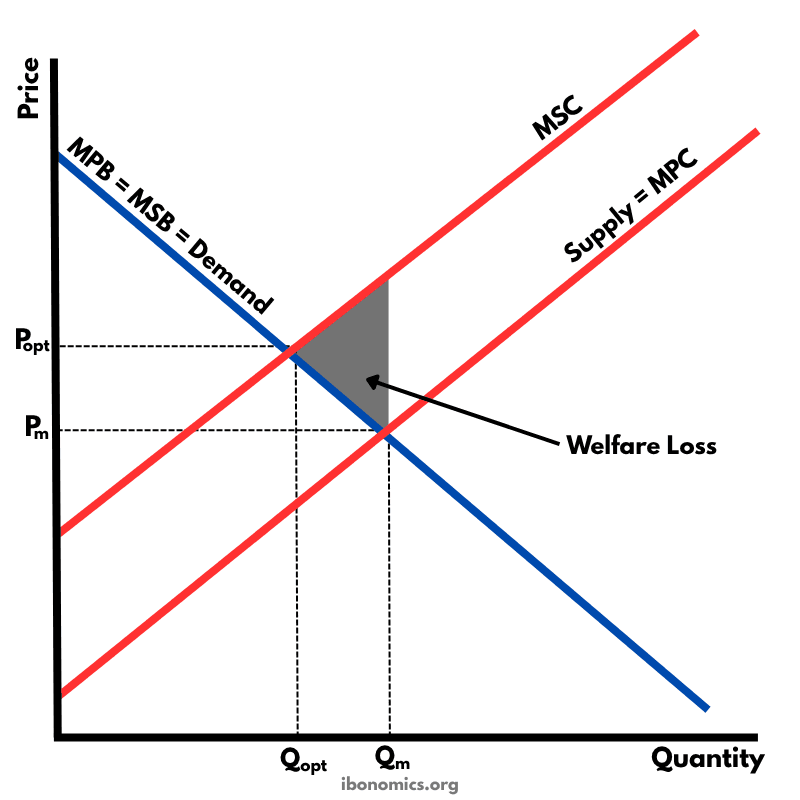
Refer to the diagram - how does a divergence between private and social cost lead to negative externalities being created in an economy.
What is:
Private cost is what the firm pays.
Social cost includes private cost plus external costs to 3rd party (pollution, congestion, health impacts).
When social cost > private cost, the firm faces no incentive to reduce output or internalise the harm.
This leads to overproduction, where output occurs at the point where MPB = MPC, not where MSB = MSC.
The difference between MSC and MPC at the market quantity represents the external cost imposed on society.
This external cost is the negative externality — harm not priced into the market.
600
Type of efficiency & why:
A bakery produces 500 loaves of bread each day using two ovens and five staff members. After upgrading its equipment, it is able to produce the same 500 loaves using only one oven and four staff members.
What is technical efficiency
The bakery is producing the same level of output (500 loaves) using fewer inputs (one oven instead of two, four staff instead of five).
Technical efficiency is achieved when a firm minimises the inputs required to produce a given level of output, and this example shows the bakery improving its production process to reduce resource use without reducing output.
600
economic growth (%) > (Productivity Growth (%) + Increase in labour force (%))
Okun's law
600
The Australian Government announces a $5 billion increase in infrastructure spending. The marginal propensity to consume (MPC) is 0.8.
Calculate the total increase in aggregate demand resulting from the initial government spending injection.
$25 billion