Remember what?
Common Module: Past the Shallows
Module A: One Night the Moon
Module B: Poetry of Robert Gray
Module C: The Craft of Writing
100
What is George's surname in 'Past the Shallows'?
Fuller
100
Identify TWO recurring motifs in the novel.
Unpredictable image of the ocean; shark-tooth necklace; Harry's nausea (link between nausea and trauma); repressed emotions.
100
What specific technique is employed in the film whenever close-ups of the moon are shown? *N.b. Only the MOST correct answer accepted.*
Motif
100
Robert Gray said that his poem, 'Byron Bay: Winter', was written in a traditional poetic form, but with loosened rhyme and rhythm.
What is the traditional form he has used?
Ballad
100
Explain TWO purposes of Module C: The Craft of Writing. Think back to the rubric!
Answers from the rubric could include:
- to strengthen and extend their knowledge, skills and confidence as writers
- to learn to write for a range of authentic audiences and purposes to convey ideas with power and increasing precision
- to study prescribed texts to use as models and stimulus for the development of their own ideas and written expression
- to examine how writers of complex texts use language creatively and imaginatively for a range of purposes, to describe the world around them, evoke emotion, shape a perspective or to share a vision
- to learn to appreciate, analyse and assess the importance and power of language
- to reflect on the complex and recursive process of writing to further develop their ability to apply their knowledge of textual forms and features in their own sustained and cohesive compositions
- to generate and explore ideas through discussion and speculations.
- to engage in the stages of drafting and revising
200
a) What is featured in the image below?
(b) What is the name of the island in 'Past the Shallows' where it is found?

(a) This is abalone. The men in the Curren family are abalone fisherman, braving the frigid ocean to dive for this rare commodity.
(b) Past the Shallows takes place on Bruny Island just off the coast of Tasmania, an Australian state that supplies 25% of the world’s abalone harvest.
200
Identify the MOST obvious technique in the following quote and explain its effect on meaning:
"[Miles] climbed onto the rails, was ready to jump, but Dad grabbed him up—held him like stone."
SIMILE
Parrett underscores the crushing strength with which Dad holds Miles down by comparing Dad's grip to stone. Conveys the power imbalance between the two and metaphorically emphasises the emotional disconnect between father and son.
200
Basic facts to know - answer ALL correctly to pass!
(a) Who directed 'One Night the Moon'?
(b) Who played Jim Ryan?
(c) What is the real life connection between the actor who plays Jim Ryan and the actress who plays Emily?
(a) Rachel Perkins
(b) Paul Kelly
(c) Paul Kelly is Memphis Kelly's father
200
This question has TWO parts.
(a) In which NSW town did Robert Gray grow up?
(b) Which of Robert Gray's hobbies does he view as a natural complement to poetry?
(a) Coffs Harbour
(b) Painting
200
Name ONE motif used in the story 'Dreamers'
* The tinkling ribbon is a recurring symbol that represents protection and control over Eric as well as the family’s overall worry over him
* The Bell
* Eagles - suggesting that the eagle was the one that killed Eric.
300
Complete the opening lines to 'This Land is Mine' from 'One Night the Moon'. (*Extra respect to those who sing the lines!*)
This land is ____
All the way to the ___ _____ ____
Every break of ___
I'm working ____ just to ____ __ ___
This land is mine
All the way to the old fence line
Every break of day
I'm working hard just to make it pay
300
Identify TWO key structural features of the novel.
Cyclical/circular narrative structure; non-linear structure; flashbacks; multiple character perspectives; use of language changes to reflect childishness/maturity.
300
Identify and describe the effect of THREE language techniques used in the following lines from the opening song 'I don't know anything any more':
"I see her face everywhere
I hear her voice across the air"
Hyperbole/Metaphor: 'I see her face everywhere'
Metaphor: 'I hear her voice across the air'
Sensory imagery of sight/sound: 'I see'/'I hear'
Rhyme: 'Everywhere'/'Air'
Assonance: 'Across'/'Air'
First person: 'I'
300
Read this poem excerpt:
"The train’s shadow, like a bird’s,
flees on the blue and silver paddocks,
over fences that look split from stone,
and banks of fern,
a red bank, full of roots,
over dark creeks, where logs are fallen,
and blackened tree trunks."
(a) What poem is this taken from?
(b) What technique is being employed in this excerpt, which causes an accumulation of visual imagery?
(a) Journey, the North Coast
(b) Asyndeton
300
After writing a creative piece, there are many questions you might ask yourself during the editing process to check the quality of your work. What are THREE of these questions?
Answers may include:
- Have you successfully achieved your artistic purpose?
- Have you used language forms and features to create meaning?
- Have you used symbolism, imagery, rhetoric, voice, characterisation, point of view, dialogue and tone to establish your purpose?
- Have you used simple and complex sentences to create meaning throughout your response?
- Is the meaning within your sentences clear?
- Have you proofed your spelling, punctuation and grammar?
- Have you received feedback from your peers and your teacher?
400
This question has THREE parts. Identify the correct name of the poem from which these quotes have been drawn:
(a) "And standing where I see the mirage of the city/I realise I am in the future."
(b) "Sprigged trees; a vista of Pre-Raphaelite shine:/beneath gentian hills, a billiard table green;"
(c) "They seemed to whisper, slipping amongst each other,/always hovering, as though resolve were ill."
(a) Flames and Dangling Wire
(b) Description of a Walk
(c) Harbour Dusk
400
Identify and describe the effect of the TWO figurative devices used in this interaction between Miles and Joe, after the death of Harry on the fishing vessel:
'You came back,' he said.
Joe nodded. He looked down at his hands and let go of the bed. Miles knew they were shaking.
'The wind was too strong,' he said. 'I couldn't get through the strait. I couldn't leave.'
And Miles knew it was lucky Joe hadn't been lost out there, too. He was lucky.
PATHETIC FALLACY/SYMBOLISM: The wind being 'too strong' to allow Joe's boat to pass through the strait and leave Bruny Island is symbolic of nature (i.e. a 'higher power' like fate) interfering in Joe's journey in order to bring him back to where he was needed most. The aggression and resisting force of the wind functions as pathetic fallacy echoes the brutality of his father's dominance and aggression during the incident on the fishing boat, which was happening at the same time Joe was attempting to leave (plot line unity). In the same way, the wind could also represent the strength of Joe's conviction to stay and support his brothers.
METAPHOR: The reference to Joe being lucky to have not been "lost out there" too, goes beyond the literal interpretation of his possible death, and signifies the potential loss of his identity/purpose and connection to his brothers if he left.
400
What grammatical distinction (technique), obvious through juxtaposition, causes subtle tension in the following dialogue between Rose and Albert's wife, leading to Albert's wife slamming the door in Rose's face:
Rose: Is the black tracker here?
Albert's wife: Albert's not here.
"Black tracker" is a common noun. Describing Albert by his racial features (adjective) and job/skill (noun), rather than his name, strips him of his identity and shows Rose's superior white voice and condescension to Albert as being 'lower' in social status than her.
"Albert" is a proper noun. Referring to him by his correct name restores his identity and power as equal to Rose and deserving of equal respect.
400
Read the following excerpt:
"Someone who worked here would have to weep,
and so we speak. The rims beneath his eyes are wet
as an oyster, and red.
Knowing all that he does about us,
how can he avoid a hatred of men?"
(a) What poem is this taken from?
(b) Identify THREE techniques and explain their effect on meaning.
(c) Why would the speaker assert that a tip worker would hate people as a result of his/her job?
(a) Flames and Dangling Wire
(b) Alliteration: Emphasises pity and sorrow.
Sibilance: Emphasises rare moment of human contact.
Alliteration: ‘rims’/‘red’
Simile: Denotes pain and suffering – our suffering.
Plural pronoun: Acknowledges shared/collective blame.
Rhetorical question: Challenging who we are and what we've become.
(c) The speaker is implying that being surrounded by mountains of human waste would be a continual reminder to the worker of our selfishness and material excess, disregarding our impact on the health of the environment.
400
This question has THREE parts.
a) What was one of the purposes of J.K Rowling's speech delivered at Harvard University?
b) What dominant technique is being used in Rowling's reference to Gryffindor in the following line: "Now all I have to do is take deep breaths, squint at the red banners and convince myself that I am at the world's largest Gryfffindor reunion."
c) When Rowling writes "Unlike any other creature on this planet, humans can learn and understand, without having experienced. They can think themselves into other people's places". To what human intellectual phenomenon is she referring?
a) To motivate students; to celebrate student's academic successes; to inform students of the benefits of failure; to entertain through humour; to build student resilience through stories of hardship and courage.
b) Intertextual Reference
c) Imagination
500
Identify the TWO of the artists, artworks or musicians referenced in the Robert Gray poems we have studied.
- 'The Raft of the Medusa' (Théodore Géricault)
- 'Nude Descending a Staircase' (Marcel Duchamp)
- Frédéric Chopin (musician)
- Paul Cézanne (painter/artist)
- Pre-Raphaelite brotherhood (painters/artists)
500
Describe THREE examples of either anomalies, paradoxes or inconsistencies evident throughout the novel.
- Dad’s constant anger and abuse, despite the warmth and comfort we often associate with familial relationships
- Miles being torn between the childhood innocence he misses and the adult reality he is forced into
- Aunty Jean’s desire to help the boys while simultaneously being harsh and somewhat irritating
- The ocean—a metaphor for the human experience in general—being both beautiful, calm and healing and extremely violent, unpredictable and volatile
- The other members of the town being able to recognise the family’s toxicity yet being unable or unwilling to help in any major capacity
- The past and the present constantly melding and intruding on each other
500
This question has TWO parts.
In the feature song, 'This Land is Mine', Jim Ryan and Albert Yang's disparate identities and cultural views of the world are represented through clever use of film techniques.
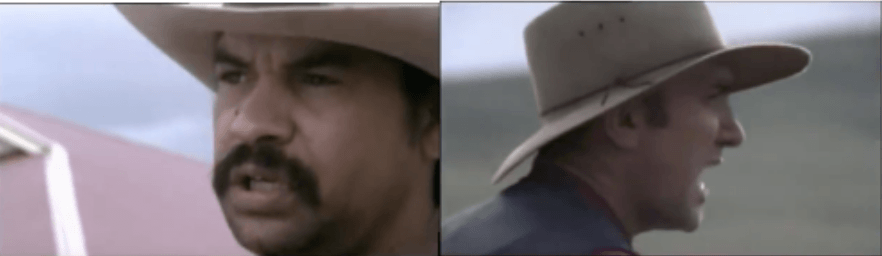
(a) Explain how juxtaposition is used in the vocal delivery of the song to show the differences between Albert and Jim's view of land ownership. Be specific in describing how the juxtaposition has been created.
(b) Identify and describe the effect of TWO film techniques used to emphasise the distinction between the two men.
*Watch from 13:20 to 16:00* https://vimeo.com/groups/427426/videos/194625175
(a) The contrast between settler and indigenous and is juxtaposed when they sing as a duet. Jim refers to the land as tenancy and ownership in terms of a contractual agreement, represented through Jim’s nasal, strident tone in singing “this land is mine”, asserting the ownership of his land. In contrast, Albert conveys a universal affinity and connection to the environment, time, ancestors and land custodianship, as expressed in his deep baritone voice in singing “this land is me”, affirming his holistic connection with the land.
(b) Panning shot: Perkins uses a panning shot to display Jim striding back and forth on his land, ordering the men to spread out across the line, demonstrating Jim’s profound sense of ownership over his land.
Tracking shot: In contrast, Perkins uses a steady tracking shot to emphasise Albert's affinity/alignment with the land.
Close-up shot: Continuous close-up focus on Albert as he delivers his first lines of the song limits view of background, implying he is one with his environment. In contrast, the panning shot of Jim traversing the land continually shows the dominance of the vast rural landscape and Jim's comparative insignificance and powerlessness.
500
Identify FOUR themes of Robert Gray's poetry.
*Must be phrased as statements, not single words*
Answers may include:
- Consumerism and its destructive effects on the environment and degradation of the human spirit
- Urbanisation and its dehumanising effects
- The natural world as a catalyst for self-discovery/ personal isolation/transcendence (religious/spiritual)
- Human fragility/insignificance in comparison to the natural world
- Representations of Australian culture through familiar iconography
- The transformative power of personal experience and/or the journey
500
Answer THREE questions below - one on each prescribed text - to pass this question:
a) What technique has Lucashenko used in the line "What was real was endless green paddocks stretching to where the scrub began, and after that the ridge of the Border Range..."
b) What technique has Rowling employed to create humour in the line: "The weeks of fear and nausea I have endured at the thought of giving this commencement address have made me lose weight. A win-win situation!"?
c) How does Lucashenko create a sense of danger surrounding Eric’s disappearance in 'Dreamers'?
a) Visual imagery, descriptive language, hyperbole, personification
b) Verbal Irony (Sarcasm)
c) Foreshadowing which hints that something threatening may happen, preparing the reader for Eric’s disappearance.