Circulatory+
Respiration
Sensory
Skele&Integ
Random 1
100
What is counter-current exchange and why is it important?
CCE maximizes the diffusion gradient. High O2 water travels against High O2 blood (70-80% of total O2 available is extracted from water).
100
What are 3 key oxygen differences between water and air?
FW has only 1/23 as much oxygen as air at 5*C.
SW has only 1/52 as much oxygen as air at 5*C. (Reduction in solubility due to salts called the Salting Out Effect)
High viscosity makes unidirectional flow more efficient.
High temperatures make water have less oxygen
100
What are weberian ossicles?
Otocephysian fishes have Weberian ossicles which has the inner ear connected to swim bladder and can be used to transmit vibrations from the swim bladder to the inner ear.
100
Why do we use ctenoid/cycloid scales over placoid scales for aging?
Placoid scales do not grow over time
100
What is a midden, why are they important?
Middens are piles of old fish dumps. You can find otoliths and DNA!
200
What is regional heterothermy?
Heat is generated in muscle – distributed with CEE system. Contributes to efficient sustained thuniform swimming in tunas. (Ex. Brain, eyes, gut stays hot but gills stay cool for O2 absorption)
200
What is a pseudobranch?
Fake gill filament! It receives oxygenated blood instead of deoxygenated blood. Leads to the the choroid rete mirabile which maintains high partial pressure of oxygen behind the retina of teleost fish.(Another use for a rete mirabile!)
200
What are otoliths used for and how do they work in the inner ear of fishes?
Three “ear stones” made of calcium carbonate (mostly). They sit on a bed of hair cells. The downward pull of gravity on lapillus (type of otolith) stimulates hair cells and allows the fish to know its orientation within a 3D space (pitch, yaw, roll). Can also be used for hearing, equilibrium, and balance. Movement of endolymph causes cupula surrounding cilia in hair cells to move which fires neurons to detect acceleration and orientation.
200
What are all the different types of teeth? What do they do?
Caniniform: Puncturing
Villiform: Snagging/capturing soft prey
Molariform: Crushing
Cardiform: Holding
Incisors: Scraping
200
What is fish slime used for?
Slime protects against pathogens, help with ion and water regulation, reduce drag, produce toxins, and feeding (discus fish). Hagfish use slime to suffocate prey and defense.
300
What is osmoregulation in fishes? Can you give examples?
Isosmotic: solutes equal in fish & water (conformers like a sea star and regulators like a shark)
Hyposmotic: less solutes in fish than water (saltwater)
Hyperosmotic: more solutes in fish than water (freshwater)
300
What is a rete mirabile, what does it do, and where are they found?
Counter-current multiplier which concentrates O2 without increasing CO2. Found behind the retinas and bottom of swim bladder below the gas gland of physoclistous fish. They are also found as heat exchangers in muscles.
300
What are two basic types of electroreceptors and what types of environments are they used for?
Tuberous receptors: Loosely packed with epithelial cells and in the epidermis, found in fish that produce their own electrical current. Used by tropical fish with low water clarity. Has no canals or external connection and is in freshwater fish only. Used in communication.
Ampullary receptors: Located in pores in skin filled with conductive gel to detect externally generated electric currents (like finding prey from muscle contractions or earth’s magnetic field).
They are useful at night or in murky waters. Potentially for migratory species.
300
What are four major methods fish use to stay in the water column?
Lift from swimming. Having fewer heavy tissues. Having more liw density compounds (oily liver), having swim bladders.
300
What is hypoxic, normoxic, and anoxic?
Hypoxic: Low-oxygen conditions.
Anoxic: Lack of oxygeon.
Normoxic: Normal oxygen conditions, near air saturation.
400
What mechanisms can a fish use to resist freezing?
Increase glycerol, urea, and TMAO in the blood to reduce the freezing point. Or synthesize antifreeze compounds to bind to ice crystals.
400
What are accessory breathing approaches?
Lungs (lungfish), cutaneous (no scales, larvae, eels), mouth upturned to surface (arapaima), gut (physostomous swim bladder, gars), labyrinth organ (climbing perch and walking catfish)
400
What is different between the elasmobranch and teleost eye?
Elasmobranchs: Can dialate and constrict pupils to regulate incoming light. Done by using protractor muscle to pull lens outward to focus. Also have nictitating membrane to protect eyes while feeding.
Teleosts: Have a tapetum lucidum which increases vision in low light by reflecting most light back through the retina.
400
Describe fast and slow muscle.
Fast: White muscle, good for BURSTS of speed. Has no myoglobin, is anaerobic.
Slow: Red muscle, good for CONSISTENCY. Has lots of mitochondria and myoglobin. Aerobic.
400
What three factors regulate rates of O2 diffusion (think about Ficks Law)?
Increase or decrease surface area of lamellae
Alter diffusion distance
Alter diffusion gradient
500
Describe the Bohr Effect.
Decreases pH means less affinity of O2 for heme groups. Shifts the Oxygen Saturation (y) by Oxygen Pressure (x) to the right but keeps the same “max” saturation. The Root Effect is an extreme form of the Bohr Effect. It also shifts the curve down, decreasing the max amount of O2 able to be binded to Heme AND decreases O2 affinity. Root effect is unique to ray-finned fishes, can help regulate buoyancy, and increase oxygen delivery during stress.
500
Will an active fish or a sedentary fish have more O2 capacity?
Sedentary fish have low activity and typically are in low O2 environments. They are more sluggish/sit and wait predators with a small home range. They can bind more O2 at low partial pressure O2 levels. Higher activity fishes require water with high partial pressure O2 in it and may have specialized hemoglobin. They can be open ocean, chasing predators.
500
How do fish generate electricity? Give specific examples.
Pump out Na+ and K+ to maintain outside positive charge and an internal negative charge. Nerve excitation then allows for ion gates to open and the positive charged ions to flood back in. Basically, making a biological battery. At least this is for the Mormyrids.
The Electric Knifefish/Electric Eel spasms then curl up to create overlap for more pulses to stun prey. They use tuberous receptors.
The Astroscopus guttatus has a special organ behind its eyes that produces an electric shock.
500
Come up to the board and draw the differences between a fish heart and a shark heart! <3
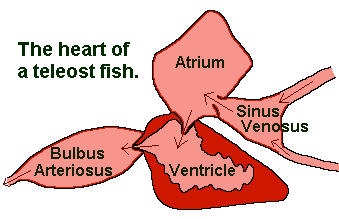
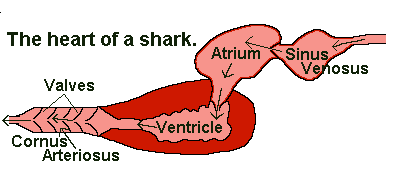
500
How does a diadromous fish deal with changing osmotic gradients?
Cortisol increases chloride cell density
Changes in how water & ions are taken up in gut
Insulin (feeding, growth, metabolism
Throxine – somatic growth, metamorphosis, osmoregulation, thyroid gland production
Estradiol – estrogen – vitellogenin – oocytes, reproductive hormones (mention mimics)
Catecholamines – neurohormones, stress hormones, fight or flight, dopamine