Terms & "Good to Know"
Scenarios
Technicalities
Time Frames
100
What does IEP stand for?
Individualized Education Program
100
What if I don’t sign the IEP?
In NH your written parental consent for the IEP is required on every IEP. So if it’s a revision of the IEP and you don’t sign it and don’t respond at all, you have given what is called implied consent. Therefore, it is important that you respond in some way.
100
Does my IEP team have to give me a copy of the IEP before the annual IEP meeting?
No. it is not written in the regulations that IEP drafts have to be given to families in advance. They DO have to send 3 year evaluations 5 days prior to a 3 year evaluation meeting. You can request to your district to send you an IEP draft prior to the meeting.
100
How often does an IEP team have to meet?
Annually, at minimum. Any IEP team member is able to request for a meeting.
Other meeting times can consist of:
-Progress meetings
-3 Year Evaluation meeting
-parent or school request meeting
200
What is the difference between an IEP and a 504 Plan?
An IEP provides Individualized Special Education and related services to meet the unique needs of the child. A 504 plan provides services and changes to the learning environment to meet the needs of the child that includes specific accommodations, supports or services for the child. A 504 is a plan for how a child will have access to learning at school. An IEP is a plan of the child’s Special Education experience at school.
200
Can I audio record an IEP meeting?
YES! You need to inform your district prior to the IEP meeting that you will be audio recording. You district also has a right to audio record as well. A formal written statement to the district that audio recording will be occurring is best.
200
Can an IEP member be excused from a meeting?
Yes, if there is consent by the parent. At each meeting it is required to have a Special Education Teacher, LEA and Regular Education Teacher. (There can be members who have dual roles). The parent must agree to the excusal in writing before the meeting occurs. Parents must also be notified 72 hours prior to the meeting or as soon as it is expected that a team member may need to be excused.*you can also choose to not meet if certain vital members are not present.
200
When your child is identified as being eligible for an IEP, how quickly do things start?
Within 30 days of determining that your child is eligible the IEP team must meet to begin to draft and IEP.
300
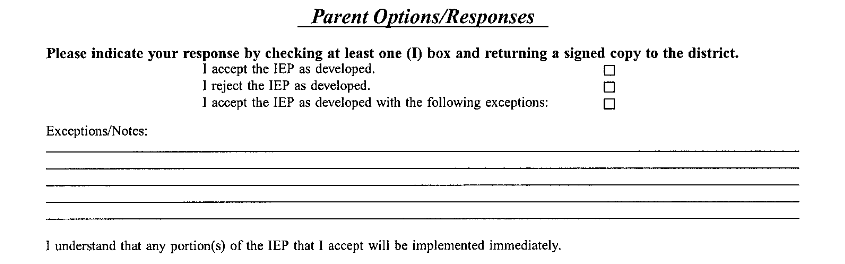
How many response options are there when signing an IEP?
3:
- I accept the IEP as developed
–I reject the IEP as developed
–I accepted the IEP as developed with the following exceptions
300
My child has behavioral issues that affect him/her in school, what do I do?
It is best to be proactive when your child begins to show case challenging behaviors in school. You should request an IEP team meeting and ask that a Functional Behavioral Assessment (FBA) be done the first time your child is suspended or has behaviors in school so that the team can create a behavior intervention plan (BIP) to address the behavioral issues in a positive manner.
300
Does by child have to go to ESY (Extended School Year) in their school?
They can, however each students needs are different. You are allowed to propose to your school district to provide education and services to your child in a different environment than their school. If your child doesn’t fit into the typical ESY Program, propose a different idea to your school for the summer.
300
How many days do you have to sign the IEP after your meeting?
14 calendar days after the meeting
400
What is the difference between an Accommodation & a Modification?
Accommodations can help her learn and then show what she’s learned without having her challenges get in the way. For instance, if your child takes longer to answer questions, she might be allowed extra time to take a test. Even with accommodations, kids are expected to learn the same content as their peers.
A modification is a change in what a student is expected to learn and demonstrate. For example, a teacher might ask the class to write an essay that analyzes three major battles during a war. A child with a modification may only be asked to write about the basic facts of those battles.
400
Every IEP student has triennial evaluations (3 Year Evaluation Meetings), what if the parents feel it is appropriate to have more evaluations in between?
You can request at any time for a School Evaluation to take place. The process for this begins with a formal request to the school to complete an evaluation. The best way to request is to write a formal letter stating: specifically why you’re requesting for the evaluation and what types of evaluations. You will also need to formally sign consent to have your child evaluated (a document the district will provide). When the district approves, they have 60 days from the date you signed the consent to finalize the testing. If the school denies the request for an evaluation, you can then request to have an Independent Educational Evaluation (IEE) completed. That is an evaluation done by an outside professional, but paid for by the school.
400
How do I make sure that my child’s IEP is appropriate or has the right supports and services?
Before looking at your child’s IEP, you should read the evaluations and evaluation reports because they form the foundation of the IEP. View strategies and a list of questions to address your child's needs. Consider what kinds of supports you provide for your child and how your child can learn best. You also have free access to collaborate with PIC (Parent Information Center) as well as your Area Agency Case Manager.
400
Once I request for an IEP meeting, how many days does the school have to schedule a meeting?
The meeting needs to occur within 20 days of the requested meeting. The best way to request for a meeting is in writing.
500
What does FAPE mean?
FAPE stands for: Free Appropriate Public Education. Free means that all eligible students with disabilities will be education at public expense. There is no cost to the parent/family. Appropriate means that your child with a disability is entitled to an education that is appropriate for her/him. It will be tailored and planned to meet her/his needs as state in the IEP. Public refers to the public school system. Children with disabilities have the right to be educated under public supervision. Education must be provided to every eligible school-age (3-21) student with a disability. The education should prepare your child for their future, further their education, employment and independent living.
500
I am not in agreement with my school district and it seems like there are no other options, what next steps can I take?
File a Due Process: A formal process for resolving disputes with a school about special education and IEPs.
Go to Mediation: Mediation is a private meeting where you and the school try to reach an agreement with the help of a trained professional who is not on either side. The Individuals with Disabilities Education Act (IDEA) says that schools have to provide mediation for free. You’re allowed to bring a lawyer or other experts to the mediation, but you have to pay them yourself. Note that if you bring a lawyer, the school will probably bring one too.
Civil Lawsuit: Going to court after Due Process- If you don’t win the due process hearing, you have the option of filing a lawsuit in state or federal court within 90 days. (The school can also file a lawsuit.) This is one the most extreme legal options and requires a lawyer. You can only file a civil lawsuit after you’ve gone through due process.
State Complaint: Ask a State Representative to step in, you can also file a state complaint about a school’s violation of IDEA within one year. This is basically a letter to the state department of education asking for an investigation.
500
What qualifies as a disability under IDEA (Individuals with Disabilities Education Act)?
*These are qualifying IEP Academic Diagnoses
A Specific Learning Disability, which can be determined subject by subject; Health Impaired (e.g. ADHD/ADD or mental health issues); Serious Emotional/Behavioral Disturbance (EBD); Communication Disorder (speech, language); Hearing or Visual or Orthopedic Impairment; Autism; Developmentally Delayed (for youth 0-8); Intellectually Disabled; Traumatic Brain Injury.
500
How many days in advance does the school need to notify a family of an IEP meeting?
The school is required to give 10 days’ notice of a meeting. However, this notice can be waived if the parent agrees and would like to meet earlier.