Foundations
Nutrition and Transport
Body Systems
Reproduction and Genetics
Ecology and Biotechnology
100
Three movements across membranes are considered:
- glucose entering intestinal epithelial cells
- nitrate ions entering root hair cells against a concentration gradient
- water moving from mesophyll cells into leaf air spaces
Which process requires energy from respiration?
A. 1 only
B. 2 only
C. 1 and 2
D. 2 and 3
Answer: B — 2 only, because movement against the concentration gradient requires active transport.
100
Question: Which tissue transports sucrose from leaves to other parts of a plant?
A. Epidermis
B. Xylem
C. Phloem
D. Palisade mesophyll
Answer: C — phloem
100
Question: Which process in yeast produces ethanol and carbon dioxide?
A. Aerobic respiration
B. Anaerobic respiration
C. Photosynthesis
D. Transpiration
Answer: B
100
Question: Red-green colour blindness is controlled by a gene on the X chromosome. Which genotype represents a colour-blind male?
A. XᴬXᴬ
B. XᴬXᵃ
C. XᵃY
D. XᴬY
Answer: C — XᵃY
100
Question: Which gas, other than carbon dioxide, contributes to the enhanced greenhouse effect?
A. Oxygen
B. Nitrogen
C. Methane
D. Hydrogen
Answer: C — methane
200
Question: Identify two cell structures in this image that indicate that Chlorella is not a prokaryote.
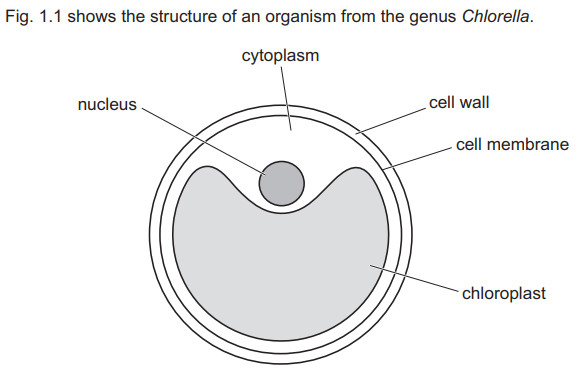
Nucleus
Chloroplast
200
Question: Use the cross-section of a leaf on your paper and label:
A, B, and C
A - Pallisade Mesophyll, B - Spongy Mesophyll, C - Air Spaces
200
Complete the statements:
Antibodies are produced by __________.
Antibodies transferred from mother to baby provide __________ immunity.
Answer: lymphocytes; passive
200
Name the organ through which substances are exchanged between the blood of a pregnant mother and the blood supply of the fetus.
Answer: placenta
200
Label processes Q, R and S on your diagram AND describe as a source or a sink
Q - photosynthesis (sink)
R - Combustion (source)
S - Feeding (sink)
300
Question: Explain how active transport differs from diffusion. (3)
- Active transport uses carrier proteins in membranes.
- Substances move from lower to higher concentration
- requires energy.
300
A photosynthesising alga is placed in hydrogencarbonate indicator. The indicator is initially red.
After 20 minutes in bright light, the indicator becomes purple.
Question: Explain why. [3]
- Photosynthesis occurs. [1]
- Photosynthesis removes/uses CO₂ faster than respiration releases it. [1]
- CO₂ concentration falls, causing pH to increase / indicator turns purple. [1]
300
Question: Describe how transmission across a synapse causes an impulse to be generated in the next neurone. [3]
- An impulse causes neurotransmitter to be released. [1]
- Neurotransmitter diffuses across the synaptic gap. [1]
- It binds to receptors on the next neurone and stimulates a new electrical impulse. [1]
300
Question: How can a change in the DNA base sequence affect the protein produced. [2]
- mRNA sequence is altered
- changes the order of amino acids
- structure and function of protein altered
300
Explain the importance of phytoplankton in an aquatic food web. [3]
Answer — any three:
- They are producers/first trophic level.
- Convert light energy into chemical energy.
- Produce glucose by photosynthesis.
- Provide food for primary consumers.
- Make energy available to higher trophic levels.
400
One tablet contains 5 g of Chlorella supplement.
Using the information in Table 1.1 on your paper, calculate the number of tablets of Chlorella supplement a person needs to take to provide the recommended daily intake of iron.
Give your answer to one decimal place. [3]
Iron needed = 12 mg
Iron in 100 g = 37 mg
Iron in 1 tablet (5g) = 37/20 = 1.85 mg
12 / 1.85 = 6.486
6.5 tablets
400
Question: Using the data on your paper, compare the distribution of stomata in the two plants and explain the differences. (4)
- Tomato has more stomata on its lower epidermis.
- Water lily has stomata only/mostly on its upper surface.
- Water lily has more upper-surface stomata than tomato.
- Tomato's arrangement reduces water loss/transpiration.
- The lower surface is less exposed to direct sunlight.
- A floating water lily's lower surface is against water.
- Therefore gas exchange must occur through its exposed upper surface.
400
Question: Describe the change in blood glucose concentration after a meal and explain how the body returns it towards normal.
- Blood glucose rises.
- Pancreas detects/in response to elevated glucose.
- Insulin secretion increases.
- Cells take up glucose.
- Liver/muscle convert glucose to glycogen.
- Blood glucose falls toward the normal concentration.
400
Two organism life cycles are shown on your paper. Label the type of cell division occurring at P, Q, R, S and T on the diagrams
P - meiosis
Q - mitosis
R - meiosis
S - mitosis
T - mitosis
400
Use the data on your paper to calculate the increase in the percentage of glass recycled between 1960 and 1990.
20 - 2 = 18%
500
Question: Explain why increasing temperature increases the rate of an enzyme-controlled reaction up to an optimum temperature, but further increases cause the rate to decrease. [5]
- Higher temperature increases kinetic energy.
- Enzyme and substrate molecules move faster.
- Collision frequency increases.
- More enzyme-substrate complexes form.
- Above optimum, enzyme denatures.
- Active site changes shape.
- Substrate is no longer complementary/cannot bind.
Award any 5.
500
Question: Describe how starch is digested in the human digestive system so that its products can be absorbed into the blood. [6]
marking points include:
- Amylase digests starch. [1]
- Starch is broken into maltose. [1]
- Amylase is produced by salivary glands/pancreas. [1]
- Maltase breaks maltose down. [1]
- Produces glucose. [1]
- Digestion occurs by enzyme-catalysed hydrolysis. [1]
- Glucose is small/soluble and can be absorbed through the villi into blood capillaries. [1]
Maximum 6.
500
Question: Describe and explain how the eye accommodates to focus on a near object (use letters from the diagram in your answer). [4]
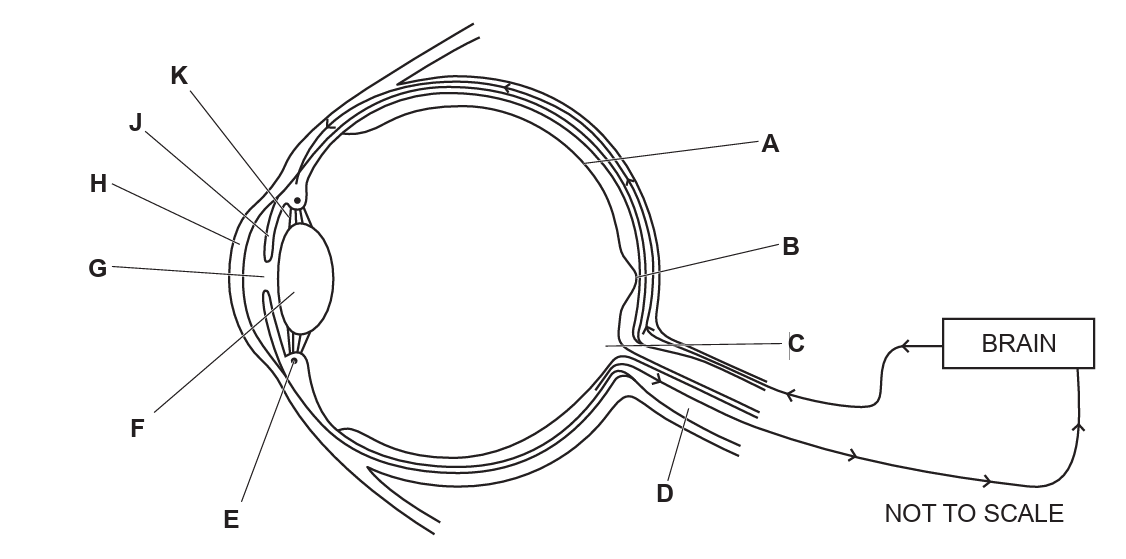
Total of four from:
1 identify E as ciliary muscle and K as suspensory ligaments and F as lens ;
2 ciliary muscle / E, contracts;
3 suspensory ligaments / K, slacken / loosen / AW ;
4 lens / F, becomes more convex / AW ;
5 more refraction ;
6 light / image (of object), is focussed onto the, retina / fovea / A or B ;
500
The gene for the ABO blood group has three alleles, IA, IB and Io. (d) A person with blood group O has parents who have blood groups A and B. Complete the genetic diagram to show how this is possible. Use the symbols, IA, IB and Io, for the blood group alleles.
Must show punnett square:
IAIO × IBIO
IA IO + IB IO ;
IOIO
500
Explain how bacteria can be genetically engineered and used to make human insulin. (4)
insulin gene removed from human + DNA / chromosome ;
ref. to restriction enzyme ;
ref. to plasmid cut open AW ;
ref. to use of ligase + in placing insulin gene into plasmid ;
ref. to formation of recombinant DNA ;
ref. to insertion of plasmid into host bacterial cell AW ;
ref. to culture of bacteria ;
ref. to use of + fermenter