Conduction
Internal energy
Radiation
Convection
Change of State
100
In what direction does heat move?
From hot to cold.
100
What property can we measure to determine the internal energy of a substance?
Temperature.
100
What is the name given to the electromagnetic transfer of radiation? (full name, not letters!)
Infrared.
100
Why does hot or warm air rise?
It has a lower density (and has a buoyant/upthrust force) that causes it to rise above cooler air.
100
What is one way of speeding up the evaporation of a liquid?
1) Heat the liquid to a higher temperature.
2) Blow wind/air across the surface of the liquid.
3) Increase the liquid surface area exposed to the air.
200
Why does a metal doorknob feel cold to the touch?
Metal is a good conductor of heat and transfers heat quickly.
200
At the molecular level, what do the molecules have because of the internal energy of the substance?
The molecules have kinetic energy.
200
Why is the inside of a vacuum flask silvered?

It reflects heat back into the liquid contained, as well as having very low absorption (and emission to the outside of the flask).
200
A radiator for a room is placed by the lower part of the wall. Why is this position most suitable for heating a room?
A radiator heats the cooler air which flows across the lower part (or half) of the room.
200
A doctor swabs alcohol on a patient's skin to cool it. Why does the doctor use alcohol instead of water?
Alcohol evaporates faster than water (owing to its lower specific heat capacity).
(Of course alcohol may sterilise the skin too!)
300
Why does the ice remain frozen while the water is boiling?
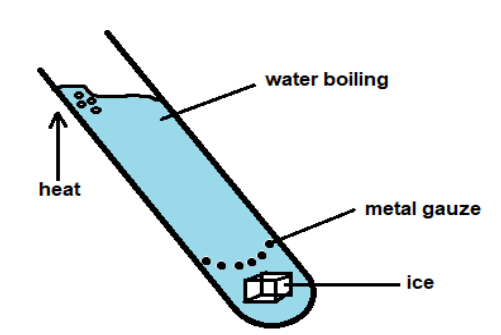
Water is a poor conductor (and the heat remains in the water at the top due to its slightly lower density).
300
What is the unit for specific heat capacity?
J/kgK
300
What are the properties of a black T-shirt that makes it less suitable to wear on a hot sunny day?
It is a high absorber of the IR radiation from the sun, as well as a high emitter (emitting IR radiation into the skin).
300
Explain where a cooling element for a refrigerator should be placed to generate the greatest cooling effect.
It should be placed at the top as heat rises to the top and may be cooled by the element, thereby decreasing the overall average temperature in the 'fridge'.
300
How does evaporation occur in terms of the molecules in the liquid and the molecules on the surface?
The molecules on the surface, owing to a large enough kinetic energy transferred to them from other molecules in the liquid have enough energy to escape from the liquid, becoming vapour in the air/atmosphere.
400
What is the name usually given to a solid substance which does not conduct heat well?
An insulator.
400
What is the specific heat capacity of water?
4200 (unit is in another question)
400
Why does a very hot metal glow red?
IR radiation is emitted below red of the visible spectrum, but when the temperature is very high the emission shifts to the visible red part too. (See A2 Blackbody spectrum)
400
What is the category and names given to the two states of matter that may exhibit convection?
Fluids: liquids and gases.
400
One beaker contains pure ice only. Another beaker contains pure ice and 'melted ice water'. What could be stated about the respective temperatures of the ice in the beakers?
The pure ice is not melting, so it must have a temperature lower than 0oC (T<0oC).
The melting ice remains at 0oC for the whole duration of its melting, so T=0oC.
500
In terms of molecules and electrons, how does thermal energy get transferred from the hot end to the cold end of a metal?
The larger vibrations of 'hotter' molecules transfer (kinetic) energy to 'cooler' molecules, from hot to cold. In a metal the electrons with larger kinetic energies at the hotter end drift towards the cooler end in a similar way to electrical conductivity (hence heat conduction).
500
A hot 500g metal block of specific heat capacity 520 J/kgK is placed in 2L of water of initial temperature 21oC, heating the water to 74oC. What was the initial temperature of the block?
1) E = mc(dT).
2) Energy gained by water = 2(kg) x 4200 x 53 = 445000 = 445kJ.
3) Change in temperature of the metal block, dT = E/mc = 445000/(0.5 x 520) = 1711oC.
4) Initial temperature of the block = 1711 + 74 = 1786 = 1790oC
That's hot!
500
Explain how the greenhouse effect enables the earth to stay warm, and how increasing greenhouse gases in the atmosphere are causing global warming.
The radiation from the sun is absorbed and re-emitted by the earth into the atmosphere. Some of this radiation is absorbed and re-emitted back to the earth by greenhouse gases (water, carbon dioxide and some methane). The rest is emitted into space. Increasing greenhouse gases causes more radiation to be re-emitted back to earth, thereby causing a general increase in surface and atmospheric temperature on the earth.
500
Explain how a hot air balloon can overcome gravity in terms of forces, and how the 'pilot' uses the burner to control the height of the balloon above the ground. What would the convection currents look like in a hot air balloon?
The balloon generates an upthrust (or buoyant force) which exceeds or is equal to the gravitational force, thereby increasing its height or maintaining its height respectively. The pilot may allow the air to cool, increasing its density and decreasing the upthrust to somewhat less than the gravitational force, causing the balloon to descend.
The convection currents would rise above the burner and flow down the sides of the balloon where its cooler.
500
A saucepan has water brought to the boil. What needs to occur in order for the temperature of the saucepan to exceed 100oC?
Once all the water has boiled away the saucepan will quickly heat up as much less energy is transferred away (into the latent heat of vapourisation, A2 only).
Hence leaving saucepans (and frying pans) unattended is dangerous!
Theoretically if the water was boiled in excess of 1atm (p>101kPa) then the boiling point will increase.