Ch. R-3.3 (exam 1)
Ch. 3.4-6.3 (exam 2)
Ch. 6.4-9 (exam 3)
Ch. 12-13 (post exam 3)
Miscellaneous/some calculations
100
As you move up and right across the periodic table, what happens to Ionization energy, atomic radius, and electron affinity?
Ionization energy increases
Atomic radius decreases
Electron affinity increases
100
Does any element have the mass listed on the periodic table? Why/why not? What is the equation to solve for the mass listed on the periodic table?
No—the mass listed on the periodic table is an average mass. It is the average of all isotopes of that element.
Average mass = mass isotope 1(% abundance isotope 1) + …
100
What is specific heat capacity? How could you use specific heat capacity to solve for heat (an equation)?
Specific heat capacity (s): the energy required to raise the temperature of 1 gram of a substance by 1 degree C
q=msΔT
100
Identify the acid, base, conjugate acid, and conjugate base in the following equation:
H2O (l) + CH3COO- (aq) —> OH- (aq) + CH3COOH (aq)
H2O (l) = acid (donates a proton)
CH3COO- (aq) = base (receives a proton)
OH- (aq) = conjugate base (acid - a proton)
CH3COOH (aq) = conjugate acid (base + a proton)
100
Which of the following sets of quantum numbers are not allowed for the hydrogen atom? If the set is not allowed, why?
n=3, ℓ=3, mℓ=2
n=4, ℓ=3, mℓ=4
n=0, ℓ=0, mℓ=0
n=2, ℓ=-1, mℓ=1
All not allowed.
n=3, ℓ=3, mℓ=2 ℓ must = 3-1 = 2
n=4, ℓ=3, mℓ=4 mℓ must = -ℓ to +ℓ = -3 to +3
n=0, ℓ=0, mℓ=0 n cannot be 0
n=2, ℓ=-1, mℓ=1 ℓ cannot be negative
200
What are ALL the rules for significant figures? Leading 0s? Trailing 0s? 0s between non-0 numbers? Non-0 numbers? Exact numbers? When adding/subtracting? When multiplying/dividing?
Leading 0s = not significant
Trailing 0s = significant only if decimal
0s between non-0 numbers = significant
Non-0 numbers = significant
Exact numbers = significant- infinite number of sf
Addition and subtraction = number of decimal places in answer depends on least precise measurement
Mult and division = number of sf in answer depends on least precise measurement
200
What is the VSEPR molecular geometry and bond angles for…
PCl5
NH3
H2O
PCl5: Trigonal bipyramidal; 90, 120 (5 bp, 0 lp)
NH3: Trigonal pyramidal; <109.5 (3 bp, 1 lp)
H2O: Bent; <<109.5 (2 bp, 2 lp)
200
In oxidation, are electrons lost or gained? Does the oxidation number increase or decrease?
In reduction, are electrons lost or gained? Does the oxidation number increase or decrease?
Oxidation: loss of electrons, increases oxidation number
Reduction: gain of electrons, decrease oxidation number
"OIL RIG"
200
What is the equation and equilibrium expression for the law of mass action?
jA + kB <—> lC + mD
K=[C]l * [D]m / [A]j * [B]k
(where K = [products]/[reactants])
200
What precipitate, if any, forms from combining…
Aluminum nitrate and barium hydroxide?
Iron (II) sulfate and potassium chloride?
*Hint-write out a ~balanced~ chemical equation!*
Aluminum nitrate and barium hydroxide: Yes, precipitate forms. Aluminum hydroxide.
2 Al(NO3)3 (aq) + 3 Ba(OH)2 (aq) —> 2 Al(OH)3 (s) + 3 Ba(NO3)2 (aq)
Iron (II) sulfate and potassium chloride: No precipitate forms.
FeSO4 (aq) + 2KCl (aq) —> FeCl2 (aq) + K2SO4 (aq)
300
Name the 3 main experiments to characterize the atom. Who was responsible for each? What was learned from each?
Cathode Ray Tube; JJ Thomson; atoms contain - charged particles called electrons, charge-to-mass ratio of an atom
Charged Oil Drop; Robert Millikan; magnitude of charge of an electron, mass of an electron
Metal Foil; Ernest Rutherford; there is a dense, + charged center in the atom called a nucleus
300
What are the 3 main types of chemical bonds? Define them. Match up these 3 molecules with the correct type of bond: dinitrogen, lithium bromide, nitrogen trihydrogen (ammonia).
Ionic:
- Atoms that form bonds by transferring electrons, 2 atoms with electronegativity difference, 1 atom that will easily lose electrons (low ionization energy) + 1 atom that wants electrons (high electron affinity), often a metal and a nonmetal
Covalent:
- Atoms that form bonds by sharing electrons, often 2 nonmetals
Polar covalent:
- Atoms that bond by sharing electrons unequally, resulting in a partial + and partial - charge, often 2 nonmetals
Dinitrogen (N2) = covalent
Lithium Bromide (LiBr) = ionic
Nitrogen Trihydride aka Ammonia = polar covalent
300
What is the difference between a formula/molecular equation, a complete ionic equation, and a net ionic equation?
Formula equation/Molecular equation: gives overall reaction stoichiometry, but not necessarily the actual forms of the reactants and products in solution. NOT a detailed representation, does not include spectator ions
Ex. K2CrO4 (aq) + Ba(NO3)2 (aq) → BaCrO4 (s) + 2KNO3 (aq)
Complete ionic equation: represents all reactants and products that are strong electrolytes, includes spectator ions
Ex. 2K+ (aq) + CrO42- (aq) + Ba2+ (aq) + 2NO3- (aq) → BaCrO4 (s) + 2K+ (aq) + 2NO3- (aq)
Net ionic equation: includes only the solution components that undergo a change, removes spectator ions
Ex. CrO42- (aq) + Ba2+ (aq) → BaCrO4 (s)
300
What is chemical equilibrium? What is the difference between homogeneous and heterogeneous equilibria? When solving heterogeneous chemical equilibrium problems, which phases do you consider?
Chemical equilibrium: The state where the concentrations of all reactants and products remain constant with time. (NOT where the concentrations are equal. It’s where they level off/don’t change.)
Homogeneous: involve the same phase
Heterogeneous: involve more than 1 phase
Only consider g and aq, ignore l and s.
300
At 327 degrees C, the equilibrium concentrations for the reaction CH3OH (g) <—> CO (g) + 2H2 (g) are CH3OH=0.15M, CO=0.24M, and H2=1.1M. Calculate Kp at this temperature.
Kc=[CO][H2]2 / [CH3OH]
Kc = [.24][1.1]2 / [.15]
Kc= 1.936
Kp = Kc(RT)delta n
delta n = mol products - mol reactants = 3-1 = 2
327 C = 600 K
Kp = (1.936)[(.08206 Latm/molK)(600 K)]2
Kp = ~ 4693 (unitless!)
400
What is the difference between a continuous spectrum and a line spectrum? What model does hydrogen follow? Which takes more energy—moving from energy level 5—>4 or from energy level 2—>1?
Continuous spectrum = all wavelengths
Line spectrum = only specific wavelengths
Hydrogen follows a line spectrum model because its electrons are quantized, or restricted to certain values.
More energy to move from 2—>1.
400
Rank the following ions/elements in order from smallest to largest:
O2-, O-, O
Cl2+, Br2+, I2+
O < O- < O2-
Same number of protons, different number of electrons. If protons stay the same while electrons increase, the ion gets larger.
Cl2+< Br2+< I2+
Same number of electrons, different number of protons. If electrons stay that same while protons increase, the ion gets smaller due to more pull from the dense, proton nucleus.
400
What are the relationships in the 3 gas laws? Which variables are proportional to one another?
Boyle’s Law: P1V1=P2V2 (1/P α V)
Charles’s Law: T1/T2=V1/V2 (V α T)
Avogadro’s Law: V1/n1=V2/n2 (V α n)
400
How do you calculate pH for strong acids/bases? For weak acids/bases? How do you calculate pOH from pH?
Strong acids/bases: pH = -log[H+], pOH=-log[OH-]
Weak acids/bases: ICE chart and Ka=[products]/[reactants]. Solve for [H+] or [OH-], then plug into pH = -log[H+] or pOH=-log[OH-].
pOH = 14-pH
400
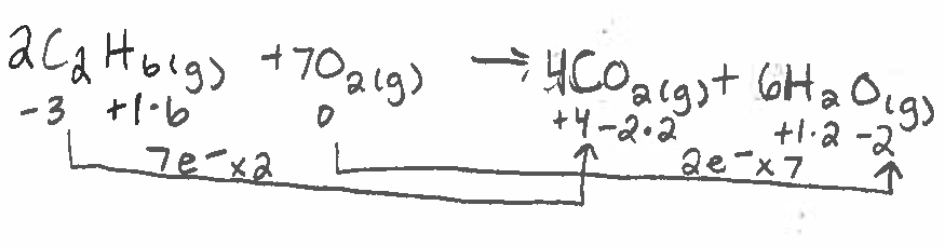
Balance the following redox reaction.
C2H6 (g) + O2 (g) —> CO2 (g) + H2O (g)
2C2H6 (g) + 7O2 (g) —> 4CO2 (g) + 6H2O (g)
500
What are the 4 quantum numbers and their rules?
Principal quantum number (n): integers 1+
Angular quantum number (ℓ): integers 0 to n-1 (s=0, p=2, d=2, f=3)
Magnetic quantum number (mℓ): integers +ℓ to -ℓ
Spinning quantum number (ms): either -½ or +½
500
Draw 3 valid resonance structures for each of the following molecules. Are all the structure equal? Why/why not?
NO3-
OCN-
NO3-: all equal.
OCN-: Not all equal. Middle > left > right. Right does worst job of minimizing formal charge on atoms (+1, 0, -2). Middle and left both minimize formal charge better (middle: -1, 0, 0; left=0, 0, -1). Middle > left because O would rather carry the -1 formal charge over N since O is more eN-.
500
As intermolecular forces decrease, what happens to…
Boiling point?
Freezing point?
Vapor pressure?
Boiling point decreases
Freezing point decreases
Vapor pressure increases
500
What is the difference between Kc and Qc?
Which direction does a reaction move when…
Kc > Qc
Kc = Qc
Kc < Qc
Kc is the equilibrium constant, which tells you the ratio of reactants to products at equilibrium. Qc is the reaction quotient, which tells you which direction the reaction will proceed.
Kc > Qc right, toward products. More reactant, so want to get rid of it by moving toward products.
Kc = Qc does not move.
Kc < Qc left, toward reactants. More product, so want to get rid of it by moving toward reactants.
500
A compound contains 47.08% carbon, 6.59% hydrogen, and 46.33% chlorine by mass. The molecular mass of the compound is 153 g/mol. What are the empirical and molecular formulas of the compound?
Assume 100g compound. 47.08g C, 6.59g H, 46.33g Cl.
mol C = 47.08g * (1 mol C/12 g C) = 3.92 mol C
mol H = 6.59g * (1 mol C/1.008 g H) = 6.59 mol H
mol Cl = 46.33 * (1 mol C/35.45 g C) = 1.31 mol Cl
Divide each by smallest # moles
3.92/1.31 = 3
6.59/1.31 = 5
1.31/1.31 = 1
Empirical: C3H5Cl
Sum up empirical mass total, then divide by overall molecular mass given.
[12(3) + 1.008(5) + 35.45(1)] = 76.49 g/mol
76.49 g/mol / 153 g/mol = 2
Multiply empirical formula by 2.
Molecular: C6H10Cl2