Key Features of Exponential Functions
Exponential Models
Linear, Quadratic, and Exponential Models
Logarithms
Logarithmic Functions
Properties of Logarithms
Exponential and Logarithmic Equations
100
What is the range of the function
y=5*3^x
y>0
100
(0,1) (1,3) (2,9) (3,27)
Determine what type of function this is.
exponential
100
Write 73 = 343 in logarithmic form
log7343=3
100
Expand
log5(2/3)
log52 - log53
200
What is the y-intercept of the
y=5*3^x
5
200
Find the total amount of money in the account after 6 years.
continuously compounded, P=1500, r=1.5%
$1,641.26
200
(0,1) (1,2) (2,7) (3,16) (4,29)
Is this a function? If so, what type of function is it?
Quadratic
200
Evaluate:
log9729
3
200
What is the x intercept of log0.1x
1
200
Rewrite as a single logarithm
9lnx-6lny
ln(x^9/y^6)
200
Solve. Round to the nearest hundredth.
6^(x+2)=4^x
-8.84
300
Write a function g(x) that represents f(x) = 2x after a reflection across the x-axis.
g(x)=-2^x
300
Write the inverse of y=4x as a logarithm
log4y=x
300
Find the equation of the inverse of
f(x)=6x+7
log6x-7
300
Use the change of base formula to evaluate. Round to the nearest thousandth.
log27
2.807
300
log2(3x-2)=4
6
400
Describe the transformations from f(x) = 3x to
g(x) = 3x-1+6
shift 1 right, 6 up
400
Write an exponential model given the following points.
(3,55) and (4,70)
y=26.9(1.27^x)
400
Solve: log(7x+6)=3
142
400
Find the equation of the inverse of f(x)=ln(x+3)-1
f-1(x)=ex+1-3
400
Use the change of base formula to solve for x.
Round to the nearest thousandth.
3^x=4
1.262
400
Find all solutions. Round to the nearest thousandths.
log2(4x+5)=log2x2
-1;5
500
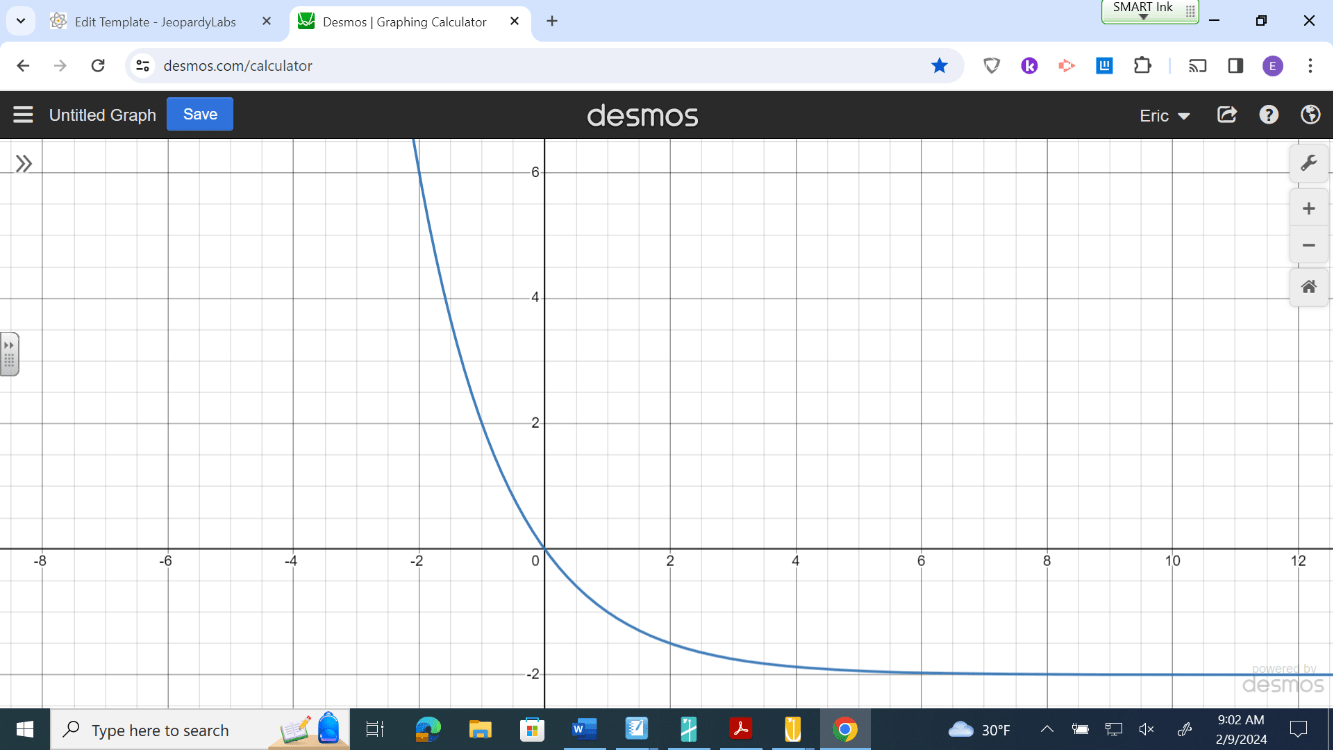
y=(1/2)^(x-1)-2 y=2*(1/2)^x-2
500
If you invest money in a continuous compound account with an interest rate of 3%, how long will it take the money to double?
About 23 years
500
At what point will f(x)=3x exceed g(x)=2x+5 and h(x)=x2+4?
(2,9)
500
Solve: 10t+1=50
Round to the nearest ten thousandth
0.6990
500
Find all solutions. Round to the nearest thousandth.
log6(x2-2x)=log6(2x-3)+log6(x+1)
1.303 (extraneous)
-2.303 (extraneous)