Transformations of Graphs
Rational Functions
Exponentials & Logarithms
The Unit Circle
Trigonometric Functions
Math III Mix Pt. 1
Math III Mix Pt.2
100
What transformations are applied to this function?
g(x) = 4cos3(x-4pi)
Vertical Stretch of Factor of 4
Horizontal Shrink of Factor of 1/3
Horizontal Translation of
4pi
to the right.
100
Determine if the function has a horizontal asymptote:
(2x^2+3)/(x - 1)
No Horizontal Asymptote
Has a slant asymptote: y = 2x+2
100
Solve for x:
(1/2)^x = 16
x = -4
100
Evaluate without a calculator:
cos((4pi)/3)
x=-0.5
100
What is the name of the horizontal translation in trig?
Phase Shift
100
Convert to degrees:
(5pi)/3
300 degrees
100
Solve the equation:
log_6(x+9)=log_6(2x-6)
x = 15
200
Write a rule for g that represents the indicated transformations of the graph of f.
f(x) = 7^x
A reflection in the x-axis followed by a translation 3 units down.
g(x)=-7^x - 3
200
Find the vertical asymptotes of
y = 1/(x^2 - 4)
x = 2 & x = -2
200
Evaluate
log_7(50)
Acceptable answers :
log(50)/log(7)
ln(50)/ln(7)
200
Evaluate the six trigonometric functions of the angle A.
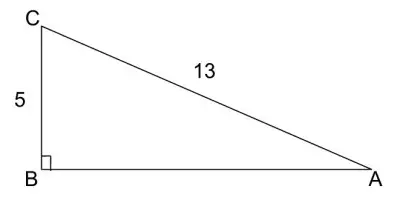
sin A = 5/13
cos A = 12/13
tan A = 5/12
csc A = 13/5
sec A = 13/12
cot A = 12/5
200
Identify the period of
g(x) = cos(5x)
Then describe the graph of g as a transformation of the graph of
f(x) = cos(x)
Period:
(2pi)/5
Transformation:
A horizontal shrink by a factor of 1/5 of the graph of f.
200
Solve the equation:
log_6(2x) + log_6(x+3) = 3
x = 9
200
In the unit circle, if
cos theta = -0.2
is in Quadrant II, what is the value of
sin theta?
sin theta = sqrt(0.96)
300
Write a rule for g that represents the indicated transformations of the graph of f.
f(x)=log_(1/2)x
A translation of 7 units right, followed by a horizontal shrink by a factor of 1/4.
g(x) = log_(1/2)(4x-7)
300
Solve the equation:
2/(2+x) = 9/(5x+7)
x = 4
300
Expand the logarithmic expression:
log_2((x^6)/(7y))
6log_2(x)-log_2(7) - log_2(y)
300
In a right triangle, theta is an acute angle and
csc theta = 19/18
Evaluate the other five trigonometric functions of theta.
sin theta = 18/19
cos theta = sqrt(37)/19
sec theta = (19*sqrt(37))/37
tan theta = (18*sqrt(37))/37
cot theta = sqrt(37)/18
300
Identify the amplitude of
g(x) = 3sin(x)
Then describe the graph of g as a transformation of the graph of
f(x) = sin(x)
Amplitude: 3
Vertical Stretch of a Factor of 3
300
Solve the equation:
9^x = 96
x = 2.077
OR
x=log_9(96)
300
Rewrite this rational function
y=(4x-4)/(2x-6)
as
y = a/(x-h) + k
y = 8/(2x-6) + 2
400
What transformations are applied to this function?
f(x) = -9/(x-4) + 4
1) Reflection across the x-axis
2) Vertical stretch of a factor of 9
3) Horizontal Translation of 4 units to the right
4) Vertical Translation of 4 units upwards
400
Solve the equation:
-1/x + 1/5 = 8/x
x = 45
400
Solve the equation:
64^x = (1/8)^(x+3)
x=-1
400
Use the unit circle to evaluate the six trigonometric functions of
theta = 3pi
sin theta = 0
cos theta = -1
tan theta = 0
csc theta = DNE
sec theta = -1
cot theta = DNE
400
Identify the amplitude, period, and translations of the function:
g(x) = -4sin(2/3(x-4))+5
Amplitude: -4
Period:
(3pi)/2
Horizontal Shift: Factor of 4 to the right.
Vertical Shift: Factor of 5 upwards.
400
Condense the logarithmic expression:
log_7(4) + log_7(2) + log_7(8)
log_7(64)
400
At what angles does
tan theta = 0?
theta = 0, pi, 2pi...
500
How do you graph a logarithmic function?
Rewrite the logarithmic function as an exponential function:
x = b^y
500
Solve the equation:
1/(x-2) - 5 = 4/(x^2 - 4)
x=-9/5
500
Write an exponential function whose graph passes through (1, 14) & (2, 28).
Hint:
y = ab^x
y=7(2)^x
500
Use the unit circle to evaluate the six trigonometric functions of
theta = -450^o
sin theta = -1
cos theta = 0
tan theta = DNE
csc theta = -1
sec theta = DNE
cot theta = 0
500
What are the periods of the six trigonometric functions?
sin (x):2pi
cos(x): 2pi
tan(x): pi
csc(x): 2pi
sec(x): 2pi
cot(x):pi
500
Solve for Triangle DEF:
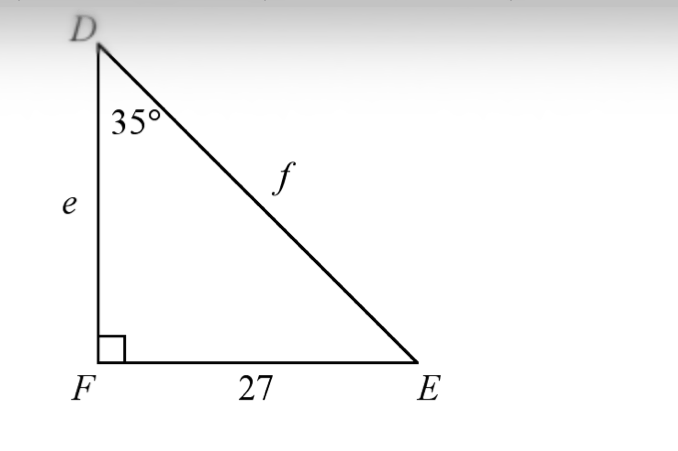
E = 55^o
e = 38.56
f = 47.07
500
Solve for Triangle DEF:
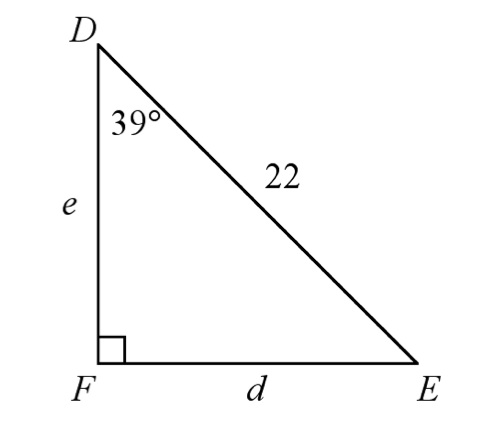
E = 51^o
d = 13.85
e = 17.10