Proteinuria
AKI Evidence
Its all about Ion's
Medicines and their mechanisms
Under the microscope
100
In this landmark trial, rituximab was compared to cyclosporine in patients with primary membranous nephropathy and proteinuria ≥5 g/day, demonstrating clear superiority at 24 months
What is the MENTOR trial (Membranous Nephropathy Trial of Rituximab)?
In this landmark 2019 NEJM trial (n=130), rituximab was compared to cyclosporine in patients with primary membranous nephropathy and proteinuria ≥5 g/day. At 12 months, remission rates were similar (60% vs. 52%), meeting the noninferiority endpoint. However, at 24 months, rituximab demonstrated clear superiority — 60% vs. 20% maintained remission — driven by a dramatically lower relapse rate after treatment cessation. This trial established rituximab as a preferred first-line immunosuppressive agent over calcineurin inhibitors.
100
KDIGO provides its strongest level of recommendation against using THIS vasopressor agent, once given in "renal dose" in ICU to prevent or treat AKI.
What is low-dose dopamine?
The KDIGO guideline provides its strongest level of recommendation (Grade 1A) against using this agent — once commonly given at 1–3 µg/kg/min for "renal protection" in the ICU — to prevent or treat AKI. Multiple negative studies, including an adequately powered RCT, demonstrated no benefit, and the drug can actually increase renal vascular resistance in AKI patients while also triggering tachyarrhythmias, myocardial ischemia, and T-cell suppression.
100
This condition arises after long-standing secondary hyperparathyroidism in CKD, where parathyroid glands become autonomous (due to nodular hyperplasia and receptor downregulation), leading to hypercalcemia, hyperphosphatemia, and very high PTH, often persisting after renal transplant or in dialysis patients and requiring parathyroidectomy when refractory to medical therapy?
What is tertiary hyperparathyroidism?
100
This humanized IgG2 monoclonal antibody selectively binds to and neutralizes APRIL (A Proliferation-Inducing Ligand), a cytokine that mediates antibody class switching in mature B cells and plasma cell survival. By suppressing APRIL, it reduces production of the pathogenic galactose-deficient IgA1 molecules that trigger autoantibody formation and immune complex deposition in the glomerular mesangium — directly targeting the "multi-hit" immunopathogenesis of IgA nephropathy.
What is sibeprenlimab (Voyxact)?
100
Diagnosis suggested by such IgG signal pattern on IF
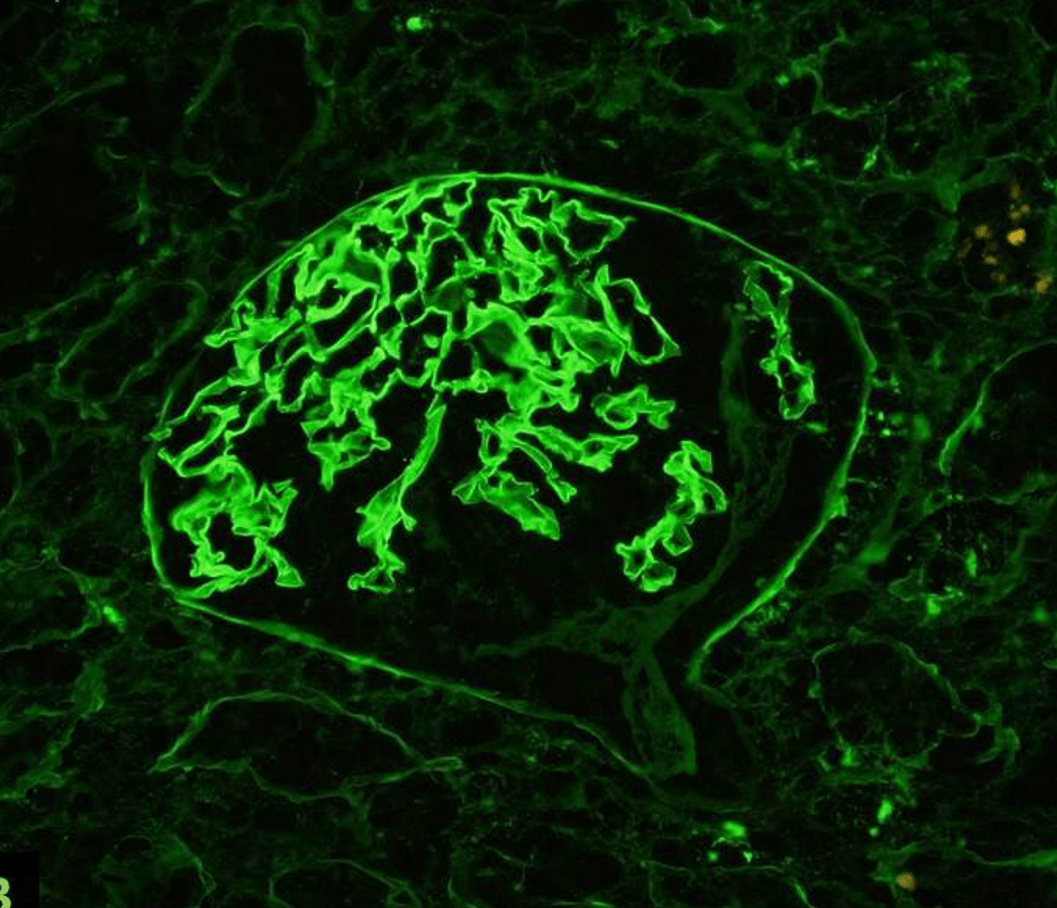
What is anti-GBM disease?
On immunofluorescence microscopy, this glomerulonephritis is characterized by intense, diffuse, linear staining for IgG along the glomerular basement membrane — in contrast to the granular pattern seen in immune-complex–mediated disease
200
According to the "4-hit hypothesis" of IgA nephropathy pathogenesis, the process begins with aberrant production of THIS specific immunoglobulin at the gut or respiratory mucosa.
What is galactose-deficient IgA1 (Gd-IgA1)?
According to the "4-hit hypothesis" of IgA nephropathy pathogenesis, the process begins with aberrant production of Gd-IgA1 at the gut or respiratory mucosa. This molecule enters the systemic circulation, is recognized by circulating IgG and IgA autoantibodies forming immune complexes, and ultimately deposits in the glomerular mesangium to trigger inflammation and complement activation.
200
According to KDIGO, THIS anticoagulation strategy is preferred for CRRT to prolong filter lifespan compared to heparin, even in patients with high bleeding risk, without affecting mortality?
What is regional citrate anticoagulation?
200
In CKD, this bone-derived hormone rises earliest in CKD, promoting phosphate excretion and reducing active vitamin D production, making it the first marker of disordered mineral metabolism?
What is FGF 23?
200
This gut-acting NHE3 inhibitor lowers serum phosphorus in dialysis patients by reducing intestinal phosphate absorption through decreased paracellular permeability, offering an alternative to traditional phosphate binders?
What is XPHOZAH (tenapanor)?
200
THESE urinary crystals are pathognomonic for an autosomal recessive disorder
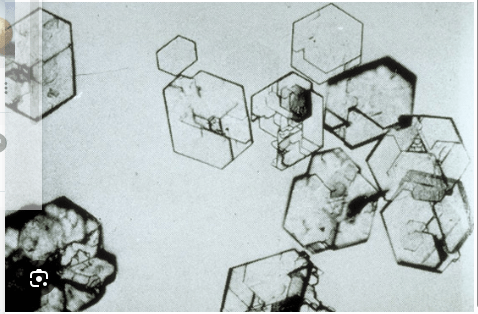
What are cystine crystals?
These hexagonal, flat crystals seen in acidic urine are pathognomonic for an autosomal recessive disorder of amino acid transport and indicate a high risk of recurrent nephrolithiasis beginning in childhood.
300
According to the KDIGO 2025 guideline, THIS is the proteinuria threshold (in grams per day) at which patients are considered at risk of progressive kidney function loss and should be considered for treatment.
What is 0.5 g/day?
The ideal treatment goal is to reduce proteinuria even further — below 0.3 g/d — while maintaining an eGFR decline rate of less than 1 mL/min/year
300
In the KDIGO staging system, this stage is defined by a serum creatinine rise to ≥3.0 times baseline, OR an increase to ≥4.0 mg/dL, OR initiation of renal replacement therapy, OR (in patients <18 years) a decrease in eGFR to <35 mL/min/1.73 m². The urine output criterion is <0.3 mL/kg/h for ≥24 hours or anuria for ≥12 hours.
What is Stage 3 AKI?
300
This electrolyte deficiency, commonly caused by chronic PPI use (e.g., omeprazole), leads to refractory hypokalemia due to impaired intestinal absorption?
What is Hypomagnesemia?
300
This class of oral diabetes medications inhibits a proximal tubule transporter, increases sodium delivery to the macula densa, restores tubuloglomerular feedback, and causes an initial drop in eGFR due to reduced intraglomerular pressure (a reno-protective effect)?
What are SGLT2 inhibitors?
300
Detection of such crystals on urine microscopy suggests THESE kidney stones
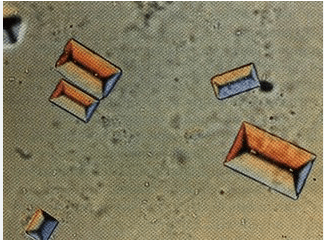
What are struvite (staghorn) calculi?
These crystals precipitate in alkaline urine (pH > 7.0) and are composed of magnesium ammonium phosphate. Their presence on urine microscopy should raise concern for infection with urease-producing organisms such as Proteus mirabilis, which can lead to this type of branching renal stone.
400
Histologic variant of FSGS characterized by wrinkling of the glomerular capillary wall with overlying podocyte hyperplasia and hypertrophy and carrying the worst prognosis
What is the collapsing variant of FSGS?
The Columbia Classification (2004) identifies five mutually exclusive histologic variants of FSGS based on light microscopy. Among them, collapsing variant — characterized by wrinkling of the glomerular capillary wall with overlying podocyte hyperplasia and hypertrophy — carries the worst prognosis, with a 65% rate of ESRD and only a 13% remission rate. It is strongly associated with HIV-associated nephropathy and APOL1 high-risk genotypes.
400
In the furosemide stress test, this is the IV bolus dose administered to patients who have received loop diuretics within the prior 7 days. A urine output of less than 200 mL over 2 hours after this dose predicts progression to severe AKI with a sensitivity of 87.1% and specificity of 84.1%.
What is 1.5 mg/kg of intravenous furosemide?
400
This classic equation states that serum sodium concentration is determined by the ratio of exchangeable sodium plus potassium to total body water, showing that hyponatremia reflects excess water and can be worsened by potassium depletion?
[Na⁺]s ≈ (Naₑ + Kₑ) / TBW.
What is the Edelman equation?
400
This weekly 1.0 mg injectable GLP-1 receptor agonist was the first to show kidney outcome benefits in a dedicated renal trial (FLOW), reducing major renal and cardiovascular events in patients with type 2 diabetes and CKD?
What is semaglutide (Ozempic)?
400
THIS is the minimum number of glomeruli generally recommended in a kidney biopsy sample to diagnose or exclude a specific histopathologic pattern with reasonable confidence, according to KDIGO guidelines.
What is 8-10 glomeruli?
500
This new molecule investigated in phase 3 REGENCY trial showed that adding this B‑cell–targeting biologic (given as intermittent 1000 mg infusions) to standard therapy improved complete renal response in lupus nephritis compared with placebo.
What is obinutuzumab?
In the phase 3 REGENCY trial (NEJM, 2025), 271 adults with biopsy-proven active lupus nephritis were randomized 1:1 to receive this drug (1000 mg on day 1 and at weeks 2, 24, 26, and 52) or placebo, all on background mycophenolate mofetil and prednisone. The primary endpoint — complete renal response at week 76 (UPCR <0.5, eGFR ≥85% of baseline, no intercurrent event) — was achieved in 46.4% vs. 33.1% (adjusted difference 13.4 percentage points; P=0.02).
500
"This multicenter RCT (published in JAMA 2025) compared indication-triggered (“on-demand”) dialysis vs routine thrice-weekly hemodialysis in stable AKI patients, showing higher unadjusted kidney recovery with the on-demand strategy
What is Liberate D trial?
500
Published in JAMA in 2025, this multicenter RCT specifically enrolled 627 critically ill patients with severe metabolic acidemia (pH ≤7.20) AND moderate-to-severe AKI (KDIGO stage 2–3). The primary outcome of 90 days all-cause mortality was not significant. However, KRT use was significantly lower in the bicarbonate group (HR for KRT initiation 0.59, 95% CI 0.46–0.75), and ICU-acquired bloodstream infections were 50% lower (4% vs. 9%).
What is BICAR-ICU 2 Trial
500
This oral C5a receptor antagonist blocks C5a-mediated neutrophil activation in ANCA-associated vasculitis while preserving terminal complement function against infections (hence does not require immunization against capsular bacteria)?
What is Avacopan?
500
THESE fan-shaped crystals in urine can be caused by a common medication
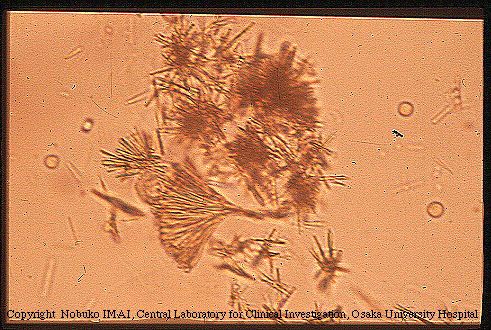
What are sulfa crystals?
These fan-shaped or "sheaves of wheat" crystals seen on urine microscopy under polarized light are highly birefringent and precipitate in acidic urine (pH < 5.5). Their formation can be prevented by aggressive hydration and urine alkalinization.