Seismic waves
Earthquake
Random
Earth Structure
1
Waves that cause Earthquake are called
Seismic waves
1
The point inside Earth where an earthquake begins. Number 3

Focus or hypocenter
1
The tallest and most famous mountain in Japan which is also a volcano sits where 3 tectonic plates meet.
Mt. Fuji
1
Made up of Earth's crust and upper mantle is called
Lithosphere
2
The fastest seismic waves that can travel through solids, liquids, and gases are called?
P waves
2
The point on Earth's surface directly above an earthquake's starting point? Number 2
Epicenter
2
The busiest country on Earth for volcanoes, one out of every 10 eruptions happens here.
Japan
2
A place where molten material from Earth's mantle reaches the lithosphere. Volcanos and hot springs are in this area
Hot spots
3
Combined P and S waves that travel along Earth's surface
Surface waves
3
What is the name for a break in Earth's crust where tectonic plates slide?
Fault
3
A group of 452 volcanoes around the Pacific ocean.
Pacific Ring of Fire
3
The inner core is made up of which elements.
Nickel and iron
4
Two types of surface waves
Love waves and Rayleigh Waves
4
Giant pieces of Earth's outer layer where most earthquakes occur called?
Tectonic Plates
4
A theory introduced by Alfred Wegener in 1912 states that at one point in time, all of the continents were joined together as one large mass of land, then the land spread apart and drifted into its current position.
Continental Drift/ plate tectonic theory
4
Explain what is happening to this picture. Please include the type of plate boundary and its effect of it. 
A divergent boundary, plates moving apart and it is causing new Earth's crust called sea floor spreading.
5
Explain what is happening in this picture. Describe 2 characteristics each.
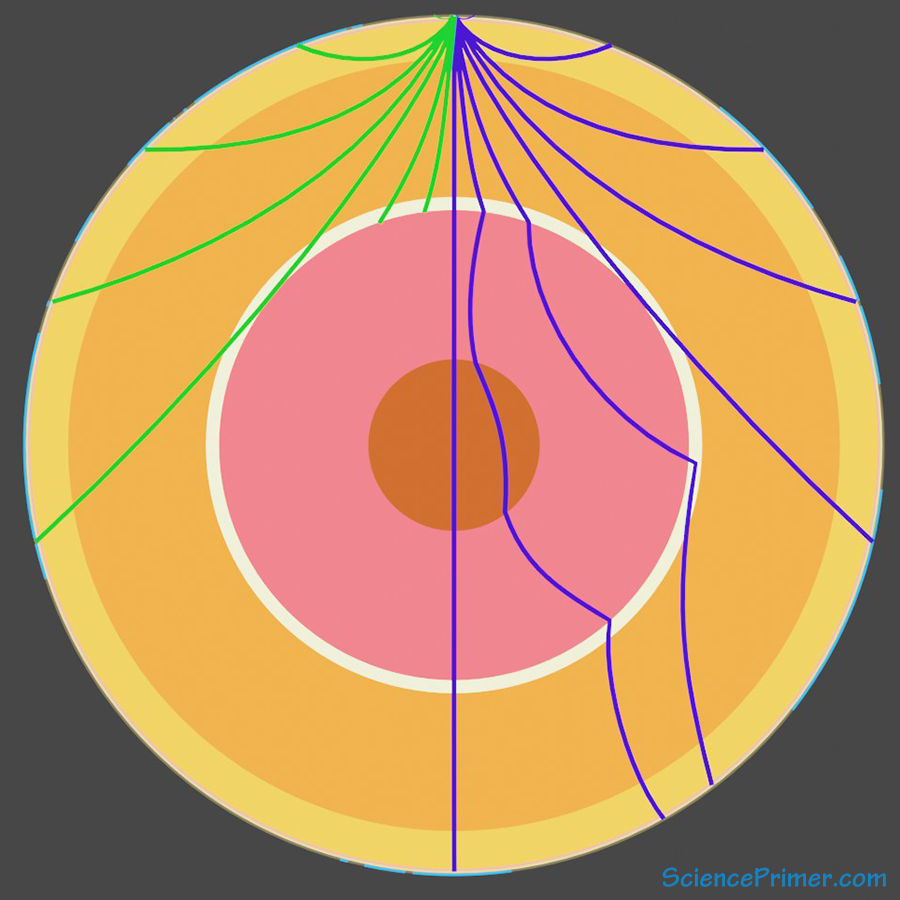
The Green S waves move slower and can travel through solids only, which can cause more damage. The purple P waves move faster and can move through solid liquid and gas.
5
Difference between seismograph and seismogram
Seismograph/seismometer- an instrument that records earthquake waves
Seismogram - tracing on the drum.
5
From about 300-200 million years ago (late Paleozoic Era until the very late Triassic), the continent we now know as North America was contiguous with Africa, South America, and Europe. They all existed as a single continent.
Pangea
5
Explain what is happening to this picture. Please include the type of plate boundary (200) and its effect of it (200).

A convergent boundary, and subduction, one plate goes under another plate?