Anything Goes
Domain and Range
Key Features of Graphs
Set builder notation
100
How can you find x and y intercepts?
Look where they cross the axis or plug in zero for the opposite letter.
100
State the definition of the domain and range of a function.
The domain is all of the x values of a function.
Range is all of the y values of a function.
100
What is/are the x-intercept(s) of this function?
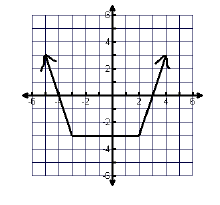
(-4,0)
(3,0)
100
How do you write negative infinity to infinity in set builder notation?
All reals {capital R}
200
What are the other names for x intercepts?
Solutions, roots and zeros
200
What is the difference between increasing and decreasing?
Increasing is where the graph is going up. Decreasing is where the graph is going down.
200
What is the interval of increase for the function below?
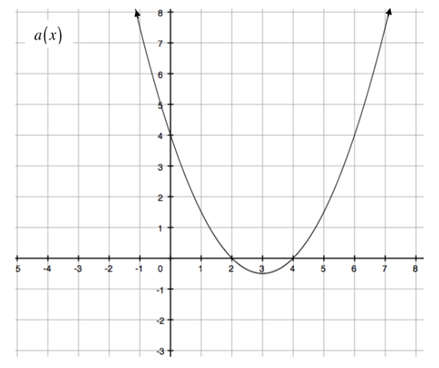
Increase: (3, +infinity)
200
Write in set builder notation: (- inifinty, -2)
x < -2
300
If the x-intercept and the y-intercept are the same, what must that order pair be?
(0,0)
300
What is the range of the function graphed below?
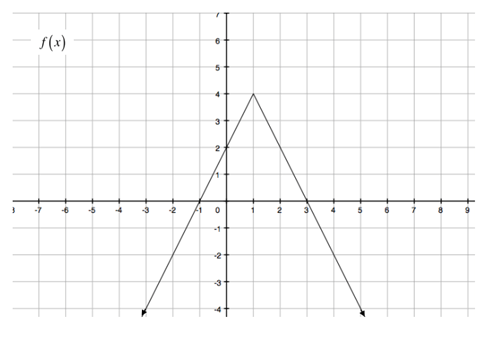
Domain: (-infinity, 4]
300
Does the function below increase from (4,8)
Yes
300
Write in set builder notation: (-10, 4)
-10 < x < 4
400
How do you know when a function is positive or negative?
Positive if the y value is greater than zero so above the graph.
Negative if the y value is less than zero or below the graph.
400
What is the domain of the function graphed below?
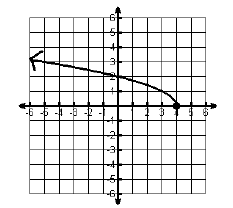
Domain: (-infinity, 4]
400
What is the negative interval of this graph?
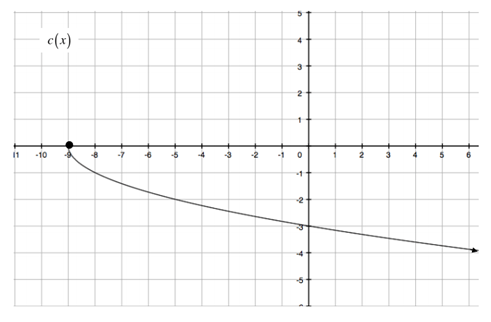
(-9, infinity)
400
Write in set builder notation: (0, infinity)
x > 0
500
Write the Domain of (-5,6] as an inequality.
-5<x≤6
500
What is the domain and range of the graph below?
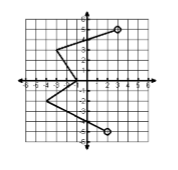
Domain: [-4,3)
Range: (-5,5)
500
What is the domain, range, increasing, and decreasing of the function below
Domain: All Real Numbers
Range: [-3, + infinity)
Increase: (2, + infinity)
Decrease: (-infinity, -3)
500
What do the brackets mean when writing in set builder notation: [ 3, 20 ]
Definite pts at 3 and 20. You would write it with and or equal to.