Theory Men
Random
Natural Selection
MRSA?
Homology
100
Catastrophism, meaning the regular occurrence of geological or meteorological disturbances (catastrophes), was Cuvier's attempt to explain the existence of
A) evolution.
B) the fossil record.
C) uniformitarianism.
D) the origin of new species.
E) natural selection.
B) the fossil record
100
During a study session about evolution, one of your fellow students remarks, "The giraffe stretched its neck while reaching for higher leaves; its offspring inherited longer necks as a result." Which statement is most likely to be helpful in correcting this student's misconception?
A) Characteristics acquired during an organism's life are generally not passed on through genes.
B) Spontaneous mutations can result in the appearance of new traits.
C) Only favorable adaptations have survival value.
D) Disuse of an organ may lead to its eventual disappearance.
E) If the giraffes did not have to compete with each other, longer necks would not have been passed on to the next generation.
A) Characteristics acquired during an organism's life are generally not passed on through genes. 
100
Which of these conditions should completely prevent the occurrence of natural selection in a population over time?
A) All variation between individuals is due only to environmental factors.
B) The environment is changing at a relatively slow rate.
C) The population size is large.
D) The population lives in a habitat where there are no competing species present.
A) All variation between individuals is due only to environmental factors.
100
If two modern organisms are distantly related in an evolutionary sense, then one should expect that
A) they live in very different habitats.
B) they should share fewer homologous structures than two more closely related organisms.
C) their chromosomes should be very similar.
D) they shared a common ancestor relatively recently.
E) they should be members of the same genus.
B) they should share fewer homologous structures than two more closely related organisms.
100
Of the following anatomical structures, which is homologous to the bones in the wing of a bird?
A) cartilage in the dorsal fin of a shark
B) bones in the hind limb of a kangaroo
C) chitinous struts in the wing of a butterfly
D) bony rays in the tail fin of a flying fish
E) bones in the flipper of a whale
E) bones in the flipper of a whale 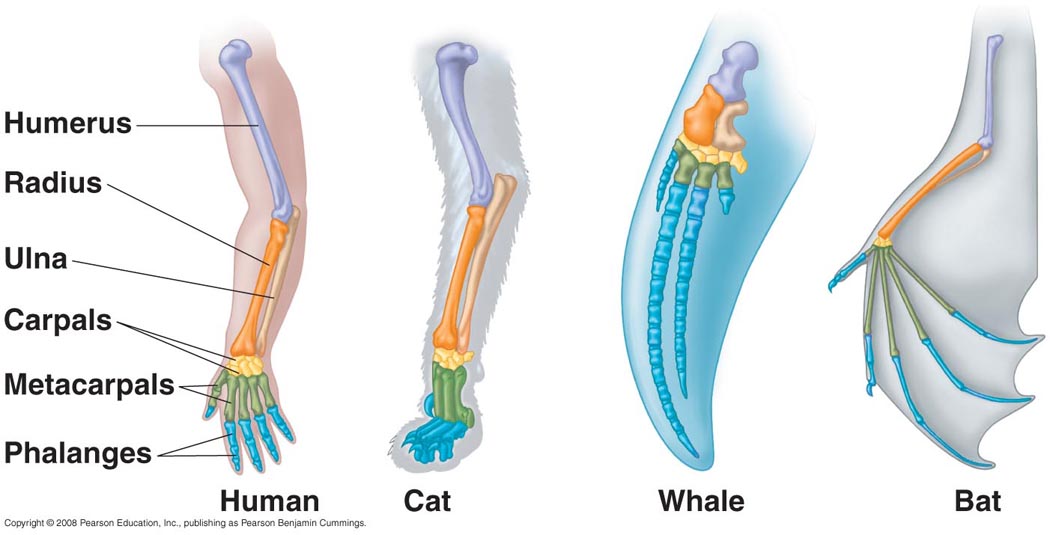
200
What was the prevailing belief prior to the time of Lyell and Darwin?
A) Earth is a few thousand years old, and populations are unchanging.
B) Earth is a few thousand years old, and populations gradually change.
C) Earth is millions of years old, and populations rapidly change.
D) Earth is millions of years old, and populations are unchanging.
E) Earth is millions of years old, and populations gradually change.
A) Earth is a few thousand years old, and populations are unchanging.
200
The role that humans play in artificial selection is to
A) determine who lives and who dies.
B) create the genetic variants, which nature then selects.
C) choose which organisms breed, and which do not.
D) train organisms to breed more successfully.
E) perform artificial insemination.
C) choose which organisms breed, and which do not.
200
Natural selection is based on all of the following except
A) genetic variation exists within populations.
B) the best-adapted individuals tend to leave the most offspring.
C) individuals who survive longer tend to leave more offspring than those who die young.
D) populations tend to produce more individuals than the environment can support.
E) individuals adapt to their environments and, thereby, evolve.
E) individuals adapt to their environments and, thereby, evolve.
200
Over evolutionary time, many cave-dwelling organisms have lost their eyes. Tapeworms have lost their digestive systems. Whales have lost their hind limbs. How can natural selection account for these losses?
A) Natural selection cannot account for losses, only for innovations.
B) Natural selection accounts for these losses by the principle of use and disuse.
C) Under particular circumstances that persisted for long periods, each of these structures presented greater costs than benefits.
D) The ancestors of these organisms experienced harmful mutations that forced them to find new habitats that these species had not previously used.
C) Under particular circumstances that persisted for long periods, each of these structures presented greater costs than benefits.
200
The upper forelimbs of humans and bats have fairly similar skeletal structures, whereas the corresponding bones in whales have very different shapes and proportions. However, genetic data suggest that all three kinds of organisms diverged from a common ancestor at about the same time. Which of the following is the most likely explanation for these data?
A) Humans and bats evolved by natural selection, and whales evolved by Lamarckian mechanisms.
B) Forelimb evolution was adaptive in people and bats, but not in whales.
C) Natural selection in an aquatic environment resulted in significant changes to whale forelimb anatomy.
D) Genes mutate faster in whales than in humans or bats.
E) Whales are not properly classified as mammals.
C) Natural selection in an aquatic environment resulted in significant changes to whale forelimb anatomy.

300
In the mid-1900s, the Soviet geneticist Lysenko believed that his winter wheat plants, exposed to ever-colder temperatures, would eventually give rise to ever more cold-tolerant winter wheat. Lysenko's attempts in this regard were most in agreement with the ideas of
A) Cuvier.
B) Hutton.
C) Lamarck.
D) Darwin.
E) Lyell.
C) Lamarck
300
Which of the following statements most detracts from the claim that the human appendix is a completely vestigial organ?
The appendix can be surgically removed with no immediate ill effects.
B) The appendix might have been larger in fossil hominids.
C) The appendix has a substantial amount of defensive lymphatic tissue.
D) Individuals with a larger-than-average appendix leave fewer offspring than those with a below-average-sized appendix.
E) In a million years, the human species might completely lack an appendix.
C) The appendix has a substantial amount of defensive lymphatic tissue.
300
Given a population that contains genetic variation, what is the correct sequence of the following events, under the influence of natural selection?
1. Well-adapted individuals leave more offspring than do poorly adapted individuals.
2. A change occurs in the environment.
3. Genetic frequencies within the population change.
4. Poorly adapted individuals have decreased survivorship.
A) 2 → 4 → 1 → 3
B) 4 → 2 → 1 → 3
C) 4 → 1 → 2 → 3
D) 4 → 2 → 3 → 1
E) 2 → 4 → 3 → 1
A) 2 → 4 → 1 → 3
300
The rise of methicillin-resistant Staphylococcus aureus (MRSA) can be considered to be an example of artificial selection because
A) humans purposefully raise MRSA in large fermenters in an attempt to make the bacteria ever-more resistant.
B) S. aureus is cultivated by humans to replenish the soil with nutrients.
C) humans synthesize methicillin and create environments in which bacteria frequently come into contact with methicillin.
D) Humans are becoming resistant to bacteria by taking methicillin.
C) humans synthesize methicillin and create environments in which bacteria frequently come into contact with methicillin.
300
It has been observed that organisms on islands are different from, but closely related to, similar forms found on the nearest continent. This is taken as evidence that
A) island forms and mainland forms descended from common ancestors.
B) common environments are inhabited by the same organisms.
C) the islands were originally part of the continent.
D) the island forms and mainland forms are converging.
E) island forms and mainland forms have identical gene pools.
A) island forms and mainland forms descended from common ancestors.
400
Which of the following represents an idea that Darwin learned from the writings of Thomas Malthus?
A) Technological innovation in agricultural practices will permit exponential growth of the human population into the foreseeable future.
B) Populations tend to increase at a faster rate than their food supply normally allows.
C) Earth changed over the years through a series of catastrophic upheavals.
D) The environment is responsible for natural selection.
E) Earth is more than 10,000 years old.
B) Populations tend to increase at a faster rate than their food supply normally allows.
400
What must be true of any organ that is described as vestigial?
A) It must be analogous to some feature in an ancestor.
B) It must be homologous to some feature in an ancestor.
C) It must be both homologous and analogous to some feature in an ancestor.
D) It need be neither homologous nor analogous to some feature in an ancestor.
B) It must be homologous to some feature in an ancestor.
400
Which of the following must exist in a population before natural selection can act upon that population?
A) genetic variation among individuals
B) variation among individuals caused by environmental factors
C) sexual reproduction
D) Three of the responses are correct.
E) Two of the responses are correct.
A) genetic variation among individuals
400
Within six months of effectively using methicillin to treat S. aureus infections in a community, all new infections were caused by MRSA. How can this result best be explained?
A) S. aureus can resist vaccines.
B) A patient must have become infected with MRSA from another community.
C) In response to the drug, S. aureus began making drug-resistant versions of the protein targeted by the drug.
D) Some drug-resistant bacteria were present at the start of treatment, and natural selection increased their frequency.
E) The drug caused the S. aureus DNA to change.
D) Some drug-resistant bacteria were present at the start of treatment, and natural selection increased their frequency.
400
Members of two different species possess a similar-looking structure that they use in a similar fashion to perform the same function. Which information would best help distinguish between an explanation based on homology versus one based on convergent evolution?
A) The two species live at great distance from each other.
B) The two species share many proteins in common, and the nucleotide sequences that code for these proteins are almost identical.
C) The sizes of the structures in adult members of both species are similar in size.
D) Both species are well adapted to their particular environments.
B) The two species share many proteins in common, and the nucleotide sequences that code for these proteins
500
Which of the following observations helped Darwin shape his concept of descent with modification?
A) Species diversity declines farther from the equator.
B) Fewer species live on islands than on the nearest continents.
C) Birds can be found on islands located farther from the mainland than the birds' maximum nonstop flight distance.
D) South American temperate plants are more similar to the tropical plants of South America than to the temperate plants of Europe.
E) Earthquakes reshape life by causing mass extinctions.
D) South American temperate plants are more similar to the tropical plants of South America than to the temperate plants of Europe.
500
If one wanted to find the largest number of endemic species, one should visit which of the following geological features (assuming each has existed for several millions of years)?
A) an isolated ocean island in the tropics
B) an extensive mountain range
C) a midcontinental grassland with extreme climatic conditions
D) a shallow estuary on a warm-water coast
A) an isolated ocean island in the tropics
500
Which of the following is not an observation or inference on which natural selection is based?
A) There is heritable variation among individuals.
B) Poorly adapted individuals never produce offspring.
C) Species produce more offspring than the environment can support.
D) Individuals whose characteristics are best suited to the environment generally leave more offspring than those whose characteristics are less well suited.
E) Only a fraction of an individual's offspring may survive.
B) Poorly adapted individuals never produce offspring. 
500
Logically, which of these should cast the most doubt on the relationships depicted by an evolutionary tree?
A) None of the organisms depicted by the tree ate the same foods.
B) Some of the organisms depicted by the tree had lived in different habitats.
C) The skeletal remains of the organisms depicted by the tree were incomplete (in other words, some bones were missing).
D) Transitional fossils had not been found.
E) Relationships between DNA sequences among the species did not match relationships between skeletal patterns.
E) Relationships between DNA sequences among the species did not match relationships between skeletal patterns.
500
Both ancestral birds and ancestral mammals shared a common ancestor that was terrestrial. Today, penguins (which are birds) and seals (which are mammals) have forelimbs adapted for swimming. What term best describes the relationship of the bones in the forelimbs of penguins and seals, and what term best describes the flippers of penguins and seals?
A) homologous; homologous
B) analogous; homologous
C) homologous; analogous
D) analogous; analogous
C) homologous; analogous 