Biomechanical Properties
B.P. in the Body
Joint Design
Arthrokinematic Application
Muscle Intro
100
Describe what the following regions on the load-deformation curve represent: elastic region, Young’s Modulus slope, plastic region, yield point, physiologic range, and point of fracture.
The elastic region is where the tissue can deform AND RETURN to its initial state. Young’s Modulus is the steepness of the slope and represents the STIFFNESS. The plastic region comes after the yield point where the tissue may not FULLY RETURN to initial state due to microtears and stress fractures. Point of fracture occurs when the tissue fails.
100
What are the 2 phases involved for loading a viscoelastic tissue? Describe each.
Creep deformation: deformation over time, variable = load. Stress relaxation: when deformed to a fixed length, the force required to maintain the new length deformation decreases over time, variable = deformation
100
What is cartilage’s role in the stress and strain curve?
Cartilage decreases stress by increasing cross-sectional area.
100
What are the classifications of synovial joints: uniaxial, biaxial, and triaxial? Please list one example of each!
Uniaxial: hinge (trochlear) - elbow joint, pivot (trochoid) - between C1 and C2 vertebrae
Biaxial: condyloid - radiocarpal joint, saddle - first metacarpal joint (thumb)
Triaxial: plane - intercarpal joint, ball and socket (glenohumeral)
100
The recruitment order of muscle fibers means ___ (large, small) motor units first. They generate ___ (more, less) tension and use ___ (more, less) energy.
SMALL units first. Less tension, less energy.
200
What is the toe region of tendon/ligament stress-strain curve?
The toe region occurs before change in original length of tendon/ligament. It represents the crimp wave stretching out first.
200
What is the strain-rate sensitivity? How does rapid loading affect tissue deformation?
When a load is applied rapidly, the tissue is stiffer and a larger force is needed to deform the tissue than if the load was applied slowly. When a tissue is load rapidly, a LARGE PEAK FORCE is required to deform the tissue.
200
In diarthroses articulations, synoviocytes synthesize THIS within the synovial fluid. What is the function of this molecule?
Hyaluronic acid; important for the health of cartilage, including immune system regulation, removal of cellular waste, and growth.
200
To improve motion, explain why we work on voluntary contraction and don’t just simply “strengthen the agonist muscle.”
Don’t just strengthen the muscle, because then you can’t deactivate the other one. Voluntary contraction facilitates deactivation of the other muscle. Ex: brushing teeth - activate biceps, deactivate triceps
200
In CONCENTRIC contraction, the actin and myosin components are pulled ___ (away from, towards) each other. Concentric = ___ class levers. In ECCENTRIC contraction, the actin/myosin components are pulled ___ (away from, towards) each other. Eccentric = ___ class levers.
Concentric: pulled towards, 3rd class.
Eccentric: pulled away, 2nd class.
300
Why is the plastic region greater in the bone load-deformation curve than for other tissues?
Bone remodels all the time through osteoblast/osteoclast activity. Bone is stiffer, so it can withstand more stress than tendon/ligament. On the other hand, any point higher than the yield point, which is not by much, will cause a fracture.
300
What does the SAID principle state? How do cortical and cancellous bone respond to stress/strain differently? How does this relate to bone’s response to compression vs. tension?
Cortical bone withstands greater STRESS, less STRAIN than cancellous bone. Cancellous bone can sustain strains of 75%. Bone can withstand greater stress in COMPRESSION than in tension.
300
In ____-arthrosis articulations, THESE are the components for static stability, and THESE Are the components for dynamic stability.
Diarthroses. For static stability: ligaments, capsule, labrum, the structure of the bone, and sometimes tendon. For dynamic stability: tendon
300
APPLICATION: flexion at the elbow joint. The olecranon process has the ___ (concave or convex) surface. The olecranon ___ (spins, slides, rolls) in the ___ (opposite, same) direction as the bony lever. The olecranon process ___ (spins, slides, rolls) in the ___ (opposite, same) direction as the capitulum of the humerus.
CONCAVE surface. Rolls in the SAME direction. Slides in the SAME direction.
300
For muscle recruitment strategy, fibers are recruited with the following considerations (6).
1. Energy conservation
2. previous experience
3. Nature of task/type of action
3. Mechanical advantage (how much you can do with the least amount of energy)
4. ROM
5. selection from a variety of mm surrounding the jt
400
Why is viscoelasticity not simply “biphasic,” “viscosity + elasticity?”
Viscoelasticity happens in biphasic structures, but it is not itself biphasic. It depends on the rate and length of time. The viscous qualities make the deformation and the return to the original shape of the material “time-dependent.”
400
What is the function of labrum? What happens if the labrum gets damaged?
The labrum is supposed to provide more static stability at the ball and socket joint. It increases surface area to decrease stress and deepen the cavity. After long term damage, it could lead to degenerative joint disease. It also causes more pain in closed packed position, end range.
400
Is loose or close packed position better for testing stability? What happens if it's too loose? Too tight?
CLOSE packed - better for testing stability. On the other hand, loose packed is better for testing mobility. The joint needs to have a sufficient amount of “joint play” to allow normal motion at the joint’s articulating surfaces.
Too loose = joint has too much play and becomes unstable. Too tight = joint has no movement and bony lever movement is restricted
400
APPLICATION: shoulder flexion at the glenohumeral joint. The humeral head is the ___ (concave or convex) surface. The humeral head ___ (spins, slides, rolls) in the ___ (opposite, same) direction as the bony lever. The humeral head ___ (spins, slides, rolls) in the ___ (opposite, same) direction as the glenoid fossa.
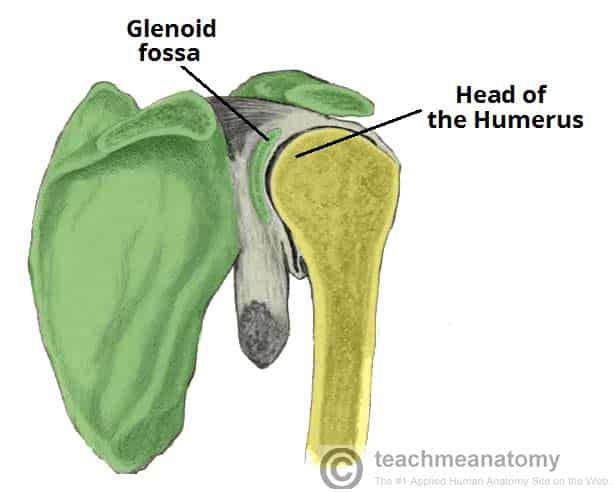 Convex surface. ROLLs in the SAME direction. SLIDES in the OPPOSITE direction.
400
The sarcomere is the functional unit of muscle fibers. Label and describe the following: Sarcomere, actin, myosin, A-band, H-zone, I-band, M-line, Z-disc.
1. Sarcomere
2. H-zone: light area within A-band that only contains myosin
3. Actin
4. Myosin
5. Z-disc: disc-like structure for actin attachment
6. A-band: actin/myosin overlap
7. I-band: light area, only actin
8. M-line: connects myosin filaments
500
How does overuse at a joint cause injury? Use biomechanical concepts to explain.
Overuse leaves no heal time, and lowers the yield point more each activity session. This is why the day of major injury, the load doesn’t even have to be huge. It would only take a small amount of force. CREEP STRAIN = tissue loaded again and again with no time to return to original shape.
500
Describe lubrication in the context of rheumatoid arthritis.
In patients with RA, the lubricin molecules that create a film over cartilage increase in viscosity. Therefore, less fluid comes out when fluid gets squeezed out of cartilage into the joint space as loading increases. There will be more pressure, and an increase in inflammation.
500
Explain why a person with tight hamstrings would experience THIS type of end feel while doing the v-sit reach test, but not while standing or sitting in a chair.
Firm end feel: stopped by soft tissue that has reached their limit of stretch.
500
APPLICATION: knee flexion at the tibiofemoral joint. The femoral head is the ___ (concave or convex) surface. The femoral head ___ (spins, slides, rolls) in the ___ (opposite, same) direction as the bony lever. The femoral head ___ (spins, slides, rolls) in the ___ (opposite, same) direction in the tibial plateau.
Convex surface. ROLLS in same direction. Slides in opposite direction.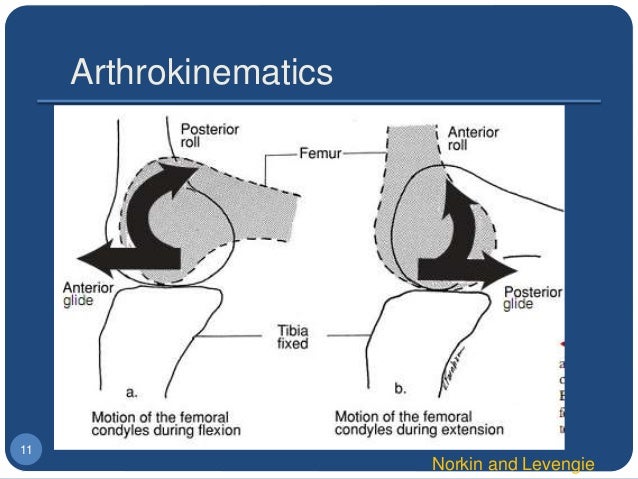
500
Finish the concept map for the following activities: cross-country run, 400m sprint, plyometric power lifting ->
Type of muscle fiber
speed of contraction
color
capillary density
# of mitochondria
myoglobin content
primary source of ATP
Glycogen content
Aerobic & Anaerobic capacity
Fatigability
Motor Unit Size
