Order in the courts
Expressive k
All about dem Graphs
At the Dinner Table
To the Mechanics
100
Rate=k[A]^2[B]^1
What is the order with respect to:
(a) Reactant A?
(b) Reactant B?
(c) Overall reaction?
(a) 2nd
(b) 1st
(c) 3rd
100
A+2B→C
The rate law is determined to be:
Rate=k[A]1[B]2
You are given:
[A]=0.200 M
[B]=0.100 M
k=0.500 M−2s−1
Rate =
0.00100M/s
100
What causes this decrease in Activation energy
Catalyst
100
The following table shows the initial concentrations of reactants and the initial rate of reaction for a chemical reaction.
Experiment [A] (mol/L) [B] (mol/L) Rate
1 0.1 0.2 0.05
2 0.2 0.2 0.10
3 0.1 0.4 0.20
Question: Determine the rate law for the reaction and calculate the rate constant k
Rate=12.5[A][B]2
100
How many steps
3
200
In a certain reaction, doubling [B] while keeping [A] constant causes the rate to increase by a factor of 4. What is the order of the reaction with respect to B?
Second order with respect to B
200
Initial [A] = 0.200 M
[A] after 40.0 seconds = 0.050 M
The reaction is first-order
Find the rate constant k.
k=ln(0.200/0.050)/40.0=ln(4)/40.0≈1.38640.0=0.0347s−1
k=0.0347 s−1
200
what is k
k = -slope
200
The following data shows the concentration of reactant A at different times during the reaction.
Time (s) [A] (mol/L)
0 0.50
10 0.40
20 0.30
30 0.25
Question: Using the integrated rate law for a first-order reaction, calculate the rate constant kkk.
k is 0.0231 s⁻¹.
200
In a reaction mechanism, the overall reaction is given as:
A+B→C+D
The reaction mechanism consists of the following elementary steps:
A→E+F
E+B→C+D
Identify the rate-determining step (RDS) of the reaction mechanism. What does this imply for the overall rate law of the reaction?
RDS: step 1
rat law is Rate=k[A]
300
1st order
300
Initial [A] = 0.100 M
[A] after 30.0 seconds = 0.050 M
The reaction is second-order
Find the rate constant k.
k=1/30.0(1/0.050−1/0.100)=1/30.0(20−10)=10/30=0.333M−1s−1
Answer: k=0.333 M−1s−1
300
What theory does this represent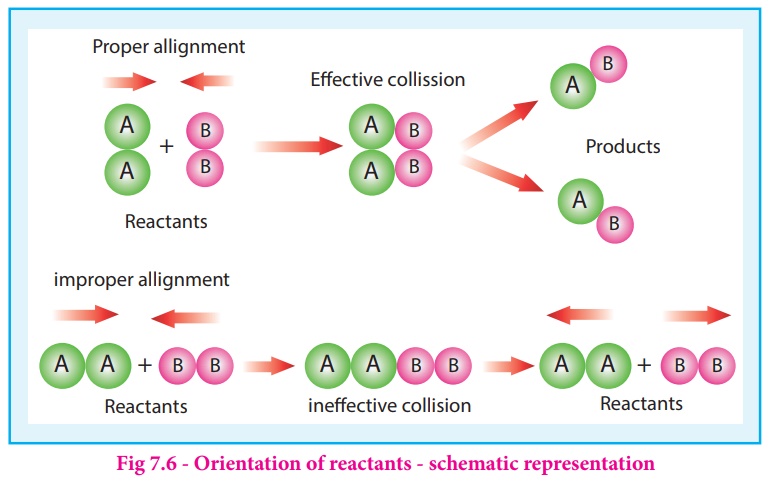
Collision Theory
300
For a first-order reaction, the following table shows the concentration of a reactant over time.
Time (s) [A] (mol/L)
0 0.30
50 0.15
100 0.075
Question: Calculate the half-life of the reaction.
Since the concentration of A halves every 50 seconds, the half-life for this reaction is 50 seconds.
300
Consider the following reaction mechanism for the decomposition of hydrogen peroxide (H2O2):
H2O2⇌H2O+O2(slow)
O2+H2O2→H2O+O2(fast)
Write the rate law for the overall reaction based on the above reaction mechanism.
Rate=k[H2O2]
400
Q2. Table Data (One Reactant)
Consider the following data for a reaction:
[A] (M)Initial Rate(M/s)
0.100 0.025
0.200 0.100
0.400 0.400
Determine the order of the reaction with respect to A.
Second order with respect to A
400
Initial [A] = 0.500 M
[A] after 25.0 seconds = 0.300 M
The reaction is zero-order
Find the rate constant k.
- [A]=−kt+[A]0⇒k=[A]0-[A]/t=0.500−0.300/25.0=0.200/25.0=0.00800M/s
k=0.00800 M/s
400
What is the half life
4 minuets
400
For the reaction A+B→CA + B the rate law is given as Rate=k[A]1[B]2, and the rate constant k=3.0 L2/mol2⋅s The following table shows the initial concentrations of A and B, but some rate values are missing.
Experiment [A] (mol/L) [B] (mol/L) Rate
1 0.10 0.20 x
2 0.20 0.10 0.12
3 0.30 0.40 y
Question: Fill in the missing rate values for Experiments 1 and 3.
x = .012
y = .144
400
The following reaction mechanism is proposed for the reaction of chlorine gas (Cl2) and methane (CH4):
Cl2→2Cl (fast)
Cl+CH4→CH3+HCl(slow)
CH3+Cl2→CH3Cl+Cl(fast)
Question:
Identify the intermediates in this mechanism.
Cl is an intermediate because it is produced in Step 1 and consumed in Step 2 and Step 3.
CH3 is an intermediate because it is produced in Step 2 and consumed in Step 3.
500
A reaction has this experimental data:
[A] (M) [B] (M) Initial Rate (M/s)
0.100 0.100 0.020
0.100 0.200 0.040
0.200 0.200 0.160
Determine:
(a) The order with respect to A
(b) The order with respect to B
(c) The overall order
(a) A is second order
(b) B is first order
(c) Overall order = 3
500
You’re told that the half-life of a first-order reaction is 10.0 seconds.
What is the rate constant k?
t1/2=0.693/k⇒k=0.693/t1/2=0.693/10.0=0.0693s−1
k=0.0693 s−1
500
What does k = at half life
k = .17325
500
A student is investigating the rate of a chemical reaction and collects the following data for the concentration of a reactant A over time:
Time (s) [A] (mol/L)
0 0.100
50 0.071
100 0.050
150 0.035
200 0.025
What is the order (use linear regression)
1st order
500
Overall reaction:
2NO+O2→2NO2
Proposed mechanism:
NO+O2⇌NO3(fast equilibrium)
NO3+NO→2NO2 (slow)
What is the Rate Law
Rate=k[NO]2[O2]