The Glass is Half Full
INSTANT Grits! (Just add Water)
Integrated Rate Law
In a Collision? Call 1-800-Chem-Istry
100
This order reaction has a half-life equation of [A]i/2k.
What is 0 order?
100
True or False: Instant rate laws are always concerned with the reactants and not the products.
What is TRUE?
100
The order of reaction is determined by graphing data and seeing which graph is _______.
What is linear?
100
The energy threshold needed to have a reaction. The minimum amount of energy that must be present.
What is the activation energy?
200
This value is included in every one of the half-life equations for kinetics.
What is k (rate constant)?
200
This is the rate law for the following first order reaction:
A --> B
What is Rate = k[A]?
200
This order reaction is the only reaction that does not have a negative slope.
What is Second Order?
200
Collisions require these two factors to occur.
What are correct orientation and sufficient energy?
300
This is the half life equation of a second order reaction.
What is 1/k[A]i?
300
This rate order results in a rate that is independent of concentration.
What is 0 order?
300
A first order reaction has a linear curve on the graph ______ vs time.
What is ln[A]?
300
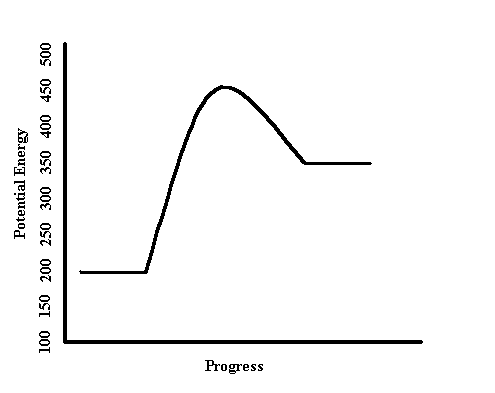 Endothermic or Exothermic.
What is Endothermic?
400
True or False: all half life equations depend on the initial concentration.
What is FALSE?
400
Determine the overall rate order for the rate law
Rate = k[A]3[B]0[C]1[D]1
What is 5?
400
The y intercept of a second order reaction.
What is 1/[A]i?
400
This is the molecule in a reaction sequence that is extremely high energy, and thus unstable. It occurs for only a brief amount of time.
What is the activated complex?
500
In first order half life, the number .693 comes from the natural log of this number.
What is 1/2?
500
Determine the rate law:
Experiment [NO] [Cl2] Rate (mol/L·s)
1 .250 .250 1.43 x 10⁻⁶
2 .500 .250 5.72 x 10⁻⁶
3 .250 .500 2.86 x 10⁻⁶
What is Rate = k[NO]2[Cl2]1?
500
First order reaction with initial concentration of .368M, 300 seconds pass, concentration of .0183M.
Determine k.
What is .01?
500
The length of the LHC (Large Hadron Collider).
What is 27 kilometers?