Gait Balance Strategies
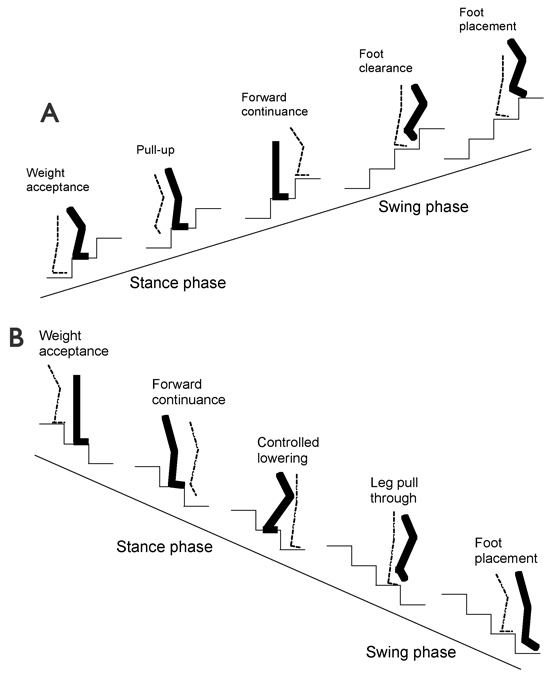
Stair Gait: Ascent
Stair Gait: Descent
Biomechanics of Running
Fun Run
100
How does pronation play a role in the weight acceptance subphase to keep balance?
Assists with shock absorption and using eversion
100
What are the events of the ASCENT phase of stair gait, and the percentages per event?
Stance phase = 64%
Weight acceptance = 14%
Pull up = 14-32%
Forward continuance = 32=64%
Swing phase = 36%
Foot clearance = 64-80%
Foot placement = 80-100%

100
What are the events of the DESCENT phase of stair gait? Percentages per event?
Stance phase = 64%
Weight acceptance = 15%
Forward continuance = 15-30%
Controlled lowering = 30=64%
Swing phase = 36%
Leg pull thru = 64-80%
Foot placement = 80-100%
100
Describe the changes in transitioning from walking to running: Center of Mass and pelvic movement.
CoM gets lower to the ground
Increase in anterior pelvic tilt

100
What are some reasons for patellofemoral pain in female runners?
Excess peak pelvic drop of contralateral side
Excess peak hip ADD
Excess peak hip internal rotation
Decreased knee “ADD” moment (GRF passing medial to center of knee)
200
1) Why does terminal swing/late swing require so much hamstring activity? (2) What other muscles at the hip/pelvis are important?
Hamstrings will decelerate the leg and position it for weight acceptance/heel strike again
ADD magnus, glute max, help in the sagittal plane and TFL/glute med and min help in the frontal plane to decelerate leg

200
What muscle groups generate the most power during ascent?
Knee extensors (quads) do the most during pull up. Need 3+/5 muscle strength
Soleus helps to pull the tibia back as well
200
What muscle groups generate the most activity during the stance phase of descent?
Eccentric contractions of rectus fem, vastus lateralis, triceps surae (gastrocsoleus) work to control the body with respect to gravity
Controlled lowering: eccentric quad (and soleus doesn’t let the tibia collapse)
200
What changes will we see at the hip in transitioning from walking to running?
Peak hip extension at toe-off
Peak hip flexion at mid- to terminal swing
Flexion/extension range changes from 40 to 60 degrees
ABD/ADD range changes from 10 to 15 degrees
Increased hip ADD during stance phase, increased ABD during swing phase
200
What are some reasons for excessive anterior pelvic tilt in runners? 
Tight hip flexors might limit hip extension
Glute max might be weak from being lengthened (sedentary job/lifestyle) so hip extension is limited
300
Midstance is an event of single limb support and therefore requires stability to avoid a pelvic drop in the frontal plane. If the single limb support is on the RIGHT leg, (1) which muscle has peak activity? (2) What side?
LEFT glute med controls hip so it doesn’t drop down
300
What muscles are mainly active during the swing phase of ascent? During which events?
Foot clearance: (concentric) TA and hamstrings for DF of foot and knee flexion, hip flexors
Rectus fem contracts eccentrically
Foot placement: hip extensors for controlled lowering and ankle DFs
300
What muscle groups generate the most activity during the swing phase of descent? Peak internal moment for any muscles?
Leg pull thru: hip flexors
Foot placement: tib ant, gastroc
Peak internal hip ABD moment (glute med)
300
How does the ROM needed at the knee change from walking to running?
Walking: need 0 degrees knee flexion at initial contact and 5 degrees at midstance
Running: now need 25 degrees knee flexion at IC and 45 degrees at MS
Swing phase: knee flexion goes from 60 degrees (walking) to > 90 degrees for running
300
How is the single leg squat/small knee bend assessment similar to running form? What qualitative factors can be assessed?
It is what the person might look like in midstance (hip and knee flexion)
Trunk leaning from midline, hip ADD, knee valgus, foot pronation is common
Femoral internal rotation
Arm ABD

400
How do we use reactive strategies during the swing phase? Early swing, midswing, late swing
Early swing - extra knee flexion with extra DF
Midswing - elevation to pass the obstacle
Late swing - knee extension and deceleration for forward sway for the lowering strategy into heel strike
400
What is the ROM needed at the hip, knee, and ankle for (1) weight acceptance to pull up? (2) Pull up to forward continuance? (Stance phase)
Hip: 50-60 degrees flexion
Knee: 50-70 degrees flexion
Ankle: 25-15 degrees DF
Hip: 15 degrees flexion to 20 degrees extension
Knee: 5-10 degrees flexion
Ankle: 15 degrees DF to 15 degrees PF
400
You are re-training your patient after a recent CVA on how to descend stairs again; however, because he is obese (BMI = 36) you have to teach him how to descend stairs medio-laterally because he is wider than the staircase. He also has right sided UE and LE weakness. What side should he descend on, and what two muscles groups are most important for this?
Walk down sideways with the right leg (weaker) first
Left glute med and left quads need strength to eccentrically control on the way down
400
How does the ROM needed at the ankle change from walking to running?
People could end up doing either dorsiflexion OR plantar flexion at initial contact
Midstance: need more dorsiflexion
Toe-off: need more plantar flexion
400
What is the step down test? What qualitative factors are we looking for in this picture?
Determine stability of the standing leg
Factors: arm strategy, trunk lean, pelvic drop, knee valgus, instability
500
Explain how we use compensatory automatic postural adjustments to recover from an unexpected perturbation during gait. Example 1: someone bumped into your back on the subway. Example 2: you slip on a banana peel during heel strike.
It might generate gastroc activation after being stretched faster than normal to help slow the body’s forward progression
Forward slip at heel strike will activate tib anterior first, followed by rectus femoris AND biceps femoris, then glute med and abs
Ab muscles will help the hip strategy, arms forward for reaching strategy
500
What is the ROM needed at the hip, knee, and ankle for foot clearance through foot placement (swing phase)?
Hip: 60 degrees flexion
Knee: 90-100 degrees flexion
Ankle: 10 degrees PF to 20 degrees DF
500
Your BF is walking down the stairs. What phase of descent is this for the RIGHT leg? What phase is it for the LEFT leg?

Right leg: foot placement
Left leg: forward continuance
500
What are some biomechanical differences between male and female runners?
Frontal plane: females have increased peak hip ADD, increased knee “ABD” moment
Transverse plane: females have increased peak hip internal rotation (heel strike), increased tibial external rotation
Females have wider pelvis → CPG pattern of flexion, ADD, and internal rotation in stance phase
500
Talk about the EMG activity during running for the following muscle groups: rectus/quads, hamstrings/gastrosoleus, and anterior tibialis.
Rectus/quads: Late swing to mid stance - rectus by itself is active in midswing, shock absorption, deceleration, placing the LE
Hamstrings/hip extensors/gastro-soleus: hamstrings decelerate momentum of tibia as knee extends just prior to initial contact
Anterior tib: dorsiflexion to clear foot during swing, ground contact with hind foot, controls lowering of forefoot to the ground during first part of stance