Business Operations
Finances, Risk, & Development of Practice
Practice-Wide Delivery of Services
Practice Methodologies
AIA Standard Forms
100
What is the 'standard of care'?
“§ 2.2 The Architect shall perform its services consistent with the professional skill and care ordinarily provided by architects practicing in the same or similar locality under the same or similar circumstances. The Architect shall perform its services as expeditiously as is consistent with such professional skill and care and the orderly progress of the Project.”
100
An architecture firm is developing a systematic way of eliminating paper copies of files for projects that have been completed. They decide that the files to be eliminated first are those for projects which no claims can arise.
Which project files should the firm shred first?
a. Files for projects tht have the fewest change orders
b. Files for projects that are beyond the statute of limitations
c. Files for projects that have a letter of recommendation from the owner
b. Files for projects that are beyond the statute of limitations
Projects that are beyond the statute of limitations are legally protected from claims.
100
An architect is working on a Community Center project through the Construction Manager at Risk (CMaR) method. Though the project has a guaranteed maximum price (GMP), the CMaR is unable to bring the project in budget or give the owner a GMP as the end of the design phase nears. The owner decides to release the CMaR from their contract and publicly bid the project. The delivery method changes to design-bid-build.
What additional responsibilty will the architect take on as a result of the changes?
a. Manage subcontractors
b. Sign applications for payments
c. Provide a detailed estimate of construction cost
d. Assist owner in determining the lowest and best bid
D. Assist the owner in determining the lowest and best bid
Determine on a project by project basis if this additional scope can be absorbed into the proposed fee or if an add-service is required
100
A recently registered architect wants to set up an architectural firm and has their first project lined up, a conceptual kitchen design that the client wants to begin as soon as possible. The architect plans to limit their work to small-scale conceptual works.
Which type of business entity should the architect adopt?
a. General corporation
b. Limited liability partnership
c. Limited liability company
c. Limited liability company (LLC)
100
An architect is retained to provide design services for a new commercial building. During construction, the owner discovers that a specified material is no longer commercially available. The architect proposes an alternative material that is reasonably consistent with the design intent. The contractor argues that the architect is obligated to guarantee that the replacement material will perform exactly like the originally specified material.
Which statement BEST describes the architect's obligation under a typical AIA agreement?
a. The architect warrants that all specified materials will perform as intended.
b. The architect is responsible for ensuring that all specified products remain commercially available through construction.
c. The architect is responsible for providing technical performance specifications
d. The architect is responsible for any failure of a substituted material unless the owner approved the substitution in writing.
c. The architect is responsible for providing technical performance specifications
AIA agreements generally establish a professional standard of care, rather than a warranty or guarantee of results.
200
In the negotiation of a contract, the architect and the owner agree that construction costs are not to exceed $5M for the construction of a new community center. During construction, however, actual costs end up totaling more than the agreed upon total. The owner, upset about change orders, wants to hold the architect responsible, but the architect claims that the cost overruns were a normal part of unexpected expenses that can occur during construction. They claim that they provided fully contractual, professional, design services consistent with the Standard of Care. The owner and architect decide to take the matter to arbitration. Which of the following rulings can you expect?
a. The architect has provided services consistent with the professional skill and ordinary care provided in the same locality, and has no control over the increase in construction costs.
b. The architect has failed to provide services agreed upon by both parties in their written agreement, which exceeded the professional skill and care ordinarily provided.
B.
The architect exceeded the standard of care by including a guarantee of the maximum construction cost.
200
The principal of an architecture firm realizes there is a significant gap between current profitability and annual goals. The principal decides to implement a sustainable stategy to increase annual profitability.
Which strategy should the principal implement?
a. Add two new interns to the team.
b. Increase billing rates by $6 per hour.
c. Accept various projects in new typologies
d. Extend the design team's work to 50 hours per week.
b. Increased billing rates will help meet the annual goal without significantly increasing operating expenses
200
Your firm has been selected to design a series of tiny homes which will act as auxiliary structures on a series of properties a developer owns. The developer wants a studio, one-bedroom, and two-bedroom option documented and the construction will be phased and built on a rolling basis as the homes are requisitioned. Your firm wants to make sure their fees capture the cost of design, the value of their expertise, and maximize profit.
Which fee proposal structure is most appropriate?
a. A fixed fee for the preliminary design phases and a fixed fee per unit type for the construction documents.
b. A fixed fee for the preliminary design phases, a fixed fee per unit type for the construction documents, and a reuse fee for all subsequent units built
c. A time and materials (NTE) fee for the preliminary design phases and a fixed fee per unit type for the construction documents
d. A time and materials (NTE) fee for the preliminary design phases, a fixed fee per unit type for the construction documents, and a reuse fee for all subsequent units built
b. A fixed fee for the preliminary design phases, a fixed fee per unit type for the construction documents, and a reuse fee for all subsequent units built
A fixed fee for the preliminary design appropriately compensates the architect's expertise; the fixed fee for construction documents also effectively covers the cost to produce the documentation, and the reuse fee is a fair way to compensate for repetitive use of the designs
200
An architecture firm is updating their rules for the proper dimensioning of their architectural drawings. They wnt to provide their construction personnel with clear and unambiuous aspects of general dimensioning.
Which of the following rules should the firm use? (Choose four)
a. Avoid notes on plans when dimensional control of an element is unneccessary so that the lack of information isn't viewed as an error or omission.
b. Provide actual dimension strings even when there is an opportunity to describe an element with a note such as "align".
c. Provide critical dimensions for things that are important in location or that must have a controlled placement.
d. Dimension corridor partitions from the corridor side of the partition with a clear egress width.
e. Dimension toilet room drywall partitions from the toilet room side of the partition.
f. Avoid the use of fractions smaller than 1/8" anywhere on floor plans.
CDEF
200
During construction, the architect observes that a contractor has installed work that does not conform to the construction documents. The architect notifies the contractor and owner of the nonconforming work. The contractor responds that the architect is responsible for identifying all defective work because the architect is visiting the site periodically.
Under a typical AIA owner-architect agreement, which is the BEST response?
a. The architect is responsible for discovering and documenting every instance of nonconforming work.
b. The architect's site observations are intended to provide the architect with reasonable knowledge of the progress and quality of the work, but do not constitute continuous observation or exhaustive inspection.
c. The architect has no responsibility for observing construction unless specifically retained as the contractor's inspector.
d. The architect is responsible for correcting defective work whenever it is discovered, regardless of who performed the work.
b. The architect'ssite visits are generally periodic observations, not continuous inspection. The architect is not assuming the contractor's responsibility for construction quality or means and methods.
300
During a mid-documentation project meeting with a client, the owner's rep dictates a requested design change that the architect believes impacts public safety. The architect voices their concern during the meeting, but is told that the executive board has made their final decision and that the building is not for the public, but for employees only. Despite this new design direction, the architect is hesitant and isn't sure what to do. According to the AIA Code of Ethics and Professional Conduct, what should the architect do?
a. Prepare the construction documents as directed.
b. Prepare the construction documents as they see appropriate.
c. Inform the building inspector of their concerns with the decision made.
c. Inform the building inspector
"If, in the course of their work on a project, the Members become aware of a decision taken by their employer or client which violates any law or regulation and will, in the Members' judgement, materially affect adversely the safety to the public of the finished project, the members shall:
- advise their employer or client against the decision,
- refuse to consent to the decision, and
- report the decision to the local building inspector or other public official charged with the enforcement of the applicable laws and regulations, unless the members are able to cause the matter to be satisfactorily resolved by other means."
300
An architecture firm successfully completes a deli project in a large city. The owner is planning to construct two more locations in the city using the same design. The owner would like to continue working with the firm under the condition of transferring the ownership of the architectural drawings. How should the architect respond?
a. transfer the ownership under partnership
b. transfer the ownership since the owner has already paid for the architectural services with the initial contract
c. suggest using the same drawings for all the upcoming projects as they are all in the same jurisdiction
d. explain to the owner that the designs are not tangible goods for sale
d. explain to the owner that the designs are not tangible goods for sale
As the architects are the authors and creators of the drawings, they are the intellectual property of the architects and are protected by US copyright laws.
300
A new client asks an architecture firm, who has extensive experience with multifamily housing projects, to design a 500-unit, mixed use project. Because the client is unknown to your firm, management has concerns about receiving compensation. Which three action items can the architect perform/ stipulate to ensure they will most likely receive payment for the project?
a. Require the client to pay all invoices in full within 30 days or include an additional 1% penalty for late payment
b. Evaluate the clients brand to determine if the client's values are in alignment with the firm's values
c. Determine if the client's budget can cover both construction costs and design fees
d. Require a deposit of 10% of the design fee upfront before beginning services
e. Ask other architects about their experience of working with this client
f. Ask contractors about their experience of working with this client
CEF
c. It is appropriate for the architect to determine if the client has a realistic understanding of the costs of the project and has a budget that will cover those costs.
e. & f. It is appropriate for the architect to verify the reputation of a new client with architects and contractors who have previously worked with them in order to verify that the client has a history of timely payment
300
A local municipality wants to update two adjacent water pump stations and contracts an architecture firm to design and document renovations. The contracted design fee is $1M with the following fee breakdown:
SD: 15%
DD: 25%
CD: 35%
Permitting & Bidding: 5%
CA: 20%
After completion of the CDs, the municipality has an election and new politicians decide the project's construction needs to be phased, completing one building at a time. Each construction phase will need to be bid and permitted separately before each begins.
What additional fee should the architecture firm request to cover the cost of the extended timeline?
$250,000
5% Permitting + 20% CA = 25% total additional fee needed
$1,000,000 design fee x 25% = $250,000 additional fee request
300
An architect is preparing the contract documents for a project in which the owner will contract directly with the contractor. The architect wants to establish the general contractual requirements governing the relationship between the owner and contractor, including payment, changes in the work, claims, insurance, and dispute resolution.
Which AIA document should the architect recommend incorporating into the construction contract?
a. AIA B101 – Standard Form of Agreement Between Owner and Architect
b. AIA A201 – General Conditions of the Contract for Construction
c. AIA A401 – Standard Form of Agreement Between Contractor and Subcontractor
d. AIA C401 – Standard Form of Agreement Between Architect and Consultant
b. AIA A201 – General Conditions of the Contract for Construction
400
An architect who is a sole proprietor carries $1M in professional liability insurance. The architect wins a new building project that requires $3M in professional liability insurance.
For how long must the architect carry the additional insurance for this project?
a. for the life of the building
b. for years after the project is completed
c. until the completion of all design phases
d. until the certificate of occupancy is issued
B. For years after the project is completed
Depending on the jurisdiction and regional requirements the number of years will vary, but the architect will be required to carry additional liability insurance for many years after the completion of construction.
For Philadelphia:
- Statute of Repose: Pennsylvania law bars any legal action for construction deficiencies or design errors more than 12 years after substantial completion of the project.
- Contract Requirements: Individual client or commercial contracts may specify a shorter or longer timeframe (e.g., maintaining coverage for 3 to 5 years post-completion), which is legally binding if agreed upon.
- Policy Type (Claims-Made): Because professional liability (Errors & Omissions) is typically a claims-made policy, architects often need to purchase "tail coverage" or run-off insurance when retiring or closing a firm to cover the window of potential liability
400
Annual Firm Expenses:
Rent - $54,600
Insurance - $60,000
Office Supplies & Software - $77,400
Utilities - $8,000
Indirect labor - $80,000
Principal - $81,500
Project Architect - $62,500
Intern A - $32,200
Intern B - $20,800
What is the firm's overhead rate?
a. 0.7
b. 1.42
c. 1.7
d. 2.42
b. 1.42
overhead rate = total indirect expenses / total direct labor expenses
400
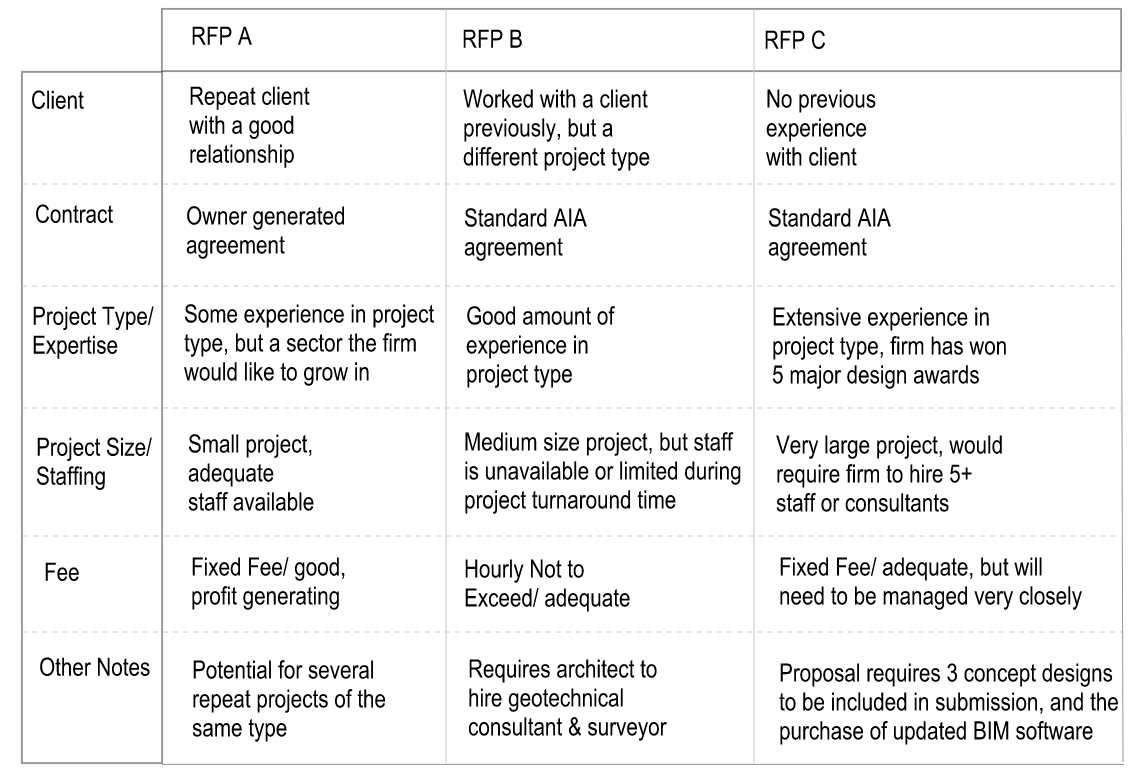 An architecture firm is evaluating three RFPs based on risk to the firm and the potential benefits of expanding to new sectors and gaining new clients. Which RFP should the firm pursue?
RFP A
This RFP allows for the potential benefits of repeat work in a new market sector. The risk of an owner-generated agreement is balanced by the small project size and a good fee.
400
A part-time intern at an architecture firm works 20 hours per week and has committed 80% of their time to assisting with internal office renovations. With growing project work they have agreed to increase their utilization rate by 8 hours while still maintaining their overall schedule.
What is the employee's new utilization rate after this adjustment in hours?
a. 42%
b. 60%
c. 80%
d. 100%
b. 60%
Calculate current utilization rate: 100%-80%=20%
Calculate direct billing utilization in hours: 20% x 20 hours = 4 hours
Calculate new utilization rate with increase of hours: (4 hours + 8 hours)/20 hours = 60%
400
ABC Architects and their consultant team have been working on a project for several months. The construction documents were completed on the afternoon of the project deadline. During the submittal of documents to the AHJ, several electrical outlets are found to be missing in the engineers drawings in locations required by code. ABC Architects is unable to reach the electrical engineer. ABC Architects must consider the following variables:
- The client has a hard deadline with possible damages if missed.
- The AHJ requires all submissions to be two sets of wet-stamped plans submitted in person at the building department
- The AHJ technician will allow the architect to add the missing outlets by hand on the plans with a red pen.
- The architect used an AIA B101 with the project owner.
- The architect used an AIA C401 with the consultant team.
How should ABC Architects handle this situation?
a. Make the changes tot he drawings by hand to ensure the deadline is not missed and notify the engineer the next day.
b. Request the engineer update the drawings and prepare for submission the next day.
c. Call the owner and request written approval to modify the drawings by hand because they own the documents being submitted.
b. Request the engineer update the drawings and prepare for submission the next day.
The engineer must make their own corrections or provide written consent otherwise.
500
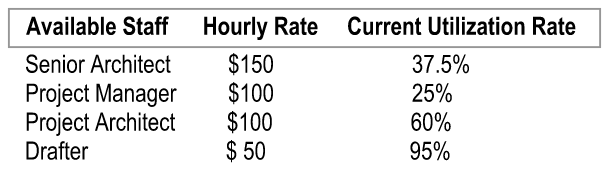
An architecture firm is working on an office renovation project. After submitting the Design Development documents, the client's feedback indicates that they need to increase the number of flexible workstation areas across 3 floors. The firm expects the change to require five weeks at 40 hours per week and so they negotiate an add-service contract for the sum of $20,000.
Which staff member should be assigned to this project to stay in budget?
a. Senior Architect
b. Project Manager
c. Project Architect
d. Drafter
c. Project Architect
This employee has the lowest utilization rate and can complete the task within budget.
5wks x 40hrs/wk = 200 hours to complete the task
$100/hr x 200hrs = $20,000 (within budget)
500
A developer hires an architecture firm to design a new apartment building. The firm completes construction documents and a building permit is issued. The firm will provide CA services at a rate of $200/hr for the principal and $150/hr for the project manager. As the firm starts CA, the owner asks for a not-to-exceed fee based on the following:
- Twenty shop drawings, which the project manager will handle at an average rate of three hours per review
- Three site visits, which the principal will handle at an average of four hours per site visit.
The firm includes a 10% allowance for unknowns. What should the NTE fee be?
a. $11,400
b. $12,540
c. $13,800
d. $15,240
b. $12,540
Shop drawing review: $150/hr x 3 hours per review x 20 shop drawings = $9,000
Site visits: $200/hr x 4 hours per visit x 3 visits = $2,400
$9,000 (shop drawings) + $2,400 (site visits) = $11,400
$11,400 + 10% allowance = $12,540
500
Your firm receives an RFP for a new library that you're interested in pursuing, but you worry your firm doesn't have the staffing to support such a large new-build project. The RFP outlines full design, construction, and commissioning services. You consider working with another design firm and are considering project delivery methods within a partnership.
Describe the differences between Bridged Design (Bridging) versus a Joint Venture (JV) and which would be most appropriate for the above described project.
Bridged Design (Bridging)
- Definition: A hybrid approach combining traditional design-bid-build and design-build methods.
- How it works: The owner hires an independent "bridging architect" to create preliminary design documents (usually up to schematic design or design development). These documents are handed over to a design-build firm that finishes the construction documents and builds the project.
- Purpose: Gives the owner more control over the initial design quality and fixed scope while keeping the cost-saving benefits of a single-source design-build contractor.
Joint Venture (JV)
- Definition: A commercial alliance or separate business entity formed by two or more independent organizations.
- How it works: Companies—such as an architecture firm and a construction contractor, or two separate design firms—pool their resources, capital, and expertise for a specific project. They share the financial profits, losses, and legal liabilities.
- Purpose: Allows smaller or specialized firms to combine forces to tackle massive or complex projects that they could not handle alone.
For this example, Bridged Design is the best partnership. A design-build contract will ensure that the project is delivered efficiently in terms of cost while bridging allows the project to have multiple architects taking on separate portions of the design, document preparation, and construction, keeping design fees managed.
500
A school board issues an RFP for a new elementary school. ABC architects has significant experience in designing elementary schools and is eager to respond to the RFP. They contact Building General Contractors (BGC), who has built several schools for ABC's clients. ABC is organized as a professional corporation and BGC is organized as an S corp. The RFP contains the following information:
- The proposal should be design-build
- The construction budget will be $20M
- The responding entity should include a complete bond and compliance with prevailing wage regulations.
- The response is due in three weeks along with a complete fee
Which of the following arrangements should ABC and BGC consider for their response to the RFP? Select the best 3 options.
a. ABC submits an RFP response and fee and lists BGC as the consulting contractor
b. ABC and BGC form a new LLC and then submit an RFP response and fee
c. ABC and BGC form a new C corporation and then submit an RFP response and fee
d. ABC and BGC form a joint-venture partnership and then submit an RFP response and fee.
e. BGC submits an RFP response and fee and includes ABC as the consulting architect
f. BGC submits an RFP response and fee and ABC submits a separate response and fee for architectural services
BDE
b. An LLC can be used to provide design-build services and can be quickly formed
d. the partnership form can be used to provide design-build services and can be easily formed
e. This arrangement represents a standard contractor led design-build
500
An architect and their in-house landscape designer complete documentation, bidding and permitting for a roof terrace on the 45th floor of an office building in accordance with contract AIA B101. During the beginning of CA, the owner's insurer requests the CDs for review. The insurer takes issue with some of the materials specified for the terrace floor citing fire and flammability concerns. They issue the following list of requirements to the architect:
- Substitute FRP grate with equivalent, fire resistant product
- Redesign assembly to accomodate new material
- Building envelope leakage testing
What action should the architect take next?
a. Issue a Bulletin including new specifications and details
b. Send an additional service proposal to the owner
c. Delegate the change of materials to the GC's subcontractor
b. Send an additional service proposal to the owner
According to AIA B101 "Provision of Changes" is considered an additional service and should be in place before altering documentation. The scope of a complete assembly change is beyond means and methods and should not be left to the GC to coordinate.