Resource Management
Project Work Planning
Contracts
Project Execution
Project Quality Control
100
An architect is putting together a team to work on an upcoming project with a site the size of a city block. The program includes a subterranean parking garage under the whole site with a street-level green roof and a small office building on the northwest corner.
The project will follow a design-bid-build methodology. Which of the following consultants should the architect NOT select for the design team?
MEP engineers
Structural engineer
Geotechnical engineer
Landscape Architect
Environmental engineer
Site surveyor
Environmental engineer
The site is a city block, and environmental engineers would be selected for sites that have nuanced ecological impacts.
100
While on a construction site visit, an architect notices an unsafe condition in the field, noting several contractors aren't wearing PPE. Who should the architect inform?
a. the architect should tell the construction workers to don their PPE
b. the architect should seek out the superintendent and review what PPE the contractors should be wearing
c. the architect should write an email to the superintendent and copy the owner
d. the architect should write an email to the owner and copy the GC
C.
Per AIA-A401, subcontractors are under the direct authority of the GC, and so it is inappropriate for the architect to give direct orders to the subcontractor. The architect is only responsible for informing the contractor of any observed unsafe construction site conditions. The owner should also be made aware of the situation on their property.
100
Define:
Liquidated Damages
Consequential Damages
Budget Contingency
and how they relate to construction deadlines.
Liquidated Damages:
A specific amount of money that contracting parties agree to as the amount of damages an Owner can recover if the Contractor breaches the contract. They are typically expressed as a dollar value per day to be owed upon late project delivery.
Consequential Damages:
The term for an unspecified cost representing foreseeable damages including lost profits, rents, financing costs, or business opportunities that are impacted by an opening delay.
Budget Contingency:
A reserved amount of money set aside in a project's budget to protect the contractor from unforeseen risks, costs, etc.
100
Who's responsibility is it to prepare change orders during CA?
While the contractor typically initiates the request, the Architect is formally responsible for preparing, documenting, and issuing construction change orders during the administration phase, often authorized by the owner. The contractor prepares the cost and time proposals, while the architect formalizes the document.
100
During a design review with the city, your community center's street facing elevations were accepted by the review board, but the signage was not accepted by the streets department. The permits need to be submitted as soon as possible to keep the project schedule. While signage is not part of the architect's scope of work, they do appear on your CD drawings. How should you go about getting your permit?
a. Submit the drawings for permit without Streets Dept approval
b. Submit the drawings for approval and apply for a variance for the signage height requirement.
c. Remove the signage from your permit drawings to get the permit approval and submit the signage separately.
Provide elevations without signage for the streets department review and issue a separate construction set to the contractor with signage included.
C. Submit the building permit and while that process is underway it allows time for signage discussions to occur with the board.
Under IBC, signage is treated as a trade permit, and since it is not included in the architect's scope, it is acceptable to remove it from permit documents.
200
Name and describe the following project delivery methods:
DBB
DB
CMAR
IPD
DBB: Design-Bid-Build
Traditional method that involves a design team and contractor working under separate contracts with an owner.
DB: Design-Build
Architect and contractor are contractually connected and hold a single contract with the owner.
CMAR: Construction Manager at Risk
Construction Manager acts as an owner's rep during design and construction. Project delivery is organized similar to DBB, but CM is involved as a cost controller, as they usually accept the risk for meeting the project deadline and owner’s cost requirements, which are usually expressed as a guaranteed maximum price.
IPD: Integrated Project Delivery
Newest model of delivery where owner, architect, and contractor share one contract and work together through all phases of design development and construction and share risk equally.
200
Staff Jan Feb Mar
Architect 100 100 100
Designer 150 150 150
Drafter 75 75 75
_________________________________________
Above is a chart showing the maximum hours per month for each staff member at your firm. Your current workload requires 300 work-hours per month, but in February a new project starts that will require an additional 75 work-hours for two months. In March, your existing project will move to bid phase and so the required number of hours will drop from 300 to 50.
In which month will you need to ask your part-time drafter to work extra hours? How many hours?
February, 50 extra hours
200
Working under an AIA B101 standard contract, an architect is hired by an owner to perform coordination efforts across the owner's MEP, Structural, and Interior Design consultants.
Despite providing the interior designer with redlines and attending many coordination meetings, the interior design CD set is delivered with many errors and omissions.
The start of bidding cannot be delayed. What should the architecture firm do first after receiving the drawings?
a. Send the owner an additional services request for compensation.
b. Instruct the firm's internal interior designer to prioritize the coordination of new ID drawings.
c. Ask the construction manager to update FF&E submittals.
A. Send the owner a request for compensation for additional coordination services.
The architect should be responsible for coordinating their services with the services provided by the owner's consultants, however, neither the architect or the architect's consultants should immediately perform any additional services as a result of a failure of performance on the part of the owner's consultants. AFTER recognizing the need for additional services, the architect must explain the facts and circumstances and establish an agreement in writing with the owner before proceeding.
200
Which duct dimensions need to be revised by the mechanical engineer?
- All ceilings: 8'-4"
- Ceiling Thickness: 1"
- BOS: 9'-6"
Assume all listed duct dimensions include insulation
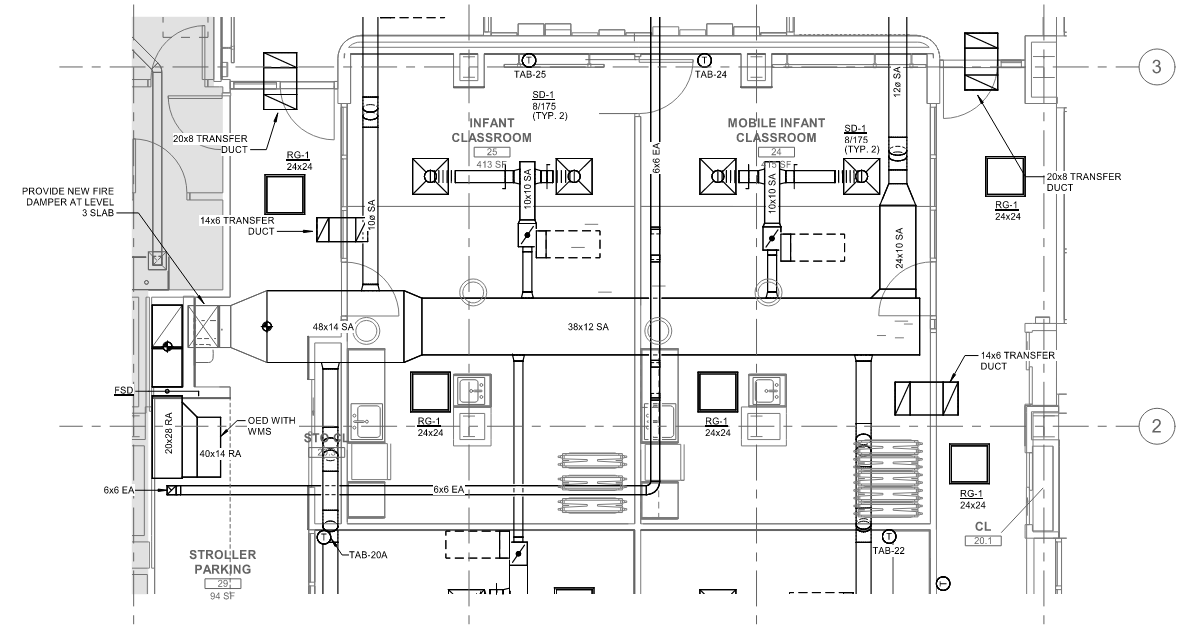
48x14 SA
40x14 RA
300
Original Mat'l Alternate Mat'l
Cost: $5/sf $10/sf
Project Delay: 20 weeks 2 weeks
During construction you receive a substitution request for a material you spec'd. The product is meant to cover 10,000sf of flooring and per the contract, overhead costs for project delays are $5,000 per week.
What is the cost savings of using the alternate material?
$40,000
Original Mat'l:
$5/sf x 10,000 sf = $50,000 mat'l cost
$5,000/wk x 20 wks = $100,000 delay cost
$150,000 total cost
Alternate Mat'l:
$10/sf x 10,000 sf = $100,000 mat'l cost
$5,000/wk x 2 wks = $10,000 delay cost
$110,000 total cost
Original Mat'l Cost - Alt Mat'l Cost:
$150,000-$110,000= $40,000 savings
300
During proposal negotiations, an architect presents a client with the following schedule:
Programming: 3 weeks
Schematic Design: 8 weeks
Design Development: 12 weeks
Construction Documentation: 16 weeks
Bidding/ Negotiation: 4 weeks
Construction Admin: 60 weeks
The client states that their board needs 2 weeks after each design phase to approve drawings to move forward.
How many additional weeks will be added to the schedule with this edit?
6 additional weeks
There are three 'design' phases listed:
SD, DD, & CD
All other phases are internal for feasibility and code review, or are management and coordination phases.
300
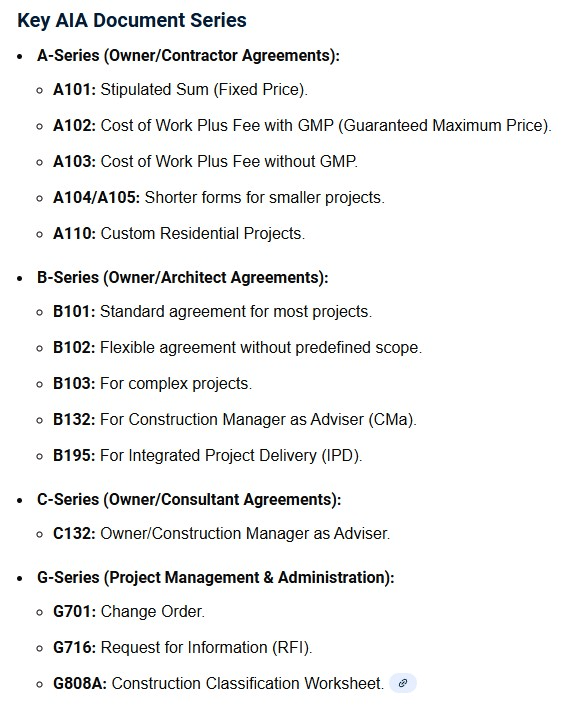
Define the following contract types:
AIA B101
AIA A201
AIA C401
AIA B101 - Standard Form of Agreement between Owner and Architect
This document contains articles laying out the architect's responsibilities, the scope of services, owner's responsibilities, cost of the work, as well as miscellaneous provisions to protect liability
AIA A201 - General Conditions of the Contract for Construction
This document includes the owner, contractor, and architect, and details duties, administration, changes, and payments for large projects, and is to be used in conjunction with A101/A02/A103
AIA C401 - Standard Form of Agreement between Architect and Consultant
This document outlines the responsibilities of an architect's consultant, the scope of services, architect's responsibilites, cost of work and misc provisions.
For reference:
300
According to code, egress pathways require swing doors that open in the direction of travel for all spaces, regardless of occupancy count. The owner of a space that is being renovated has an existing sliding door they want to use as part of an egress pathway. What should the architect do to address this code issue?
a. Request a DRB hearing review
b. Appeal to the AHJ for a variance
c. Petition for an injunction
B. The project does not conform to documented life safety code compliance, so the architect must appeal to the AHJ for a code variance where the board can determine the safety of the design on a case-by-case basis.
300
While documenting a renovation project of an existing building, you realize several details are missing information because of concealed building conditions. These conditions won't be revealed until demolition is underway. To control for unexpected costs, which two strategies should be employed:
a. Contingencies
b. Unit Prices
c. Change Orders
d. Addenda
e. Bid Alternates
f. Supplemental Instructions
b. Unit Prices
Unit prices establish a cost for performing additional work by the contractor when encountering unknown conditions
e. Bid Alternates
Bid alternates define a change in cost for scope or quality of materials elsewhere that can offset an additional cost at the point of unknown conditions.
400
A Project Manager planned for 120 hours of labor in the Design Development phase. The drafter's labor has an average rate of $20/hr and the firm has a planned multiplier of 3.
At the end of the DD phase, only 100 hours had been used. What was the excess profit the firm earned from unbilled hours?
$1,200
120 hours(planned) - 100 hours(used) = 20 hours
20 hours x $20 per hr overhead = $400 overhead
$400 x 3 planned multiplier = $1,200 profit
400
A residential project includes work to both an existing kitchen and an existing shed. The contractor's schedule is shown below:
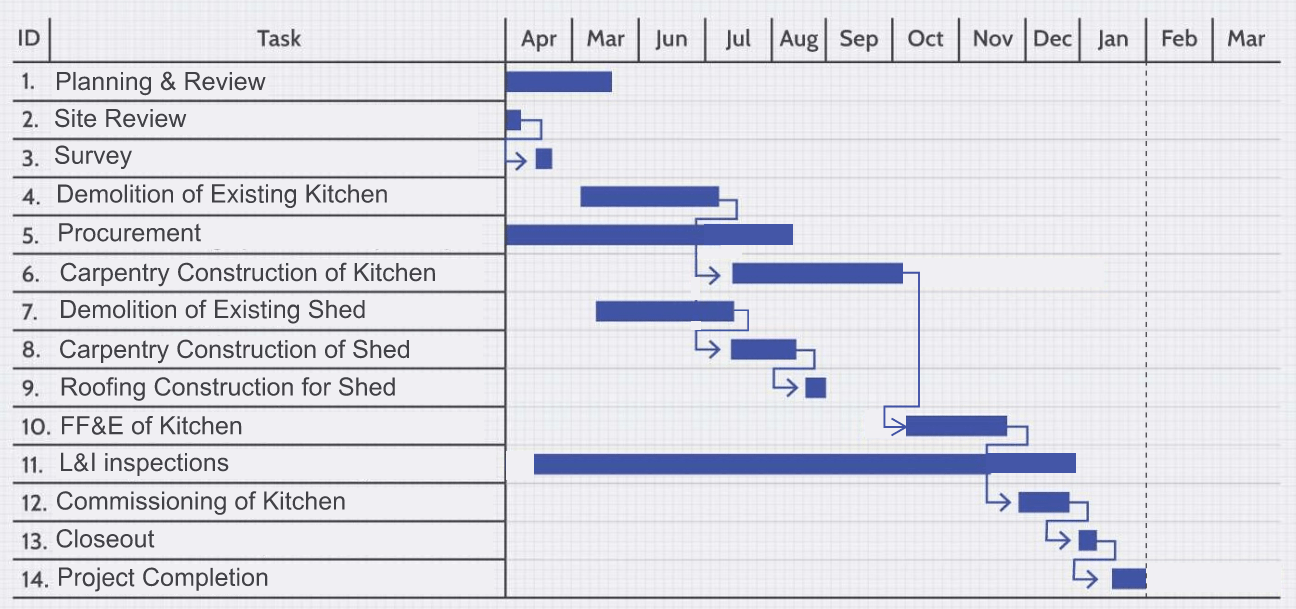
During construction, unforeseen conditions extend the construction of the shed by one month. In the kitchen, however, construction goes faster than expected and finishes one month ahead of schedule. Unfortunately, some of the Furniture lead times were misestimated and so procurement gets pushed two months.
Given the information above, in what month should the project reach completion?
End of January/ Beginning of February
400
An architect is working under AIA B101 for a project. As part of this contract, the architect's fee has been determined to be 6% of the cost of construction.
In the SD phase, a cost estimator originally calculated the cost of the work to be $4.5M; however, now that CDs are nearly complete, the updated cost estimate predicts the cost of work will be $5M due to owner requested changes.
The compensation fee breakdown for the various phases is as follows:
SD: 15%
DD: 15%
CD: 20%
Bid: 10%
CA: 30%
What is the adjusted fee for the CD phase with the new cost estimate?
$60,000
The previous two phases are complete and billed for, so they can be ignored for future billings.
$5,000,000 total cost of work x 0.06 (6%) fee = $300,000 total fee
$300,000 total fee x 0.2 (20% for CD) = $60,000 CD fee
Phases already billed (even portions of CA) can not be adjusted for previous progress payment, however, any future payments can be calculated using the the new construction cost.
400
A community center is near completion and the punch list has been circulated by the contractor in preparation for substantial completion. A few days later, a bad storm causes leaking in the roof and ruins the gymnasium flooring. The architect's contract is written to end 30 days after substantial completion and the new lead time for flooring is 9 weeks.
What two actions need to be completed by the architect before any others?
a. A new schedule for owner approval
b. A request for liuidated damages for contractor review
c. An invoice for additional services for owner payment
d. A punch list for areas not damaged for contractor approval
e. A notice to the contractor for witholding final payment.
f. A change order for new flooring
C. Additional services are required to extend the length of the contract with the owner.
E. Final payment to the contractor should not be released until roof and flooring damages have been repaired.
400
Which government agencies have jurisdiction on a project in Philadelphia? Name the agency for each of the following categories:
a. AHJ
b. DRB
c. Infrastructure Review
d. Code Enforcement
e. Public Art
If multiple versions of code documents have conflicting information regarding minimum requirements, which are you meant to follow?
A. Licenses & Inspections (L&I)
B. Zoning Board/ Planning Commission
C. Streets Department
d. Fire Marshal
e. Art Commission
The most stringent code interpretation takes precedence
500
A project manager is preparing a budget for an upcoming proposal. The office uses the following standard fee structure across all projects:
- 20% gross for consultant fees
- 30% net of the fee for direct salary for the drafter
- 10% net for the architects non-reimbursable expenses
- 45% net to cover indirect overhead expenses
- Total design fee is $1,250,000
Given this information, how much of the fee is left for the firm's profit margin?
$150,000
$1,250,000 total design fee x 0.2 (20%) consultant fee percent = $250,000 consultant fee
$1,250,000 total design fee - $250,000 consultant fee = $1,000,000 net design fee
30% salary + 10% expenses + 45% indirect overhead = 85% gross overhead
100% net design fee - 85% gross overhead = 15% profit
$1,000,000 net fee x 0.15 (15%) profit percentage = $150,000 profit
500
Define these project schedule types:
CPM
Fast-track schedule
Milestone chart
CPM: Critical Path Method
This project scheduling technique identifies the longest sequence of dependent, successive tasks in a project and uses that to determine overall project timing.
Fast-Track Schedule
This project scheduling technique focuses on performing tasks in parallel that were originally planned to be sequential. This technique requires tasks be identified that don't have a dependency on each other.
Milestone Chart
This project scheduling technique focuses on a visual timeline. Unlike detailed Gantt charts, they simplify complex schedules by focusing only on major checkpoints.
500
What are the key differences between
CM as-contractor vs CM as-advisor?
Construction Manager as Constructor (CMc/CMAR):
CM acts as a general contractor, taking on financial risk, holding subcontractor contracts, and guaranteeing the price/schedule.
Construction Manager as Advisor (CMa):
CM acts as an independent consultant or owner’s agent, providing expertise without taking on construction risk or direct responsibility for subcontractor performance
500
An architect is assigning tasks to the phases of project using integrated project delivery (IPD). The task "Create performance specifications and confirm sustainability targets" falls into which of the following phases:
a. Conceptualization
b. Criteria Design
c. Detailed Design
d. GMP Development
e. Implementation Documents
f. Permits
g. Construction
B. Criteria Design
The Criteria Design phase establishes specifications and sustainability goals for the project that guide design decisions in the following phases.
500
Define these three estimating techniques:
Order of Magnitude
Assemblies
Unit Price
ROM: Rough Order of Magnitude
High-level, early-phase forecasting technique, typically accurate within -25% to +75%. It utilizes historical data, expert judgment, and material cost to provide a rapid, ballpark figure for feasibility studies and initial budgeting before detailed designs exist.
Assemblies:
Groups individual material and labor components into functional, pre-defined units (e.g., a "wall assembly" includes studs, drywall, insulation, and paint). This method provides faster, more accurate, and better-organized estimates than square-foot methods, typically within $\pm$10-15% accuracy.
Unit Price:
A bottom-up technique that determines total project costs by multiplying the required quantity of work items (e.g., cubic yards of concrete, linear feet of pipe) by their cost per unit, including labor, material, and equipment. It offers high precision for bidding by breaking down projects into detailed, manageable components. Requires completed CDs to accurately estimate.