C1/2
C3/4
C5
C6/7
Music
100
What happens to its particles when a solid melts?
the forces of attraction weaken and the particles can move over and under each other.
100
Name 3 subatomic particles, with their masses and charges.
proton - mass = 1, positive charge;
electron - mass = negligible, negative charge;
neutron - mass = 1, neutral charge
100
Explain how cations and anions are formed.
cations - loss of electrons
anions - gaining electrons
100
How is a covalent bond formed?
Sharing of electrons between non-metals
100
Finish the lyrics (100 extra points if you sing it): Girl, you know I want your love Your love was handmade for somebody like me Come on now, follow my lead I may be crazy, don't mind me
Say, boy, let's not talk too much Grab on my waist and put that body on me Come on now, follow my lead Come, come on now, follow my lead
200
What changes happen to particles during the different changes of state?
Physical changes (not chemical) = molecules/particles gain or lose energy - weakening/strengthening forces of attraction - more/less movement
200
State what the atomic number and mass number represents
atomic number - how many protons in an atom (= electrons)
mass number - how many protons plus neutrons
200
Explain why ionic compounds have high melting points and high boiling points.
strong forces of attraction between ions require lots of energy to break the bonds apart.
200
Explain why covalent, simple molecular compounds are poor conductors of electricity.
Explain why covalent, simple molecular compounds have low melting and boiling points.
Poor conductors of electricity - they do not have any flowing/free electrons or ions (charged particles)
Low melting/boiling point - they have very weak intermolecular forces, doesn't require much energy to break them
200
Finish the lyrics (100 extra points if you sing it): But I hear sounds in my mind Brand new sounds in my mind
But honey I'll be seein' you, ever, I go But honey I'll be seein' you down every road I'm waiting for it, that green light, I want it
300
What is the difference between a pure substance and a mixture?
Pure - composition cannot change, same in all parts in a piece of the substance.
Mixture - contains elements and/or compounds that are not chemically joined together and can be separated.
300
Iodine is 80% I-127, 17% I-126, and 3% I-128. Calculate the average atomic mass of iodine.
126.86
300
Explain why ionic compounds conduct electricity when they are molten and in aqueous solution.
Explain why ionic compounds do not conduct electricity as solids.
conducting electricity - there is a flow of charge because the ions are free to move when in a molten/aqueous form, but they are fixed in a solid and cannot move.
300
Describe how metallic bonding occurs
Positive ions are held together in a lattice structure with the strong forces of attraction between sea of delocalised electrons and the positive ions
300
Finish the lyrics: 'Cause since I've come on home, Well my body's been a mess And I've missed your ginger hair And the way you like to dress
Won't you come on over Stop making a fool out of me Why don't you come on over Valerie?
400
From a heating curve, how do you know when a substance is undergoing a state change?
When there is no increase in temperature and the line is horizontal.
400
Explain the links between an element’s position in the periodic table and its electronic configuration.
group number - number of outer shell electrons
period number - number of electron shells
400
Name 5 common polyatomic ions and their charges.
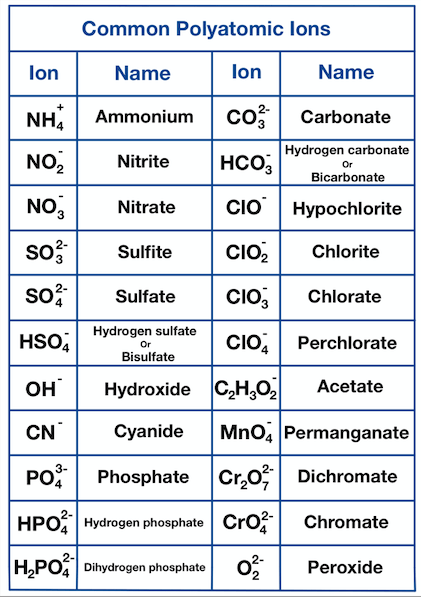
400
Describe the limitations of two different models used to represent structure and bonding (dot & cross, ball & stick, displayed formula, or 3D).
Dot & cross - Only shows the outer electrons, using both dots and crosses makes it looks like electrons from carbon atoms and oxygen atoms are different.
Ball & stick - Does not accurately show the relative sizes of the atoms and the distances between them. The bonds are not really like sticks.
Displayed formula - Does not show the relative sizes of the atoms and the bonds between them.
3D space filling model - Does not show how the bonds are formed.
400
Finish these lyrics: (100 extra points if you sing it) I got this feeling inside my bones It goes electric, wavey when I turn it on All through my city, all through my home We're flying up, no ceiling, when we in our zone
I got that sunshine in my pocket Got that good soul in my feet
500
Explain the arrangement/movement/forces of attraction between solid, liquid and gas particles.
Solids - arranged in a fixed pattern, are very close together, stay fixed in position, can only vibrate
Liquids - randomly arranged, close together, always flowing, can move around freely
Gases - randomly arranged, lots of space between each other, move around freely and very quickly
500
Explain 3 differences between Mendeleev's periodic table and the modern periodic table.
Mendeleev's contained 63 elements elements, arranged in order of increasing atomic mass, he left gaps in his table, elements with similar chemical properties went in horizontal rows initially, then into vertical columns, made predictions about properties of undiscovered elements, based on properties of nearby elements.
500
write the formula for at least one of these compounds: sodium chloride, sodium carbonate, lithium phosphate, ammonium sulfate
Sodium Chloride: NaCl
Sodium Carbonate: Na2CO3
Lithium phosphate: Li3PO4
Ammonium sulfate: (NH4)2SO4
500
Describe the properties of diamond, graphite, fullerenes and graphene.
Describe the structures of diamond, graphite, fullerenes and graphene.
Diamond - strong tetrahedral lattice structure; hardest material, doesn't conduct electricity, high melting/boiling points
Graphite - layers, lattice structure, weak intermolecular forces between layers; conducts electricity, soft, high melting/boiling points
Fullerenes - simple covalent, usually in spherical or tubular form; weak intermolecular forces, soft and slippery, low melting/boiling points.
Graphene - one sheet thick, hexagonal lattice structure; very strong, conducts electricity, soft, light
500
Who is Stefani Joanne Angelina Germanotta?
Lady Gaga