Role and Structure of Legal System?
Role of Legal Personnel
How laws are made
Politics
Participation in Democratic Process
100
Morals, Ethics and Values are the reasons we have...
Laws and they change
100
This legal professional presides over the courtroom, ensures the trial is fair, explains the law to the jury, and determines the sentence if the accused is found guilty.
What is a judge?
100
What is a proposed law called?
A Bill
100
List the aims and Beliefs of a political party
Teacher to assess answer
100
In Australia's democratic process, this is both a hard-won legal right for citizens aged 18 and over, as well as a compulsory legal responsibility.
What is voting?
200
Three levels of Government are and list and example of what they are responsible for:
Local - Waste
State - Health
Federal - Immigration
200
The lawyer responsible for presenting the case against the accused on behalf of the state or the community, aiming to prove their guilt beyond a reasonable doubt.
What is a prosecutor?
200
Law made by judges through court decisions (precedents), rather than by parliament.
What is common law?
200
This occurs when one political party wins more than half of the seats in the lower house of parliament, allowing them to pass laws without needing the support of minor parties.
What is a majority government?
200
Examples of these include the right to free speech and peaceful assembly, paired with the responsibility to obey the law and serve on a jury if called.
What are democratic rights and responsibilities?
300
The division of power is separated into 3 areas:
Name and State what they do?
Legislative - Makes Laws
Executive - Administer the Laws
Judicial - Makes judgements and enforce the laws
300
A group of ordinary citizens randomly selected from the community who must listen to the evidence in a trial and decide on the final verdict of guilty or not guilty.
What are jurors? (or What is a jury?)
300
This type of law is made by parliament, rather than by judges in a court.
What is statue law?
300
This occurs when no single political party wins more than half of the seats in the lower house of parliament, forcing the governing party to rely on the support of independents or minor parties to pass laws
What is a minority government?
300
The system used in Australian federal elections for the House of Representatives, where voters rank candidates in order of choice rather than just picking one.
What is preferential voting?
400
What are the levels of the court?
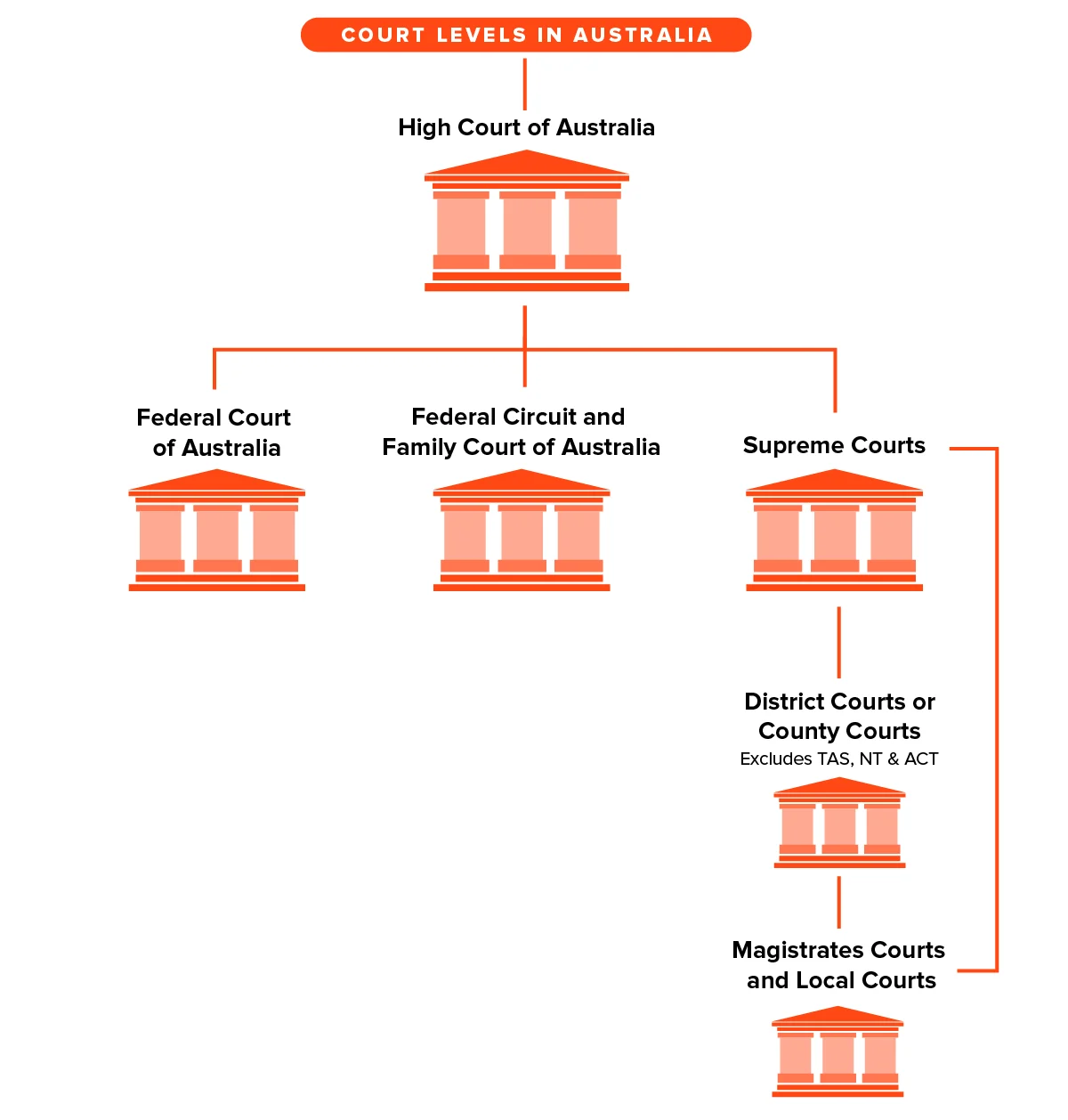
400
This courtroom official directly assists the judge by maintaining order, swearing in witnesses, and looking after the jury during their deliberations.
What is a tipstaff?
400
This area of law deals with disputes between individual citizens or organizations, covering areas like contracts, torts (negligence), and property law.
What is Private Law? or What is Civil Law
400
This situation occurs immediately following an election when no single political party or coalition wins enough seats to form a majority government on their own.
What is a hung parliament?
400
The voting method used for the Australian Senate designed to allocate seats to parties based on the total percentage of votes they receive nationwide or statewide
What is proportional representation?
500
What cases are seen in each court?
Local?
District?
Federal?
High?
Drug?
Children?
Family?
Coroner?
Local Court: Deals with civil disputes involving smaller amounts of money (up to $100,000) and less serious criminal matters (summary offences like driving infractions, shoplifting, or minor assaults).
District Court: Deals with mid-level serious criminal matters (indictable offences like armed robbery, manslaughter, or sexual assault, but not murder) and larger civil disputes (up to $750,000).
Drug Court: A specialist court that deals with eligible offenders who have a severe drug dependency, focusing on supervised rehabilitation and treatment programs rather than standard prison sentences.
Children’s Court: A specialist court dealing with criminal offences committed by young people (under 18 at the time of the offence) and care/protection applications for children and young people.
Coroner's Court: A specialist court that investigates unusual, unexpected, or suspicious deaths, as well as the causes of major fires and explosions in NSW.
Federal Court: Deals with matters arising under Commonwealth (national) legislation, such as corporations law, trade practices, industrial relations, bankruptcy, and immigration appeals.
Family Court: (Now officially the Federal Circuit and Family Court of Australia) Resolves complex family law matters, including marriage dissolution (divorce), parenting child custody disputes, and the division of property.
High Court: The highest court in Australia. It deals with cases involving the interpretation of the Australian Constitution and hears final appeals from all other federal and state supreme courts.
500
The specific individual who has been charged with a criminal offence and is forced to stand trial in a court of law.
Who is the accused? (or Who is the defendant?)
500
This area of law deals with disputes between individual citizens and the state (government), covering areas like criminal law, constitutional law, and administrative law.
What is public law?
500
This group consists of senior government ministers, chosen by the Prime Minister, who meet regularly to make major decisions on national policy and government administration
What is the Cabinet?
500
To succeed in Australia, a referendum must achieve this strict voting requirement: a majority of voters nationwide, plus a majority of voters in at least four out of six states.
What is a double majority?