Sectionalism
Path to the Civil War
The Civil War
Reconstruction
Reactions to Reconstruction
100
Which statement best explains how geographic and economic differences between the North and South contributed to sectionalism by 1860?
A. The North developed an industrial economy while the South remained agricultural and dependent on slavery.
B. The South had more access to European trade networks than the North.
C. The North rejected the use of any labor systems while the South relied on free labor.
D. The South developed more cities and urban centers than the North.
A. The North developed an industrial economy while the South remained agricultural and dependent on slavery.
100
Which of the following abolitionists was the founder and editor of The Liberator, an abolitionist newspaper in the north?
A. William Lloyd Garrison
B. Harriet Tubman
C. John Brown
D. Frederick Douglass
A. William Lloyd Garrison
100
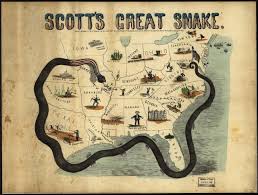
Which of the following BEST describes the Union strategy in the Civil War?
A. launch large-scale attacks of the south and take their capital
B. continue the war for as long as possible to kill Confederate morale
C. secure an alliance with Great Britain to gain more troops and weapons
D. surround Confederate port cities to "suffocate" them from resources
D. surround Confederate port cities to "suffocate" them from resources
100
Which event BEST describes the relationship between President Andrew Johnson and the Radical Republicans in congress?
a. Johnson signing into law the Civil Rights Act of 1866
b. Johnson pardoning all Confederate generals
c. Johnson appointing Radical Republicans to his cabinet
d. Johnson's impeachment by congress in 1868
d. Johnson's impeachment by congress in 1868
100
-Poll taxes
-Grandfather clauses
-Literacy tests
Which of the following would BEST be a title for the list above?
a. Radical Republican attempts to expand natural rights to freemen
b. Andrew Johnson's imposing of restrictions on former Confederate veterans from voting
c. Southern restrictions placed on freedmen voters
d. Abraham Lincoln's conditions for black men to vote
c. Southern restrictions placed on freedmen voters
200
Which of the following people would have MOST LIKELY been a member of the Democratic Party in the 1830s?
A. a banker in New York City
B. a factory worker in Boston
C. a merchant in Philadelphia
D. a farmer in Tennessee
D. a farmer in Tennessee
200
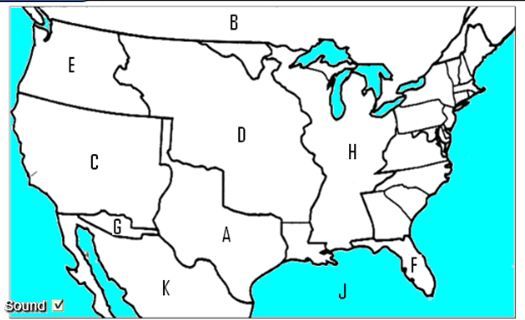
How did the United States acquire the plot of land labeled C?
A. through a treaty with Great Britain
B. they purchased it from France
C. through an agreement with Native Americans
D. through a war with Mexico
D. through a war with Mexico
200
How did the Dred Scott Decision contribute to the Civil War?
a. it angered northern abolitionists who worried it would expand slavery into new territories
b. it angered southerners who felt it did not go far enough to protect the institution of slavery
c. it angered western settlers who did not want to compete with southern slave labor
d. it angered southerners who were upset over the court permitting anti-slavery laws in Kansas
a. it angered northern abolitionists who worried it would expand slavery into new territories
200
Which of the following best explains the purpose of the 13th, 14th, and 15th Amendments during Reconstruction?
A. They established the federal government's authority over state governments.
B. They attempted to secure natural rights and citizenship for formerly enslaved people.
C. They reorganized the Southern economy to match the Northern industrial model.
D. They created new political parties to represent freed African Americans.
B. They attempted to secure natural rights and citizenship for formerly enslaved people.
200
Which of the following signaled the end of Reconstruction?
a. the Ku Klux Klan Act of 1871
b. passage of the 14th Amendment
c. the Reconstruction Act of 1867
d. the Compromise of 1877
d. the Compromise of 1877
300
The American System, as proposed by Henry Clay, was designed to promote economic development through internal improvements and protective tariffs. Why did Southern states oppose this plan?
A. It would increase prices for imported goods that the South relied upon.
B. It would reduce the South's agricultural exports to European markets.
C. It favored Northern industrial interests over Southern agricultural interests.
D. It would require Southern states to pay higher federal taxes than Northern states
C. It favored Northern industrial interests over Southern agricultural interests.
300
Use the information to answer the question.
Timeline of Western Expansion
- 1803: Louisiana Purchase
- 1820: Missouri Compromise
- 1854: Kansas-Nebraska Act
- 1861: Secession and Civil War
Which conclusion can best be drawn from this timeline?
A. Westward expansion consistently strengthened the unity of the nation.
B. Each act of westward expansion intensified sectional conflict over slavery.
C. The federal government successfully prevented conflicts between North and South.
D. Western expansion had little impact on the development of sectionalism.
B. Each act of westward expansion intensified sectional conflict over slavery.
300
Which of the following was an advantage the Union had during the Civil War?
a. home-field advantage (most battles were fought in the north)
b. better system of railroads and more supplies
c. higher morale from American public for the war
d. foreign alliances with Great Britain and France
b. better system of railroads and more supplies
300
The Freedmen's Bureau, established in 1865, best represents which change in the federal government's role?
A. The federal government withdrew from involvement in state affairs.
B. The federal government expanded its role in protecting the rights of marginalized citizens.
C. The federal government reduced funding for social welfare programs.
D. The federal government transferred control of Reconstruction to state governments.
B. The federal government expanded its role in protecting the rights of marginalized citizens.
300
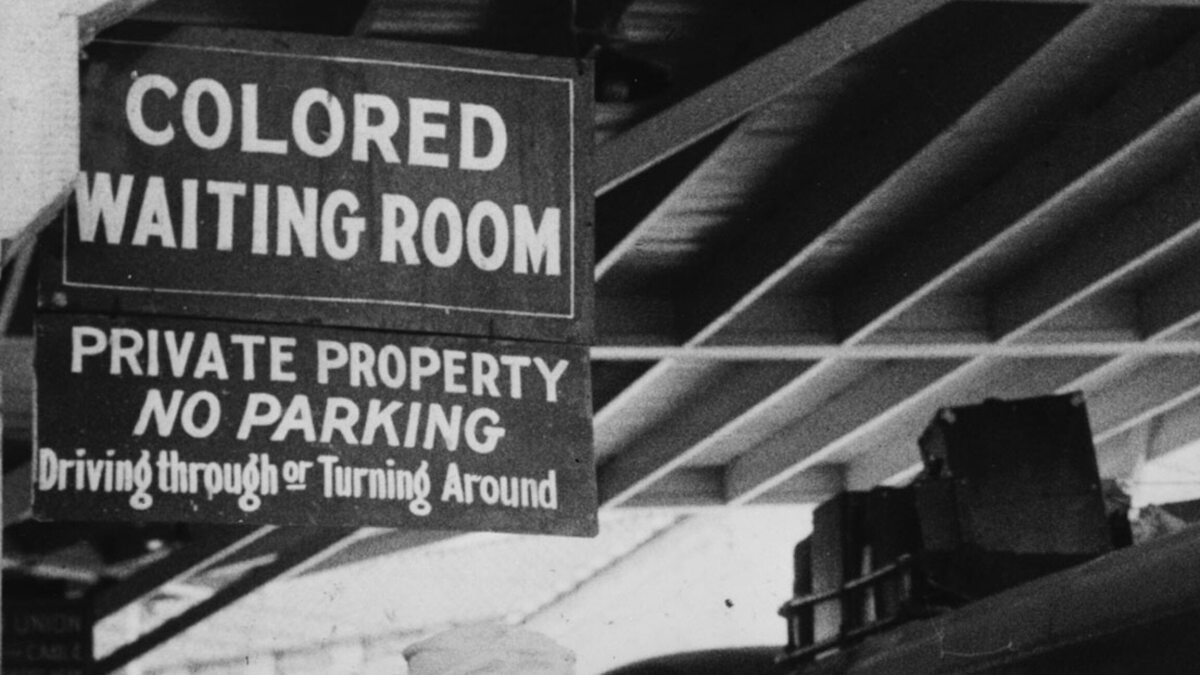
Which of the following Supreme Court decisions allowed for laws like this to be in place?
a. Brown v. Board of Education
b. Plessy v. Ferguson
c. Dred Scott v. Sandford
d. Gibbons v. Ogden
b. Plessy v. Ferguson
400

Which of the following conclusions can be drawn from this map?
A. the American public was not voting as much in 1860 compared to 1856
B. sectional differences influenced the results of the 1860 election
C. the vast majority of the United States supported protecting the institution of slavery
D. Stephen Douglas was able to unite Democratic voters for his ticket
B. sectional differences influenced the results of the 1860 election
400

Which of the following BEST describes the result of the Kansas-Nebraska Act and Bleeding Kansas as shown in this mural?
A. it intensified sectionalism between slave and free states
B. it intensified sectionalism over the tariff issue
C. it cooled tensions between slave and free states as a compromise was reached over slavery in Kansas
D. it decreased sectionalism as both northern and southern states condemned the actions of John Brown
A. it intensified sectionalism between slave and free states
400

This excerpt provides justification for what action?
a. the rejection of the theory of nullification
b. the extension of slavery into western territories
c. the enactment of the Indian Removal Act
d. the ruling in Worcester v. Georgia
c. the enactment of the Indian Removal Act
400
Which of the following is a correct comparison of Abraham Lincoln's plan for Reconstruction and the Radical Republicans' plans?
a. Lincoln wanted full natural rights for freemen immediately while Radical Republicans wanted it to take time
b. Lincoln wanted to be more lenient on former Confederate states while the Radical Republicans wanted to punish former Confederate states
c. Lincoln supported the keeping federal troops in the south while the Radical Republicans wanted to remove them
d. While Lincoln and the RRs both desired unity, they disagreed on whether or not the 13th Amendment should be passed immediately
b. Lincoln wanted to be more lenient on former Confederate states while the Radical Republicans wanted to punish former Confederate states
400
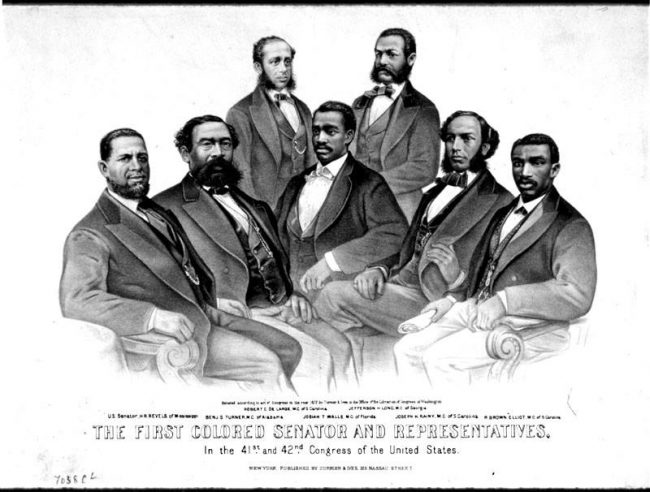
Which of the following Reconstruction amendments MOST LIKELY contributed to the result of the picture
a. 13th Amendment
b. 14th Amendment
c. 15th Amendment
d. 16th Amendment
c. 15th Amendment
500
Read the excerpt:
"[Hostility to the institution of slavery] increased, until, in 1819–20, it deprived the South of more than half the vast territory acquired from France [in the Louisiana Purchase]. The same hostility [divided] Texas and seized upon all the territory acquired from Mexico."
—Mississippi Secession Convention, 1861
This text best supports which effect of westward expansion?
A. Westward expansion contributed to regional conflicts that resulted in the Civil War.
B. Westward expansion was responsible for an interruption in diplomacy with European powers.
C. Westward expansion encouraged U.S. citizens to identify themselves by their country over their states.
D. Westward expansion united U.S. citizens around the cause of expanding the nation to the Pacific Ocean
A. Westward expansion contributed to regional conflicts that resulted in the Civil War.
500
"A house divided against itself cannot stand. I believe this government cannot endure, permanently half-slave and half-free. I do not expect the union to be dissolved-I do not expect the house to fall-but I do expect it will cease to be divided. It will be all one thing, or all the other,"-Abraham Lincoln, 1858
How does Lincoln's quote here connect to the growing sectionalism of the antebellum era?
A. the United States would have to accept the institution of slavery if it were to continue
B. the United States must not interfere with the establishment of western territories
C. it is not possible for the United States to be divided on the institution of slavery by sectionalism
D. the United States was close to ending the sectional tensions over slavery
C. it is not possible for the United States to be divided on the institution of slavery by sectionalism
500
It is rather for us to be here dedicated to the great task remaining before
us . . . that this nation under God shall have a new birth of freedom, and that
government of the people, by the people, for the people shall not perish from
the earth.
—Abraham Lincoln, Gettysburg Address, 1863
What outcome did Abraham Lincoln believe would accomplish the goal mentioned in this excerpt?
a. a new Constitution would be written.
b. The Union would be preserved without slavery.
c. The government would give more power to the states.
d. New states would replace those lost to the Confederacy.
b. The Union would be preserved without slavery.
500
Read the information:
Long-term Effects of the Reconstruction Act of 1867
- 1868-1877: Southern states gradually readmitted as they meet federal requirements
- 1870: 15th Amendment passed to protect voting rights based on race
- 1871: Ku Klux Klan Act passed to combat terrorist violence
- 1877: Compromise of 1877 ends Reconstruction; federal troops withdrawn
- 1890s-1960s: Jim Crow laws systematically segregate and discriminate against African Americans
Based on this information, which conclusion can best be drawn about the long-term success of the Reconstruction Act of 1867?
A. The Reconstruction Act of 1867 permanently secured civil rights for African Americans in the South.
B. The Reconstruction Act of 1867 temporarily achieved its goals but failed in the long term
C. The Reconstruction Act of 1867 had no significant impact on African American rights in the South.
D. The Reconstruction Act of 1867 was more successful in protecting Native American rights than African American rights.
B. The Reconstruction Act of 1867 temporarily achieved its goals but failed in the long term
500
“After slavery we had to get in before night too. If you didn’t, Ku Klux would drive you in. They would come and visit you anyway. They had something on that they could pour a lot of water in. They would seem to be drinking the water and it would all be going in this thing, They was gittin' it to water the horses with, and when they got away from you they would stop and give it to the horses, When he got you good and scared he would drive on away. They would whip you if they would catch you out in the night time,”--Henry Blake, a sharecropper in Arkansas
How did President Ulysses S. Grant and the federal government respond to instances like this?
a. they sent troops to drive the Klan out of the south
b. they reduced the number of troops in the south
c. they negotiated with the Klan for a peaceful surrender
d. they forced the passage of the 13th, 14th, and 15th amendments
a. they sent troops to drive the Klan out of the south